We post news and comment on federal criminal justice issues, focused primarily on trial and post-conviction matters, legislative initiatives, and sentencing issues.

DISTRICT COURTS CAN SCREW UP
Hard as it may seem to believe, from time to time, federal district courts can make some pretty rookie mistakes.
 Throwing the Baby Out With the Bathwater: Last week, the 4th Circuit reversed the conviction of Cristian Arias, one of three defendants accused of being MS-13 members who had committed a murder. The defendants’ attorneys agreed on a joint defense that none of the defendants had been involved. But in her passionate closing argument, Cristian’s attorney suggested that the other two may have done it, but her client had been picked up and was driving around with them after the fact.
The other defendants’ lawyers stood to object several times, but the judge waved them back into their seats. After all the arguments were done, they moved for a new trial because Cristian’s lawyer had essentially accused their clients of the killing. But rather than a new trial or simply instructing the jury that it should disregard counsel’s suggestion, the judge told the jury “to completely disregard the entire closing argument offered by [Cristian’s counsel] on behalf of [Cristian]. You may not use any of the information or arguments she offered as you deliberate in this case.”
The 4th ruled that “even if there were several individual aspects of Cristian’s argument that were improper, much of the argument was not. For instance, at one point during the closing, Cristian’s counsel argued that there was little evidence corroborating [an informant’s] testimony and that there was evidence indicating [the informant] had previously implicated gang members other than Cristian when discussing the murders with other witnesses. Cristian’s counsel also argued there was little evidence indicating Cristian was anything more than a peripheral member of the gang. Whether or not these arguments were convincing aside, no one suggests they were improper. Thus, while the district court enjoys broad discretion to control closing arguments, it abused that discretion in this case by striking all of the argument, even the unobjectionable parts.”
The Circuit criticized the judge for not hearing other counsels’ objections at the time they tried to raise them. Had he done so, the 4th said, the judge could have given proper limiting instructions without throwing the whole baby out with the bathwater.
Sleight of Hand: Last week, the 9th Circuit reversed Eduardo Valencia’s convictions for Hobbs Act robbery and an 18 USC 924(c) for carrying a gun, and sent it back for a new trial.
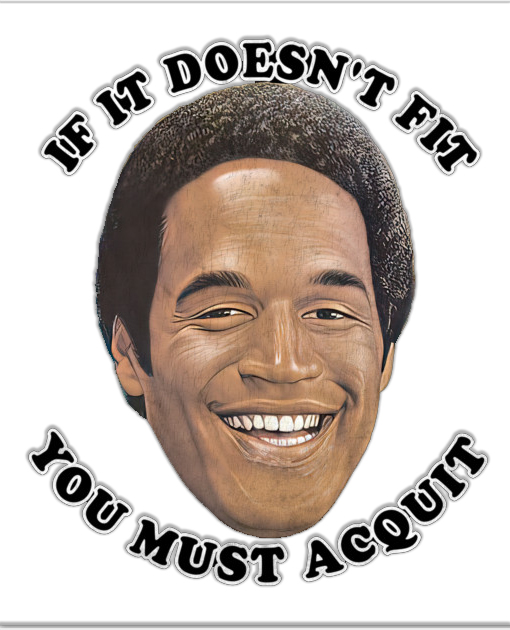
Eddie has tattoos covering the backs of both hands. His lawyer wanted him to hold his hands to show them to the jury, so counsel could argue that the video of the crime showed that the robber had no tats and thus could not be her client. Maybe the judge was mindful of OJ Simpson’s attempt to try on the killer’s gloves and blurting out, “They’re too small,” without taking the stand. This non-testimony testimony let attorney Johnny Cochran memorably argue at closing, “If it doesn’t fit, you must acquit.” For whatever reason, the judge held that Eddie could not exhibit his hands to the jury unless he took the stand.
 The district court found that such a display would be testimonial, “and therefore that [the defendant] would have to take the witness stand and subject himself to cross-examination” if he showed his hand tattoos to the jury.Eduardo declined to take the stand, and he was convicted.
The 9th ruled that its own precedent in United States v. Bay established that exhibiting a tattoo was not testimonial. On appeal, the government conceded that the district court’s holding was wrong, but argued the error was harmless because the jury could see Eddie’s hands when he was sitting at counsel table. “That the jury could see Eduardo’s hands in open court misses the point,” the Circuit held. “The fundamental error is that the district court forced Valencia to take the stand in order to display an identifying physical characteristic—hand tattoos—to the jury. That was precisely the error in Bay, and it is the error here.”
United States v. Arias, Case No. 24-4308, 2026 U.S.App. LEXIS 27288 (4th Cir. September 3, 2026)
United States v. Valencia, Case No. 24-3820, 2026 USAppLEXIS 27285 (9th Cir. Sept 3, 2026)
United States v. Bay, 762 F.2d 1314 (9th Cir. 1984)
~ Thomas L. Root