Tag Archives: 924(c)

Another Circuit Sets Impossible Bar for Dimaya 924(c) Claims – Update for October 8, 2018

We post news and comment on federal criminal justice issues, focused primarily on trial and post-conviction matters, legislative initiatives, and sentencing issues.

LISAStatHeader2small

CIRCUITS BUSY SHUTTING DOWN 924(C) DIMAYA CLAIMS

violence160110In the wake of Sessions v. Dimaya, a lot of people doing time for using or carrying a gun during a crime of violence have hoped to attack their 18 USC 924(c) convictions by arguing the underlying crime was not violent. Two courts of appeals – the most recent one last week – are making that pretty hard. A third circuit may be on the way there.

Section 924(c) makes it punishable by a minimum five-year consecutive sentence, to use, carry, or possess a firearm in connection with a “crime of violence.” The “residual clause” of 924(c) defines “crime of violence” to mean a felony “that by its nature, involves a substantial risk that physical force against the person or property of another may be used in the course of committing the offense.” In Johnson v. United States and, later, in Dimaya, the Supreme Court invalidated similar residual clauses, because what might or might not constitute a “substantial risk” was so vague that a reasonable person was unable to determine beforehand what the legal effect of conduct would be. For example, while murder certainly carried a substantial risk that physical force may be used against the victim, how about drunk driving (which, if it were the defendant’s fourth or tenth offense – depending on the state – might be a felony)?

Due to Johnson and Dimaya, all manner of offenses that may sound like they’re violent have been held not to be “crimes of violence.”

Irma Ovalles, convicted of being part of a carjacking crew that used baseball bats and assault rifles, filed a 2255 motion challenging her 924(c) conviction on the grounds that carjacking in its ordinarily sense is not a crime of violence. Last week, the 11th Circuit handed down a ruling that all but dooms her effort.

violent170315To determine whether a prior offense is a “crime of violence,” which is what Johnson and Dimaya address, a court is to use a “categorical approach,” which requires a reviewing court not to look at what the defendant actually did to, for example, assault a police officer in, say, Tennessee. Instead, the court is to ‘imagine’ an “idealized ordinary case of the crime,” and figure out whether it could be done without using violent physical force. Sure punching a cop would use violent physical force. But what if the defendant spit on the police officer instead? If Tennessee state law would permit prosecuting such an act, would that – disgusting though it might be – be held not to be “violent physical force?” If so, the predicate crime is not a “crime of violence.”

So assume the defendant were packing a gun hidden in her waistband while assaulting the officer? Or pulled the gun and pistol-whipped him? Would the fact that she reasonably been prosecuted for spitting on him instead mean that the crime was not violent, and thus render the 924(c) residual clause impermissibly vague?
categorical181008The 11th Circuit cleanly cut the “categorical approach” Gordian knot. “On the flip side,” the Court said, “Johnson and Dimaya also make clear… that if 924(c)(3)’s residual clause is instead interpreted to incorporate what we’ll call a conduct-based approach to the crime-of-violence determination, then the provision is not unconstitutionally vague.” Unlike the categorical approach, the conduct-based approach does not focus on legal definitions and “hypothetical ordinary case,” but instead looks at how the defendant actually committed the underlying crime. The 11th held that where the crime of violence being weighed is not a prior offense, but instead a contemporaneous one (and you cannot commit a 924(c) offense without simultaneously committing a crime of violence or drug trafficking offense), then the conduct-based approach had to be used under the rule of “constitutional doubt.” The rule of “constitutional doubt” holds that any reasonable construction available must be used in order to save a statute from unconstitutionality. “Accordingly,” the Circuit ruled, “we hold that 924(c)(3)(B) prescribes a conduct-based approach, pursuant to which the crime-of-violence determination should be made by reference to the actual facts and circumstances underlying a defendant’s offense.”

Under the conduct-based approach, Irma is clearly going to be in deep trouble when her case gets back to the district court. As one 11th Circuit judge asked in his concurring opinion, “How did we ever reach the point where this Court, sitting en banc, must debate whether a carjacking in which an assailant struck a 13-year-old girl in the mouth with a baseball bat and a cohort fired an AK-47 at her family is a crime of violence? It’s nuts.”
violence181008

The 4th Circuit just last month heard en banc arguments in United States v. Simms, which may go the same way as Barrett and Ovalles.

Ovalles v. United States, Case No. 17-10172 (11th Cir., Oct. 4, 2018)

United States v. Barrett, Case No. 14-2641 (2nd Cir., Sept. 10, 2018)

United States v. Simms, Case No. 15-4640 (4th Cir., decision pending)

– Thomas L. Root
LISAStatHeader2small

Two Circuits Split on Whether Conspiracy to Be Violent Is Itself Violent – Update for September 20, 2018

We post news and comment on federal criminal justice issues, focused primarily on trial and post-conviction matters, legislative initiatives, and sentencing issues.

LISAStatHeader2small

TWO CIRCUITS SPLIT ON HOBBS ACT CONSPIRACY AS VIOLENT CRIME

Two more federal circuits last week joined the chorus of appellate courts holding that a Hobbs Act robbery supports a conviction under 18 USC 924(c) for using a gun during crimes of violence, but they split on whether a conspiracy to commit Hobbs Act robbery is itself violent.

violence180508The 2nd Circuit continues to hold that the conspiracy to commit a violent crime is also a violent crime. The 5th Circuit, however, ruled that a conspiracy to commit Hobbs Act robbery can only be violent under the 924(c) residual clause, and it held that the residual clause is unconstitutionally vague in light of last April’s Supreme Court decision in Sessions v. Dimaya.

The split may set up a Supreme Court decision on conspiracy as a violent crime down the road, but probably not in the 2018-2019 term, which starts in two weeks.

United State v. Barrett, Case No. 14-2641-cr (2nd Cir. Sept. 10, 2018)

United State v. Davis, Case No. 16-10330 (5th Cir. Sept. 7, 2018)

– Thomas L. Root
LISAStatHeader2small

What Will A Blended FIRST STEP Bill Contain? – Update for August 15, 2018

We post news and comment on federal criminal justice issues, focused primarily on trial and post-conviction matters, legislative initiatives, and sentencing issues.

LISAStatHeader2small

WHAT WILL BE ADDED TO FIRST STEP IN THE WHITE HOUSE DEAL?

As we have reported, the Trump Administration is brokering a deal to amend the FIRST STEP Act to include some of the sentencing reform provisions of the Sentencing Reform and Corrections Act. The compromise, intended to appease SRCA co-sponsors Sen. Charles Grassley (R-Iowa) and Sen. Richard Durbin (D-Illinois), should clear the way for a Senate vote on FIRST STEP, and passage of some badly needed prison reform.

grassley180604Not everything in SRCA will get dropped into the Senate version of the FIRST STEP Act. Nevertheless, what is proposed is significant to a lot of people.

The SRCA additions to FIRST STEP will probably include:

• Reductions in some drug mandatory minimums, reducing penalty from life to 25 years for a third drug conviction, and from 20 to 15 years for a second drug conviction.

Sentencestack170404•   Ending 18 USC 924(c) “stacking” charges. This provision would prohibit the doubling up of mandatory sentences for carrying a gun during drug or violent crime offenses. The way 924(c) is written now, a defendant who carries a gun while selling pot three days in a row commits three separate 924(c) offenses. The first one carries a consecutive 5 years, and the second and third each carry a consecutive 25 years, meaning the defendant gets 55 years plus the pot sale guidelines. The change in the law makes clear that the increased penalty for a second or third 924(c) offense applies only after conviction for the first one.

• Increase “safety valve” application. This provision would give judges more discretion in giving less than the mandatory minimum for certain low-level crimes, including people with Criminal History II in the safety valve provisions of 18 USC 3553(f).

• Retroactivity for the 2010 Fair Sentencing Act. This provision would make the FSA, which changed sentencing guidelines to treat offenses involving crack and powder cocaine more equally, retroactive to people sentenced before the law went into effect.

"Just the facts, FAMM."
                          “Just the facts, FAMM.”

Last Friday, FAMM released an extended series of fact sheets reviewing which SRCA sentencing provisions are in play. The document, written as a memo to Congress members and staff, is entitled “Fact sheets explaining potential sentencing additions to FIRST STEP Act.” It explains in detail the provisions possibly being added to FIRST STEP, and describes cost savings and justice issues surrounding each.

Also last week, Marc Holden, general counsel to Koch Industries and point man for the Koch initiatives on criminal justice reform, wrote, “By supporting these smart-on-crime, soft-on-taxpayers reforms, President Trump is demonstrating exemplary leadership. If Congress is able to pass the FIRST STEP Act with these sentencing provisions included, it would give the president a lasting, landmark achievement on criminal justice reform that has eluded previous administrations.”

FAMM, Facts sheets explaining potential sentencing additions to FIRST STEP Act (Aug. 10, 2018)

Freedom Partners, President Trump is Leading on Criminal Justice Reform; Senate Should Send Him a Bill (Aug. 9, 2018)

– Thomas L. Root
LISAStatHeader2small

Tenth Circuit Firebombs 924(c) Residual Clause – Update for May 15, 2018

We post news and comment on federal criminal justice issues, focused primarily on trial and post-conviction matters, legislative initiatives, and sentencing issues. 

LISAStatHeader2small
10th CIRCUIT SAYS DIMAYA MEANS 924(c) RESIDUAL CLAUSE IS UNCONSTITUTIONAL

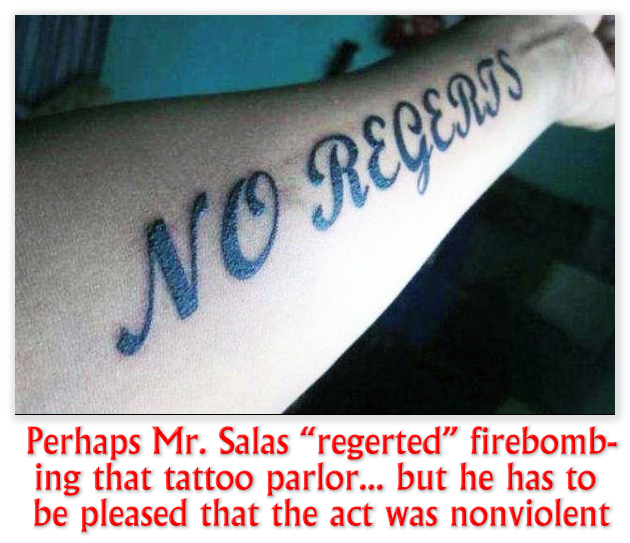
regrets180515Cliff Salas was convicted of conspiracy to commit arson under 18 USC 844 for using a Molotov cocktail to firebomb a tattoo parlor, which came with an add-on 30-year sentence for using a destructive device in a crime of violence.

Under 18 USC 924(c), a defendant who uses or possesses a firearm or destructive device in a drug trafficking offense or crime of violence receives a mandatory consecutive sentence of from five years to life, depending on the type of gun or device, on whether it’s a first 924(c) offense or subsequent offense, and on how the weapon was used. A “crime of violence” is defined as either (1)  an offense that has as an element the threatened use or actual use of physical force against a person or property; or (3) an offense that presents a significant risk of physical harm to people or property.

Because an 18 USC 844 arson conviction is too broad for generic arson, the enumerated clause of 18 USC 924(c) does not encompass Sec. 844 arson. Likewise, the elements clause, which requires use of force against the property of another, does not encompass Sec. 844 arson, because the property burned up may be one’s own. That meant that that arson must come under the 924(c) residual clause.

vaguenes160516Two weeks ago, the 10th Circuit hurled its own Molotov cocktail at the 924(c) residual clause, striking it as unconstitutional under the 5th Amendment. The Court concluded that the Supreme Court’s recent Dimaya decision required that the 924(c) residual clause be declared too vague. “Ultimately,” the Court said, “Sec. 924(c)(3)(B) possesses the same features as the ACCA’s residual clause and Sec. 16(b) that combine to produce ‘more unpredictability and arbitrariness than the Due Process Clause tolerates,’ and Dimaya’s reasoning for invalidating Sec. 16(b) applies equally to Sec. 924(c)(3)(B). Sec. 924(c)(3)(B) is likewise unconstitutionally vague.”

Currently, only the 6th Circuit holds that Sec. 16(b) is unconstitutional while 924(c)(3)(B) is not.

United States v. Salas, Case No. 16-2170 (10th Cir. May 4, 2018).

– Thomas L. Root

LISAStatHeader2small

1st Circuit Says Bank Robbery is Still Violent – Update for October 19, 2017

We post news and comment on federal criminal justice issues, focused primarily on trial and post-conviction matters, legislative initiatives, and sentencing issues.

LISAStatHeader2small
VIVA LA DIFFERENCE

paperwork171019Since the Supreme Court ruled two years ago in Johnson v. United States that the “residual clause” of the Armed Career Criminal Act was unconstitutional, many forests have been felled to produce the paperwork blizzard that has buried federal courts in sentence challenges.

The ACCA requires that if a convicted felon caught with a gun has three prior convictions for crimes of violence or drug offenses, the sentence that must be imposed is no longer zero to 10 years, but rather 15 years to life. There are three ways a prior offense may be a “crime of violence” under the ACCA. The offense must be either

(1) an enumerated offense (burglary, arson, extortion or use of explosive”); or

(2) an offense that has as an element the threatened use or actual use of physical force against a person; or

(3) an offense that presents a significant risk of physical harm to others.

The first clause is called the “enumerated clause,” because it enumerates certain offenses that count, period. The second is called the “force clause” or “elements clause,” because it relates to crimes that include elements of purposeful force. The third is called the “residual clause,” because it sweeps up what’s left.

violence160110In Johnson, the Supreme Court said the residual clause was so vague that no one could figure out what it meant. For that reason, it was unconstitutional to use the residual clause to make someone liable under the ACCA. The problem was that the same (or very similar) language was used elsewhere in the same statute (18 USC 924) and the criminal code (such as in 18 USC 16(b)). One might think that Johnson invalidated the residual clause in those definitions, too. But one might be wrong…

Whether Johnson invalidates the residual clause in the 18 USC 16(b) “crime of violence” definition was argued a little over two weeks ago in the Supreme Court. That decision will issue before next summer. Meanwhile, battle continues to rage in the lower courts, leading to some rather surprising claims.

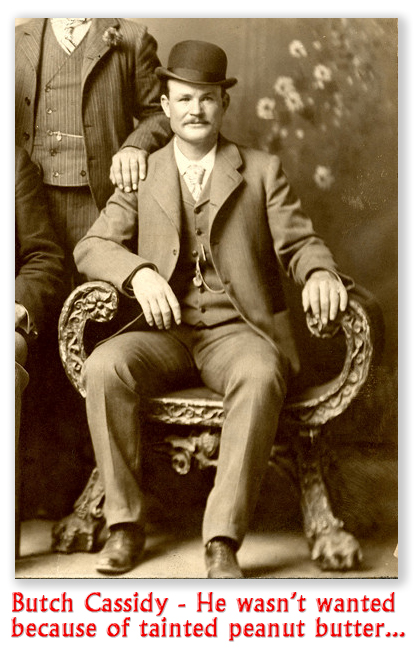
butch171019We confess here that we like bank robbery. It’s old fashioned – you know, Jesse James, Bonnie and Clyde, Willie Sutton – and an easy crime to understand. In a federal criminal world of meth labs, insider trading, trading in incorrectly-packeted lobster and throwing back undersized fish, bank robbery is a crime that’s pretty easy to understand. We suspect that someone like Virginia Governor Bob McDonnell never felt a frisson of illicit thrill when a political donor bought his wife an Oscar de la Renta dress, not the way Butch Cassidy was pumped when he knocked over the San Miguel Valley Bank. After all, when was the last time you saw a movie about the Feds trying to take down a CEO for selling tainted peanut butter?

Jeff Hunter was a bank robber, now doing 270 months for the offense. The last 60 months are a consecutive sentence for using a gun during a crime of violence. After Johnson, Jeff filed a post-conviction motion claiming that the extra 60 months was unwarranted, because while he had a gun, a bank robbery is no longer a crime of violence after Johnson.

knifegunB170404This might seem counter-intuitive to you. Of course a bank robbery is a crime of violence, you say. Just as you never should take a knife to a gunfight, you need never take a gun to a nonviolent crime. Who’s ever heard of an armed inside trader?

Last week, the 1st Circuit agreed that while Johnson may sweep broadly, it doesn’t sweep that broadly. No matter what the constitutional status of the residual clause might be, the Circuit said, Jeff’s offense remains a “crime of violence” because of the force clause. The 1st has already held that a bank robbery “has as an element the use, attempted use, or threatened use of physical force against the person of another” for purposes of the career offender guidelines (USSG 4B1.2(a)(1)), which use the same “crime of violence” definition as does the ACCA.

But the 924(c) definition varies slightly. All of the others refer to using physical force against another person. The 924(c) subsection definition refers “use of physical force against the person or property of another.”

robbery171019

Aha! Jeff argued that there is a difference. The 1st agreed, but said that difference does not help him. “The addition of ‘or property’ renders § 924(c)(3)(A)’s scope greater than that of § 4B1.2(a)(1),” the court said. In other words, under the ACCA, if Butch Cassidy had robbed the Union Pacific Overland Flyer by threatening to shoot the engineer, that would have been a crime of violence. If he had robbed it by threatening to shoot the engineer’s dog, it would not have been. shootdog171019However, if he robbed the First National Bank of Winnemucca by threatening to shoot the branch manager’s dog (which was “property”), the offense would been just as much a “crime of violence” as if he had threatened to shoot the manager himself.

Ah, the beauty of the law! Because the statute says bank robbery is effected by “by force and violence, or by intimidation,” the 1st Circuit said, “we hold that federal bank robbery, and a fortiori federal armed bank robbery, are crimes of violence under the force clause of § 924(c)(3).”

Hunter v. United States, Case No. 16-2483 (1st Cir., October 16, 2017)

– Thomas L. Root

LISAStatHeader2small

Some Short Notes from D.C. – Update for August 7, 2017

We post news and comment on federal criminal justice issues, focused primarily on trial and post-conviction matters, legislative initiatives, and sentencing issues.

LISAStatHeader2small
TWO INTERESTING D.C. CIRCUIT RULINGS END LAST WEEK

The D.C. Circuit handed down a pair of rulings last Friday. One, the reversal of sentences (and in one case, a conviction) for four Blackwater contractors over a 2007 Baghdad massacre, was widely reported. The other, a case about prisoners’ waivers of FOIA rights, flew under the radar. Both are of significance to federal inmates.

LISAStatHeader2small

D.C. CIRCUIT SAYS 924(C) SENTENCE IN BLACKWATER CASE VIOLATES 8TH AMENDMENT

carriefgun170807The big news from the D.C. Circuit last Friday was the reversal of sentences for four Blackwater private security contractors who massacred 14 civilians after they mistakenly thought they were under attack on a Baghdad street. Buried in that decision is a holding of interest to federal prisoners with 18 USC 924(c) convictions, especially where those counts are stacked to result in horrendous sentences.

The contractors were armed with government-issued M4 rifles, which of course can be set to fire fully automatically. Because of that, each of the defendants – found guilty of committing a crime of violence with a gun – got a mandatory sentence of 30 years because the weapon was a machine gun.

Apparently, hanging the 924(c) machinegun sentence on the defendants was contentious, even in the Justice Department. The D.C. Circuit agreed, ruling that applying the mandatory 30-year sentence to the contractors – based “solely on the type of weapons… used – violated the 8th Amendment’s prohibition against cruel and unusual punishment.

In its opinion, the Circuit tried mightily to limit the decision to the facts of the case: It notes the firearms were a type required by the government, the contractors all had prior unblemished military records and no other convictions, it was a war zone where snap judgment was the difference between life and death, the contractors did not choose to be on that street corner, but were ordered there by their commander, and they did not set out that day to blow away civilians. The Court also noted that when 924(c) was last amended, the concept of private contractors protecting U.S. diplomats was not envisioned.

overkill170807“Combining all of these considerations,” the appellate court said, “we conclude the mandatory 30-year sentences create the rare case that leads to an inference of gross disproportionality… None of the penological justifications our society relies upon when sentencing criminals — incapacitation, rehabilitation, retribution, or deterrence — are properly served here by a sentence whose length is determined solely based on the type of weapon used during the crime.”

The Blackwater case has a rare set of facts, and run-of-the-mill defendants – who, for example, use a submachine gun to rob a bank – are unlikely to get much love from the holding. However, now the 8th Amendment camel’s nose is inside the tent. It will be interesting to see whether 8th Amendment claims become a staple of 924(c) defense elsewhere in the country.

United States v. Slatten, Case No. 15-3078 (D.C.Cir., Aug. 4, 2017)

LISAStatHeader2small

D.C. CIRCUIT SAYS FOIA RIGHTS CANNOT BE WAIVED BY PLEA AGREEMENT

The government often demands, as a price for plea agreements, that defendants waive their right to pursue Freedom of Information Act requests.

Last Friday, the D.C. Circuit outlawed the practice, holding that the FOIA waiver is unconnected to any “legitimate criminal justice interest” and is void as a matter of public policy.

foia160930The Court said a “prosecutor is permitted to consider only legitimate criminal justice concerns in striking a plea bargain—concerns such as rehabilitation, allocation of criminal justice resources, the strength of the evidence against the defendant, and the extent of a defendant’s cooperation with the authorities… This set of legitimate interests places boundaries on the rights that can be bargained away in plea negotiations.”

While banning FOIA suits “may occasionally promote the government’s legitimate interest in finality,” the Circuit said, “they only do so by making it more difficult for criminal defendants to uncover exculpatory information or material showing that their counsel provided ineffective assistance. That argument takes the finality interest too far. After all, a defendant can never waive his right to bring a colorable claim of ineffective assistance of counsel, even though such claims undermine finality… FOIA plays a significant role in uncovering undisclosed Brady material and evidence of ineffective assistance of counsel, and in practice has led to uncovering records relevant to ineffective-assistance-of-counsel claims, such as plea offers not communicated by defense counsel to clients.”

Price v. Dept. of Justice Attorney Office, Case No. 15-5312 (D.C.Cir., Aug. 4, 2017)

– Thomas L. Root

LISAStatHeader2small

Live by the Sword, Die by the Sword – Update for April 4, 2017

We post news and comment on federal criminal justice issues, focused primarily on trial and post-conviction matters, legislative initiatives, and sentencing issues.

LISAStatHeader2small

SUPREMES SAY COURT CAN CONSIDER MANDATORY GUN SENTENCE WHEN SENTENCING ON UNDERLYING CRIME

Outside of TV cop shows, no one likes drug dealers or violent criminals waving firearms around, which is probably why no crime this side of kiddie porn is easier to demagogue than laws that slam gun-toting criminals.

gun160718Take 18 USC 924(c), which sets penalties for criminals who use, carry or possess a gun “during and in relation to” a crime of violence or drug-trafficking offense. A defendant convicted of a 924(c) offense must get a mandatory sentence of at least 5 years (with increased penalties if the perp “brandished” it or fired it, and whopping increases if, for example, it was fully automatic). What’s even more impressive, the statute raises the mandatory minimum to 25 years for the second offense. Oh yeah, and all 924(c) penalties must be consecutive to any other sentence.

Watch how the math works: On Monday, Bart Badguy robs a convenience store with a .44 Klutzman stuck in his waistband, and makes off with a bag of Doritos. Realizing later that he has nothing to dip it in, he robs another convenience store the next day, the same revolver displayed under his belt, and grabs some French onion dip. The federal sentencing guidelines set him at 63-78 months for the two robberies, and the court sentences Bart at the bottom (understanding what hunger can do to a man).

doritos170404But Paula Prosecutor is a canny lawyer, and she thus had the foresight to get Bart indicted for two 924(c) counts along with the two robberies. The first 924(c) count adds 60 months to the 63 months the district court imposed for the robberies. The second 924(c) count – arising from Bart’s going back for the dip – adds 300 months to the robberies and the first 924(c) conviction. Total sentence: 403 months (35¼ years) for chips and dip.

No one would argue against punishing crimes of violence involving guns more harshly than other offenses. Shooting legend Elmer Keith is credited with observing that one should never bring a knife to a gunfight, and the sentiment – that people carrying guns are likely to use them – undergirds 924(c).

knifegunB170404But the statute is inflexible, and the government has had its fun with it as a result. While Congress probably meant that a second 924(c) conviction – carrying a 25-year mandatory minimum – had to follow a prior 924(c) conviction, prosecutors years ago sold the Supreme Court that the statute did not say there had to be an intervening conviction. In Deal v. United States, a 1994 decision, the Supreme Court held that a drug-addled bank robber who held up six banks in a 3-month period – carrying a gun for all of them – had to get a 105-year sentence.

Yesterday, the government – which had lived by the sword – died by the sword.

The Supreme Court unanimously reversed the 8th Circuit, holding that a sentencing court may consider the length of a mandatory consecutive sentence when setting the length of an underlying sentence.

In Dean v. United States, the defendant was charged with committing two robberies with a gun. The robberies carried a guidelines sentence of 84 to 105 months. One of the two 924(c) counts carried a mandatory 5 years, and the second carried a mandatory 25 years. Both sentences had to be consecutive to the underlying sentence and each other.

So Levon Dean got to sentencing knowing that he had a minimum 360 months coming. His lawyer argued that it was more than enough, and the judge hardly needed to pile on another 84 months for the underlying offense. While the district court, the judge said he was not allowed to adjust the sentence of the underlying robbery to zero to account for the two consecutive gun sentences. Levon got 400 months.

knifegun170404The 8th Circuit agreed with the government that the underlying offense had to be sentenced as though the 924(c) counts were not there, and then the consecutive sentences had to be stacked on like pancakes. Anything else, the Justice Department argued, would thwart the will of Congress.

How convenient for the government that the will of Congress becomes a crucial consideration in Dean, while it was utterly irrelevant 24 years ago in Deal! Yesterday, however, the Supreme Court found it not so convenient, holding that while adjusting the underlying offense guidelines to zero might negate the will of Congress, that did not matter. The plain text of the statute was clear, and the plain text governs:

The Government speaks of Congress’s intent to prevent district courts from bottoming out sentences for predicate 924(c) offenses whenever they think a mandatory minimum under 924(c) is already punishment enough. But no such intent finds expression in the language of 924(c). That language simply requires any mandatory minimum under 924(c) to be imposed “in addition to” the sentence for the predicate offense, and to run consecutively to that sentence. Nothing in those requirements prevents a sentencing court from considering a mandatory minimum under 924(c) when calculating an appropriate sentence for the predicate offense.

The government argued that Congress’s intent that the underlying offense be sentenced without regard to the 924(c) count could be inferred from the statute’s silence. But in another consecutive-sentencing statute for identity theft, Congress included specific language limiting the district court’s ability to adjust the underlying sentence.

Sentencestack170404The Supremes ruled that because “Congress has shown that it knows how to direct sentencing practices in express terms,” but did not in 924(c), a sentencing court may impose a sentence on the underlying offense of one day, in order to make the overall sentence consistent with what the court considers appropriate under 18 USC 3553 (the sentencing statute). The Court said, “we ordinarily resist reading words or elements into a statute that do not appear on its face.”

Dean will go back to court for resentencing, where he will receive 30 years and a day.

Dean v. United States, Case No. 15-9260 (Apr. 3, 2017)

– Thomas L. Root

LISAStatHeader2small

A Trio of Significant Decisions – Update for February 27, 2017

We post news and comment on federal criminal justice issues, focused primarily on trial and post-conviction matters, legislative initiatives, and sentencing issues.

LISAStatHeader2small
7th CIRCUIT SAYS KIDNAPPING NOT CRIME OF VIOLENCE

Antwon Jenkins was convicted of kidnapping and carrying a firearm during a crime of violence. He appealed, claiming the government had violated the plea agreement. He got 188 months for the kidnapping and another 120 months for the 18 USC 924(c) charge.

kidnap170227Before the appeal was decided, Johnson v. United States was decided by the Supreme Court, holding the residual clause of the Armed Career Criminal Act was unconstitutionally vague. Antwon amended his appeal to claim that the 924(c) conviction was void, because kidnapping could only be a crime of violence under the residual clause, making the conviction unconstitutional under Johnson.

Last Friday, the 7th Circuit agreed. It found that the first element of kidnapping – unlawfully seizing, confining, inveigling, decoying, kidnapping, abducting, or carrying away — does not necessarily require the use of force. The government argued that because the second element, holding for ransom or reward or otherwise, must be unlawful, it necessarily requires at a minimum the threat of physical force, but the Circuit disagreed. “Holding can be accomplished without physical force. For example, a perpetrator could lure his victim into a room and lock the victim inside against his or her will. This would satisfy the holding element of kidnapping under 18 USC § 1201(a) without using, threatening to use, or attempting to use physical force.”

The decision brings the 7th Circuit into harmony with other circuits that have held that similar crimes of false imprisonment and kidnapping by deception do not have physical force as an element.”

Antwon had not raised the issue in the trial court, but the 7th found that despite this, he had met the stringent FRCrimP 52(b) “plain error” standard for bringing it up for the first time on appeal. The Court said, “A 120‐month prison sentence for a nonexistent crime undermines the fairness of the judicial proceedings and cannot stand.”

United States v. Jenkins, Case No. 14-2898 (7th Cir., Feb. 24, 2017)
LISAStatHeader2small

WHO YOU GONNA BELIEVE?

For state prisoners who have exhausted their habeas corpus claims, 28 USC § 2254 permits filing the claims in federal court. Such cases are not easy to win, because federal courts will go with the state court’s decision unless it’s absolutely unreasonable. Even filing the cases on time is tough.

Mostly, 2254 does not affect federal prisoners, but a decision last Friday by the 11th Circuit delivers a stark message that federal inmate litigants should take to heart: if your lawyer drops your case without telling you, that’s one thing. But if he or she is just stupid – even really, really stupid – you’re bound by counsel’s mistakes.

Ernest Cadet, a Florida prisoner, was denied habeas corpus relief in state court. Under the convoluted rules that apply to 2254 motions, his one-year clock then started running for filing in federal court. It stopped with only 5 days left when he filed for review with the Florida Supreme Court.

But even an average lawyer should know how to count...
But even an average lawyer should know how to count…

While his Supreme Court petition was pending, Ernie hired Attorney Goodman, a guy who may have been a “good man” but was a lousy attorney. When the Supreme Court turned Ernie’s motion down, the inmate told Goodman they didn’t have much time to file a 2254. He said inmates in the law library warned him that he had to act fast. Goodwin replied he had read the statute, and Ernie had a full year, asking “who are you going to believe, the real lawyer or the jailhouse lawyer?”

The correct answer was “the jailhouse lawyer.” Goodwin filed the motion within the time he thought Ernie had, but it really about a year late. The federal district court threw out the petition as untimely. Ernie appealed.

The 11th Circuit upheld the dismissal. Inmates love to talk about “equitable tolling” as an end run around statutory deadlines, but the plain fact, the Circuit said, is that equitable tolling is an extraordinary remedy “limited to rare and exceptional circumstances and typically applied sparingly.” To warrant equitable tolling, a prisoner has to show he has been pursuing his rights diligently but that some extraordinary circumstance prevented timely filing.

lawyermistake170227The Court said attorney miscalculation of a filing deadline “is simply not sufficient to warrant equitable tolling, particularly in the post-conviction context where prisoners have no constitutional right to counsel.” The relevant distinction should be between attorney negligence – which is “constructively attributable to the client” – and “attorney misconduct that is not constructively attributable” to the client because counsel has abandoned the prisoner. A lawyer’s “near-total failure to communicate with petitioner or to respond to petitioner’s many inquiries and requests over a period of several years” might be abandonment. “Common sense,” Justice Alito concluded in a prior Supreme Court case, “dictates that a litigant cannot be held constructively responsible for the conduct of an attorney who is not operating as his agent in any meaningful sense of that word.”

The problem in this case is that Goodman never abandoned Ernie. He kept communicating, but arrogantly dismissed the possibility Ernie and his jailhouse lawyer friends might be right without doing as much as five minutes’ worth of research to see whether they might be.

Ernie “acted with reasonable diligence,” the Court said, “but the reasonable diligence and extraordinary circumstance requirements are not blended factors; they are separate elements, both of which must be met before there can be any equitable tolling.” Just because an agent (the lawyer) is grossly negligent does not mean he had abandoned his principal (the client).

Goodman was stupid, but he did not disappear on Ernie. The 11th held that “because the attorney is the prisoner’s agent, and under well-settled principles of agency law, the principal bears the risk of negligent conduct on the part of his agent… as a result, when a petitioner’s post-conviction attorney misses a filing deadline, the petitioner is bound by the oversight.

Cadet v. State of Florida DOC, Case No. 12-14518 (11th Cir., Feb. 24, 2017)
LISAStatHeader2small

CAN YOU HEAR ME NOW?

In a remarkable decision handed down by the 4th Circuit last Thursday, a deaf inmate’s claim that the BOP violated his 8th Amendment and 1st Amendment rights by denying him a sign-language interpreter and videophone link.

hearme170227The inmate complained that he was denied an interpreter to assist at medical appointments, and to enable him to take a class required because of the nature of his offense. He also said communications with the outside was limited to an antiquated TTY phone device, which he could only use when a BOP staff person trained in TTY was available to supervise. Often, he said, he was denied TTY access because of staff shortages or just because of arbitrary reasons, and he could never use the TTY on nights or weekends.

The Circuit reversed a district court decision that threw out all of the claims, saying the inmate did not have to show he had been harmed by the 8th Amendment deliberate indifference, just that there was a substantial risk of harm. As for the 1st Amendment claim, the Court swept away BOP claims of the security risks of a videophone, holding that the Bureau could easily monitor videophone calls just as it did TTY calls.

The BOP tried to derail the case by promising to provide interpreters in the future, stating that inmates would be provided “with a qualified interpreter… if necessary for effective communication during religious ceremonies or programs.” That was good enough for the district court, but the 4th swept the promises aside: “It is well established that a defendant’s voluntary cessation of a challenged practice moots an action only if subsequent events made it absolutely clear that the allegedly wrongful behavior could not reasonably be expected to recur,” the Court said. “Even if we ignore the equivocation inherent in the promise to provide interpreters ‘if necessary’ the statement amounts to little more than a ‘bald assertion’ of future compliance, which is insufficient to meet BOP’s burden.”

Heyer v. Bureau of Prisons, Case No. 15-6826 (4th Cir., Feb. 23, 2017)

– Thomas L. Root

LISAStatHeader2small