All posts by lisa-legalinfo

7th Circuit Trusts BOP Healthcare… and 190,000 prisoners laugh – Update for March 27, 2017

We post news and comment on federal criminal justice issues, focused primarily on trial and post-conviction matters, legislative initiatives, and sentencing issues.

LISAStatHeader2small

L-O-L

Jeff Rothbard’s case made us laugh, and not in a good way.

Jeff has an unfortunate knack for fraud. He’s not likely to change his ways, given that he’s “an older man with serious health problems.”

costlydrug170327His district court sentenced him to 24 months, even though the Presentence Report suggested a home confinement and halfway house, due to Jeff’s particularly virulent form of leukemia. Jeff has stayed alive this long because he takes nilotinib, a one-of-a-kind drug that holds the cancer in check. He needs the drug every day: if the nilotinib is discontinued even for briefly, the leukemia will come roaring back.

There’s a catch. The drug costs about $125,000 a year.

On appeal, Jeff complained that incarceration could well kill him, because the BOP was unlikely to give him such an expensive drug. The BOP maintains a “formulary” (a listing) of drugs that its physicians are permitted to prescribe. Nilotinib is not on the list.

But the BOP told the district court that if one of its doctors believes that a patient needs a non-formulary drug, the doctor may prescribe it by following certain procedures. The BOP said a new inmate could continue on non-formulary drugs for four days after arrival, during which time he would be assessed. The BOP assured the court it could approve non-formulary drugs in a matter of hours, if need be. In fact, the BOP said it had received 10 requests by its doctors for nilotinib in the last six years, and all had been approved.

Last week, the 7th Circuit upheld the sentence, concluding it was reasonable. While the Circuit admitted that the BOP had “an incentive to be sparing with its orders for particularly expensive non-formulary drugs, such as nilotinib, there is no evidence… that it has done so… The record shows that BOP has ordered nilotinib itself on ten other occasions, evidently in recognition of the fact that it might be essential (as it apparently is for Rothbard).”

Of course, what the Circuit overlooked was that nilotinib was approved the ten times a BOP doctor actually requested it. That stat overlooks how many time a prisoner needed the drug but the doctor at the institution refused to make the request to the Central Office.

BOPdocs170327In this case, the 7th admitted the decision was a close one because the “BOP is not willing or able to pre-commit to nilotinib for Rothbard, before he has gone through the intake examination at the prison medical center. Although it might be sensible in cases such as this one for BOP to have some way of examining people before they report, that is not its practice and we are not persuaded that the lack of a pre-report examination is independently actionable. In addition, we cannot find fault with BOP’s reservation of the right to conduct its own medical examination.”

What made us laugh was the Court’s warning to the BOP. It said that if Jeff “shows up at a BOP facility and discovers that the responsible people are dragging their feet in a way that deprives him for any significant time of his nilotinib, or if the BOP evaluator (contrary to all of the evidence we have seen) takes the position that a medically suitable alternative from the formulary exists, Rothbard is free to use the BOP’s grievance procedures to complain about any such problem.”

Now there’s a threat to make the BOP director quake in his boots. If Jeff is denied the drug he cannot live without, he can file his BP-8. BP-9, BP-10 and BP-11. Then after the 230+ days it takes to complete the largely futile BOP grievance procedures, if Jeff has still not gotten the drug, he can file a habeas corpus action (provided he’s still alive).

remedy170327In a sharp dissent, Judge Richard Posner showed no confidence in the BOP: “Essentially the prosecution, the district court, and now my colleagues, ask that the Bureau of Prisons be trusted to give the defendant, in a federal prison, the medical treatment that he needs for his ailments. Yet it is apparent from the extensive literature on the medical staff and procedures of the Bureau of Prisons (a literature ignored by my colleagues) that the Bureau cannot be trusted to provide adequate care to the defendant.”

This decision ought to read by anyone who has a medical issue with the BOP.

United States v. Rothbard, Case No. 16-3996 (7th Cir., March 17, 2017)

LISAStatHeader2small

THE LESS SAID, THE BETTER

Ryrica Custis, a Virginia prisoner, had lost his toes in a pre-prison accident. The prison assigned him to an upper bunk anyway, and of course he fell off the ladder trying to climb in. He filed an inmate complaint in the grievance system, but the prison grievance manual listed the wrong address to which to send it. By the time Ry remailed it to the right place, the prison said he was too late.

Ry sued in federal court for injuries he had suffered. Under the Prison Litigation Reform Act, inmates may file federal suits about prison conditions only if they first exhaust administrative remedies in the prison grievance system. In Jones v. Bock, a 2007 case, the Supreme Court held that failure to exhaust remedies is no more than an affirmative defense. In other words, if the prison fails to raise it in its answer, the failure to exhaust is waived and the suit may proceed.

Exhaustion170327After Jones, the 4th Circuit held in Moore v. Bennette that if the inmate did not plead in the complaint that he had exhausted remedies, the court could dismiss it “so long as the inmate is first given an opportunity to address the issue.” Some district courts, like the one Ry had sued in, started acting on their own to dismiss inmate suits where the courts deemed that the inmate had not exhausted remedies.

Last week, the 4th Circuit put a stop to that practice. It explained that in Moore, the district court did not raise exhaustion sua sponte (on its own motion). Instead, the prison administration raised it as an affirmative defense. The Circuit held that Jones means that (1) an inmate does not have to say anything about exhaustion in his complaint, and (2) unless the inmate actually admits in his complaint that he did not exhaust remedies, district courts may not dismiss the case on its own. To the extent that 4th Circuit decisions have said otherwise, they were overruled.

Custis v. Davis, Case No. 15-7533 (4th Cir., Mar. 23, 2017)

– Thomas L. Root

LISAStatHeader2small

Legal Shotgun Misses in Missouri ‘Crime of Violence’ Case – Update for March 23, 2017

We post news and comment on federal criminal justice issues, focused primarily on trial and post-conviction matters, legislative initiatives, and sentencing issues.
LISAStatHeader2small

MISSOURI UNLAWFUL USE OF GUN STATUTE STILL A VIOLENT CRIME

The first appellate casualty relying in part on the Supreme Court’s March 6th Beckles decision was reported this week.

gunb160201Steve Hudson pleaded guilty to felon-in-possession of a gun under in 18 U.S.C. 922(g). The district court enhanced Steve’s sentence under USSG 2K2.1(a)(4)(A) based on Steve having a prior conviction for a “crime of violence,” that being a conviction for unlawful use of a firearm under Missouri Rev. Stat. § 571.030.1(4). The district court relied on an 8th Circuit 2009 holding in United States v. Pulliam, that a violation of that Missouri statute is a “violent felony” for purposes of the Armed Career Criminal Act.


In Pulliam, the 8th found the same Missouri statute to be a crime of violence under the ACCA, because the crime fell under the Force Clause, that is, it “has as an element the use, attempted use, or threatened use of physical force against the person of another.” Pulliam held that “[i]t goes without saying that displaying an operational weapon before another in an angry or threatening manner” fits the Force Clause to a “T.”

In arguing that Pulliam should be overruled, Steve took a shotgun approach (appropriate for a gun case, perhaps), arguing Pulliam has been superseded by recent Supreme Court decisions in Johnson v. United States, Curtis Johnson v. United States, Descamps v. United States, and Mathis v. United States.

violence160110The 8th Circuit swept aside his arguments. In Johnson, the Court held that a portion of the definition of “violent felony” in the ACCA known as the Residual Clause. Relying on Beckles, the Circuit held Johnson did not apply: “Although the definition of “crime of violence” under the guidelines until recently included an identically-worded residual clause, the guidelines are not subject to constitutional vagueness challenges.”

More to the point, the Circuit noted, Pulliam was a Force Clause case, so that even without Beckles, Johnson would not have applied.

The Circuit agreed with Steve that the Curtis Johnson case addressed the Force Clause, holding that the Clause “requires the use, attempted use, or threatened use of ‘violent force—that is, force capable of causing physical pain or injury to another person’.” But even so, the Missouri statute fit under the Force Clause: Steve was convicted of “exhibiting a weapon that is readily capable of lethal use in an angry or threatening manner.” “Lethal” the Court said, means “capable of causing death.” Therefore, the Court said, “threatening use of such a weapon necessarily involves a threatened use of violent force, not merely an unwanted physical touching. Pulliam, therefore, is consistent with Curtis Johnson.”

anger170322Steve’s final attack was that because the Missouri statute would support a conviction if the gun had been displayed in either a threatening or an angry manner, the statute set forth alternative elements for committing an offense, and categorically the crime was too broad to fit in the Force Clause. His argument, apparently, was that Mathis prohibited the court from figuring out whether the crime had been committed in an “angry” manner or in a “threatening” manner.

The 8th Circuit rejected the argument. Pulliam, it said, “concluded that both means of committing the offense (an angry display or a threatening display) involve the requisite threatened use of force.” Thus, no matter how Steve was convicted – “angry” or “threatening” – the Missouri crime counted as a crime of violence to enhance his federal sentence.

United States v. Hudson, Case No, 15-3744 (Mar. 21, 2017)

– Thomas L. Root

LISAStatHeader2small

Vitamins Not Healthy For Illinois Man – Update for March 22, 2017

We post news and comment on federal criminal justice issues, focused primarily on trial and post-conviction matters, legislative initiatives, and sentencing issues.
LISAStatHeader2small

SUPREMES BRING 7TH CIRCUIT INTO LINE WITH EVERYONE ELSE; LEGAL COMMUNITY YAWNS

Earlier this week, the Supreme Court ruled that a man who spent 48 days in jail on charges fabricated by the police could sue under the 4th Amendment for an unreasonable seizure, that being the seven weeks he spent in stir.

Dangerous controlled substance?
       Dangerous controlled substance?

Elijah Manuel was riding in a car pulled over for a turn-signal violation. He complained that the Joliet, Illinois, police beat him and called his racial epithets. The police found a vitamin bottle containing pills (amazing thing, that). When field tested, the pills were found to be negative for illegal drugs, but that didn’t stop the officers from claiming the pills were Ecstasy and arresting Elijah anyway.

The pills tested negative again at the station, but the police report falsely said otherwise. A magistrate found probable cause, and kept Elijah locked up. A short while later, a grand jury – relying on the false police reports and testimony – indicted him.

Eventually, the state crime lab report came back reporting the pills were vitamins. Even then, it took a few weeks for the district attorney to dismiss charges and set Elijah free.

The issue before the Supreme Court was whether a claim for malicious prosecution could be brought under the 4th Amendment even after “legal process” – that being the magistrate’s finding of probable cause – issued. The 7th Circuit said it could not be: once legal process issued, such a complaint had to be brought under the 5th Amendment.

false170322In the event readers wonder why we don’t always report on Supreme Court cases like this one, the reason is this: Ten out of 12 federal circuits already held that Elijah’s 4th Amendment claim worked even after legal process issued, and in fact, even after a grand jury indictment, because legal process, like the initial seizure at the time of arrest, is unreasonable if it is based on fabricated evidence. The 8th Circuit had never ruled on the issue, and the 7th Circuit – ruling in Elijah’s case – got it wrong. As far as significance, this case is a yawner.

The decision includes dissents by Alito and Thomas, as well as a number of subsidiary issues orbiting the majority opinion like a legal planetary system. The case only got to where it is today because Elijah waited to the very last minute to file the case, and in fact missed the deadline to sue for false arrest, but not to sue for continued detention. The Justices debate the proper starting point for calculating the statute of limitations, a debate that has a kind of number-of-angels-dancing-on-the-head-of-a-pin quality to it.

At most, Manuel v. Joliet provides a clear basis for an additional constitutional claim – the 4th Amendment – when someone is locked up on bogus charges. It does not, however, really plow much new ground.

Manuel v. Joliet, Case No. 14-9496 (Supreme Court, Mar. 21, 2017)

– Thomas L. Root

LISAStatHeader2small

Some Legal Kibbles – Update for March 20, 2017

We post news and comment on federal criminal justice issues, focused primarily on trial and post-conviction matters, legislative initiatives, and sentencing issues.

kibbles170320Today, we offer a few kibbles of legal interest that have been cluttering our dog pound for the last few days…

LISAStatHeader2small
US ATTORNEYS TO FOCUS ON VIOLENT CRIME, WHICH INCLUDES DRUG TRAFFICKING

There is some indication that the Trump Administration may be expanding violent crime enforcement activities, a category which Attorney General Jeffrey Sessions believes must include gun and drug offenses. In keeping with the President’s fixation on violent crime, Sessions last week ordered United States Attorneys to work with with local and state prosecutors “to investigate, prosecute and deter the most violent offenders.”

Sessions’ directive said, “federal prosecutors should coordinate with state and local counterparts to identify the venue (federal or state) that best ensures an immediate and appropriate penalty for these violent offenders.”

Attorney General Jeffrey Sessions

In keeping with the new emphasis on violent crime, Sessions has appointed Steve Cook, chief of the Criminal Division for the U. S. Attorney’s Office for the Eastern District of Tennessee, and one of last year’s most vocal opponents of sentencing reform, as associate deputy attorney general with a mandate to focus on violent crime. Cook told a newspaper last year, “When you put criminals in jail, crime goes down. That’s what incapacitation is designed to do, and it works.” He called the idea that most offenders in federal prisons are nonviolent drug pushers is a myth.

violent160620Some critics the emphasis on violent crime as federal encroachment. “An expanded federal criminal justice agenda comprised of federal-state-local task forces targeting violent offenses and coupled with tougher federal sentences would be a substantial change in practice and a step in the wrong direction,” says Ryan King, senior fellow at the Urban Institute Justice Policy Center.

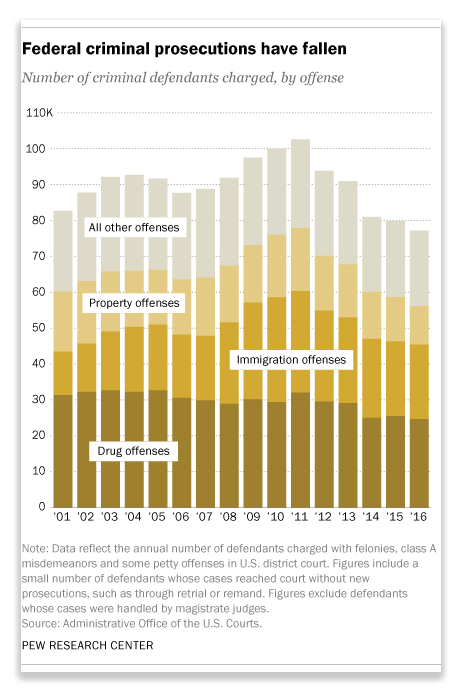
Tougher sentences could quickly reverse declines in BOP inmate population, especially in higher-level joints. According to a new Prison Policy Initiative report, 50% of the 189,000 federal prison inmates were convicted of drug offenses. Violent-crime convictions account for just 7% of the federal total.

The Crime Report, At ‘critical moment’ under Trump, report gives hard facts on incarceration (Mar. 14, 2017)

The Trace, Meet the hardliner Jeff Sessions picked to carry out his violent crime crackdown (Mar. 15, 2017)
LISAStatHeader2small

WE’VE GOT YOUR NUMBER

The U.S. Sentencing Commission last week released its 21st annual Sourcebook of Federal Sentencing Statistics, covering fiscal year.

stats170320The current-year book is available online as an interactive book that defies downloading. It contains a wealth of sentencing stats broken down in over 100 tables (as well as sentencing date by federal district, another 97 tables).

Slogging through the Sourcebook takes awhile, but it yields a lot of fascinating data. Of special interest:

•   the number of cases ending with guilty pleas remained steady at 97%

•   offenses included 32% drug, 30% immigration, white-collar (including fraud) 13%, guns 11%, child porn 3%.

•   14% of people challenging their sentences on direct appeal won reversal, but only 5% ended up with a better sentence.

•  two out of three resentencings resulted from the 2-level reduction for drug offenses, Rule 35(b) reductions for helping the government were 11% of resentencings, and 10% were from wins on 2255 motions.

• continuing the pathetic performance on compassionate release, the courts granted a total of 51 inmates sentence reduction (a mere 0.4% of all resentencings).

•   in new sentencings last year, 49% were within the Guidelines range, a two-percent increase over last year. Only 2% of sentences were above the range, while 19% were below the range for reasons other than government motion. About 20% of sentences were reduced because the defendant helped the government, and another 9% were cut for early disposition of an immigration case.

U.S. Sentencing Commission, Sourcebook of Federal Sentencing Statistics 2016  (Mar. 12, 2017)
LISAStatHeader2small

PLEA BREACHES AND PLAIN ERROR

Like 97% of other federal defendants, Jim Kirkland made a deal with the government to plead guilty. In exchange, the government agreed to recommend the bottom of the guidelines range at sentencing.

But when Jim stood in front of the judge, the government went crazy on him, not just failing to recommend the bottom, but instead pushing for the very top, and bringing in live testimony of how terrible a few of his prior state crimes had been. The probation officer recommended the dead center of the sentencing range, and the judge gave it to him, saying that was what he had had in mind all along.

betray170320Jim’s sentencing lawyer must have been snoring too loudly to object, but on appeal, Jim raised the government’s plea breach. The AUSA admitted it was a plain breach, but argued the error did not affect Jim’s substantial rights or seriously affect “the fairness, integrity, or public reputation of judicial proceedings,” two of the standard Jim had to meet before proving F.R.Crim.P. 52(b) “plain error.” The government’s rationale was that the district judge said he said the 300-month midpoint sentence “frankly, happens to coincide with my own independent decision,” and that was sufficient evidence that the court would have imposed the same exact sentence even if the AUSA had recommended the bottom of the guidelines.

Last week, the 5th Circuit agreed with Jim. Clearly unhappy at the government’s breach of its promise, the Court said “the government did not merely recommend a high-end sentence but also strongly argued and presented testimony in support of that recommendation, recounting in great detail the graphic and… explicit facts involved in Kirkland’s offense of conviction and a prior offense and emphasizing his criminal history and his violation of the conditions of his supervised release. The testimony and argument by the Government filled more than nine pages of the sentencing transcript. Therefore, the district court may have been influenced not only by the Government’s recommendation, but also by Government’s passionate emphasis of aggravating factors in support of that recommendation, which brought public safety concerns to the forefront.”

When the government breaches a plea agreement, a defendant may either ask the court to order specific performance of the plea agreement and resentencing before a different judge, or withdrawal of the guilty plea. Jim asked for and got resentencing before a new judge.

United States v. Kirkland, Case No. 16-40255 (Mar. 17, 2017)

– Thomas L. Root

LISAStatHeader2small


Cosmic Justice in the 5th Circuit – Update for March 17, 2017

We post news and comment on federal criminal justice issues, focused primarily on trial and post-conviction matters, legislative initiatives, and sentencing issues.

LISAStatHeader2small
INEFFECTIVE ATTORNEY HAS INEFFECTIVE ATTORNEY

irish170317Defendants who hired Abe (call me “Anthony”) Fisch for their criminal defense hardly enjoyed the luck of the Irish. Anthony and his sidekick – former FBI informant Lloyd Williams – would approached defendants with pending criminal charges, explaining to them that if they paid Anthony vastly inflated legal fees up front, he would use some of the money to pay off high-ranking federal officials to get the cases dismissed or settled on really good terms.

Some may find the following shocking: Anthony and Lloyd had no government contacts on their bribery payroll. Instead, they just took the money and run.

It worked for awhile, with anxious defendants and their families parting with over $1.5 million to the deceptive duo. The record included tales of shoeboxes with $450,000 being left on the seat of Anthony’s car. But it all fell apart finally, and Anthony, Lloyd and (for good measure) Anthony’s wife all got charged.

Williams had a better lawyer than he deserved, because he pled guilty quickly. Anthony and his wife went to trial. Wifey got acquitted, but Anthony went down hard, getting 15 years. He appealed on a host of issues, but earlier this week, the 5th Circuit rejected them all.

order170317All but one. Anthony – a defense attorney who talked countless clients out of reasonable plea deals because he was allegedly bribing their way out of trouble, and who discouraged clients from preparing for trial for the spurious reason that their cases were going to be thrown out – complained to the district court that his defense attorney was ineffective. If so, this would truly be cosmic justice. But even lawyers who made a career out of screwing criminal defendants are entitled to effective counsel.

philosophy170317Anthony filed a motion before sentencing claiming his trial attorney was ineffective by (1) failing to interview key witnesses, including FBI agents; (2) failing to investigate potential defenses; (3) failing to introduce impeachment evidence; (4) failing to make offers of proof to admit exhibits; (5) failing to request proper jury instructions; and (6) refusing to ask for a trial continuance after counsel fell ill during trial and underwent surgery. Anthony supported his claims with affidavits and text message conversations between himself and counsel.

lawyer15170317The district court threw out the motion without requesting further briefing or holding a hearing. On appeal, the 5th Circuit reversed the dismissal of the claims. The Court said, “We conclude that the factual issues underlying Fisch’s claims of ineffective assistance cannot be determined on the current record. The Supreme Court has noted that such factual issues are best resolved by the district court on 28 U.S.C. § 2255 review. See Massaro v. United States, 538 U.S. 500, 505 (2003). Consequently, we decline to address Fisch’s ineffective assistance claims on direct appeal. Nothing about our affirmance of Fisch’s convictions affects Fisch’s right to bring ineffective assistance of counsel claims—including those that were stated in Fisch’s motion below—in a timely § 2255 proceeding.”

Therefore, Anthony will get another bite of the apple in a 2255 motion. We have one prediction: whatever his trial counsel’s failings (if there were any at all), they had nothing on the havoc Anthony deliberately wreaked on his clients.

United States v. Fisch, Case No. 15-20663 (5th Cir., Mar. 14, 2017)

– Thomas L. Root

LISAStatHeader2small

Guilty Plea Set Aside Due to Too Much Information – Update for March 16, 2017

We post news and comment on federal criminal justice issues, focused primarily on trial and post-conviction matters, legislative initiatives, and sentencing issues.

LISAStatHeader2small
BALL OF CONFUSION

The federal criminal justice system has adopted rituals as byzantine as a medieval exorcism to ensure that defendant’s guilty pleas are “knowingly, voluntarily and intelligently” made. And who can complain about that? Federal Criminal Rule 11 contains a laundry list of items a court must discuss with a defendant to make certain he or she understands all of he ramifications of a plea of guilty.

dazed170316To the shell-shocked defendant entering a plea of guilty, the entire proceeding passes as a jumble of nerves, rote answers and head-pounding legalese from judges and lawyers. That’s too bad, too, because by and large the defendant is later held to have perfectly digested everything said and to have meant every word he or she uttered in return.

That’s probably the way it should be, because no system could survive that made it too easy to withdraw a guilty plea after the fact. But that is not to obscure that – out of the 97.3% guilty-plea rate in the federal system – a good number of defendants go through whatever gyrations their lawyers tell them to perform during a guilty plea hearing, and only realize the finality of what they mindlessly agreed to after the fact.

For that reason, a case like United States v. Johnson, decided this week by the 2nd Circuit, is a breath of fresh air.

To believe the Feds, Cal Johnson was a bad dude, selling all manner of drugs and keeping guns in a nightclub he ran in the southern tier of New York State. The police found a gun behind the jukebox, and Cal was charged as a felon-in-possession and for drug distribution. In federal drug crimes, if the government alleges two prior drug convictions, the defendant’s sentence can be dramatically increased. Cal had two 20-year old drug beefs when he was arrested in 2012. They may have been committed when George H.W. Bush was president, but that didn’t matter: they weren’t too old to jack his mandatory minimum sentence to life.

TMI170316For reasons that baffled the Court of Appeals (and us), Johnson pled guilty without a plea agreement. At his change-of-plea hearing, the government explained that “the possible maximum penalty is life imprisonment” and that “the mandatory minimum pursuant to statute is life imprisonment.” The prosecutor also noted that “there’s a supervised release term required of at least ten years”; that “if there’s any violation of the terms of supervised release, the Court would have the power to add an additional five years of imprisonment for any violation thereof”; that the second count had a “possible maximum sentence” of ten years with “no mandatory minimum required”; and that, with respect to both counts, “in addition to these possible maximum penalties,” Cal would lose certain rights, including the right to vote, to possess a firearm, to hold certain public offices, and to obtain certain licenses.

The district judge then told Cal about the guidelines. The judge “described one calculation with the result that “the guidelines range is 30 to life,” another that is also “30 to life,” another that “would be 262 to 327 months,” another that “would be 151 to 188 months,” another that “is 108 to 135 months” and one that is “188 to 235 months.” He then added: All of the guideline provisions I’ve just described are nevertheless trumped by the fact that the statutory mandatory minimum is a life term under Section 21 U.S.C. 841(b)(1)(A) and as I indicated that is the statutory mandatory minimum in this case when I indicated the possible penalties under count one. So the Guidelines are trumped by that statutory mandatory minimum.”

Finally, the judge asked Cal’s lawyer if he knew any reason why Johnson should not plead guilty. Defense counsel said no. The judge accepted Cal’s plea.

A few months before sentencing, however, Cal wrote to the judge saying he wanted to withdraw his guilty plea, because 

my plea was not made knowingly or voluntary. I was mislead and ineffectively assisted by my attorney into believing that your Honor could sentence me to a sentence lower than the statutory sentence provided in Section 841(b)(1)(a) of the sentencing codes.

During my plea allocution you stated that you had the power to go above, below, or even outside the guidelines depending on the laws at the time of my sentencing. I misunderstood you to mean you could sentence outside of the statutory sentences as well.

Without being lead to believe this by my attorney I would never have plead guilty to charges that sentence me to a mandatory term of life in prison.

The district court told Cal that it was his tough luck: the life sentence was mentioned during the change-of-plea. He should have paid better attention.

jibber170316Last Tuesday, the 2nd Circuit disagreed. Certainly, Cal was told about the life sentence. The problem is that he was told too much. With all the jibber-jabber about statutory maximum sentences, statutory minimum sentences, applicable guidelines and supervised release after incarceration ended, Cal had been so bombarded with data that he was worse off than if he had no information at all. The Court said that “the baffling complexity of the prosecutor’s account did, however, render serious the failure by the court to confirm that Johnson understood the sentence that his guilty plea entailed. Johnson says that he was confused, and it is easy to see how that might be. Johnson was not trained in the law.”

COPInfo170316The matter that most concerned the 2nd Circuit was especially noteworthy, because all too often, we see it ignored by courts facing this kind of issue. The Circuit complained that his lawyer’s statement that he saw no reason for his client not to enter a plea was utter nonsense. “The most significant fact for Johnson at his plea hearing—a fact that he had to understand for his plea to be voluntary, knowing, and intelligent—was that life imprisonment was the certain consequence of pleading guilty. This was not merely a potential sentence, or one possible maximum among other possibilities, but his certain and inevitable sentence upon conviction. By pleading guilty, he was effectively sentencing himself to spend the rest of his life in prison; yet this fact was not conspicuous at his plea hearing, which included discussion of many other “possible” (though actually impossible) sentences and robotic references to (inapplicable) calculations and judicial discretion.”

Johnson’s plea gained him absolutely nothing. The Court expressed wonderment that “Johnson—in the midst of trial preparation—would knowingly elect to plead when a plea could yield no discount from the worst that could happen at trial.”

Johnson’s plea was withdrawn, and the case was sent back to the district court for trial.

United States v. Johnson, Case No. 15-3498 (2nd Cir., Mar. 14, 2017)

– Thomas L. Root

LISAStatHeader2small

All Physical Force is Not “Physical Force” – Update for Wednesday, March 15, 2017

We post news and comment on federal criminal justice issues, focused primarily on trial and post-conviction matters, legislative initiatives, and sentencing issues.

LISAStatHeader2small
4TH CIRCUIT REVERSES SELF, HOLDS VIRGINIA COMMON-LAW ROBBERY IS NOT VIOLENT

With all of the recent news about Beckles v. United States, where the Supreme Court held that constitutional vagueness cannot apply to Guidelines sentences, it’s easy to forget that there is still a burgeoning legal industry in weighing whether crimes once thought to be violent for Armed Career Criminal Act cases are still violent.

violent170315The ACCA enhances the sentence of a felon caught with a gun if he (or in rare cases, she) has three prior qualifying convictions. The convictions may be serious drug offenses or “crimes of violence.” A “crime of violence” has traditionally been (1) burglary, arson, extortion or use of explosives (the “Enumerated Clause”); (2) a crime that involves use or attempt to use physical force (the “Force Clause”); or (3) a crime that involves significant risk that physical force may be used (the “Residual Clause”).

In 2015, Johnson v. United States held that the Residual Clause was unconstitutionally vague. In the wake of the decision – which was held by the Supreme Court to retroactively apply to people already convicted of ACCA offenses – prisoners have been returning to court to escape harsh ACCA sentences (which start at 15 years) where their predicate offenses no longer qualify.

A substantial procedural problem for a lot of the defendants is that the district courts often did not bother to explain under which ACCA clause their prior crimes fit. It hardly seemed to matter: if someone had been convicted of robbery, it seemed to fit under the Force Clause or the Residual Clause, so it hardly mattered to the outcome which clause it was on which the sentencing judge relied.

After Johnson, however, it suddenly made a big difference. It certainly did to Bobby Winston, who got 275 months back on 2002 for a felon-in-possession charge, where one of the predicate crimes was Virginia common-law robbery. The Johnson retroactivity gave prisoners a one-year window to file motions under 28 U.S.C. Sec. 2255 seeking relief if Residual Clause cases had been used to bootstrap their convictions into ACCA sentences. Bobby filed, arguing that the Virginia common-law robbery could no longer be a predicate for his lengthy sentence.

buzzsaw70315Bobby ran straight into a procedural buzzsaw. The government argued that his 2255 motion had to be dismissed., because the district court had never said Virginia common-law robbery was a Residual Clause offense. The government contended it was a Force Clause offense, which was consistent with a 22-year old 4th Circuit decision that the Virginia crime employed physical force.

Monday, the 4th Circuit handed Bobby a win. First, the Circuit rejected the government’s procedural roadblock, holding that which the sentencing record did not establish that the Residual Clause served as the basis for concluding that Bobby’s common-law robbery conviction was a violent felony, “nothing in the law requires a court to specify which clause… it relied upon in imposing a sentence.” The appellate panel said, “We will not penalize a movant for a court’s discretionary choice not to specify under which clause of Section 924(e)(2)(B) an offense qualified as a violent felony. Thus, imposing the burden on movants urged by the government in the present case would result in selective application of the new rule of constitutional law announced in Johnson, violating the principle of treating similarly situated defendants the same.”

But is Virginia common-law robbery a violent crime? The 4th noted that since its 1995 decision that the offense qualified, the Supreme Court had ruled that the Force Clause only applied to “violent force… capable of causing physical pain or injury to another person.” Applying that standard, the Circuit said, requires that the federal court adhere to how state courts apply the offense, focusing on “the “minimum conduct criminalized by state law, including any conduct giving rise to a realistic probability, not a theoretical possibility that a state would apply the law and uphold a conviction based on such conduct.”

Common-law robbery or a simple purse-snatching?

Virginia courts have held that commission of common-law robbery by violence requires only a “slight” degree of violence, “for anything which calls out resistance is sufficient.” The violence used to commit common-law robbery “does not need to be great or cause any actual harm to the victim.” Thus, in one case, when a defendant grabbed a woman’s purse with force enough to spin her around but not cause her to fall, the force was enough for common-law robbery, but was not violent force within the U.S. Supreme Court’s definition.

Therefore, the 4th said, Virginia common-law robbery was no longer a crime of violence, and it will not support an ACCA conviction.

United States v. Winston, Case No. 16-7252 (4th Cir., March 13, 2017)

– Thomas L. Root

LISAStatHeader2small

Rumors Moving at Lightspeed – Update for March 13, 2017

We post news and comment on federal criminal justice issues, focused primarily on trial and post-conviction matters, legislative initiatives, and sentencing issues.

LISAStatHeader2small
 HAVE YOU HEARD WHAT I’VE HEARD?

Will Rogers once wisely observed that “rumor travels faster, but it don’t stay put as long as truth.”

Oh, if Will had only been a regular reader of what is derisively known in the prison system as “inmate.com.” If Will had done any time, he’d have really known what rumors are all about.

hope170313The inmate.com we’re talking about is not the real inmate.com, run by an inmate penpal service: these folks are not the culprits we’re looking for. Instead, the inmate.com we mean is the one that spews false hope like a broken sewer. We get asked almost weekly to clear up rumors of pending legislative, judicial, regulatory or presidential actions that will release prisoners. The only common thread running through all the rumors sent to us is that they’re false.

In the past two weeks, we’ve heard from a number of inmate readers with questions like this one:

There is a new rumor going around here that President Trump has requested the House Judiciary Committee to close the wasteful federal prison camps? and if it does not get done he will do it by executive order.

Another writer asked:

Have you heard rumors that Trump is supposed to close 78 federal camps and put the inmates on home confinement? It’s all over the prison system and officers have been talking about it… The rumor about the home confinement came from the suggestion from the BOP director. You can go online and see he made a recommendation to Congress. I have seen a copy of the suggestion…

rumors170313This rumor arose so quickly, and was being reported so widely, that we figured we would explore it. It did not take long for the Internet to yield the facts.

First, the bad news. President Trump – who along with the Attorney General wants to increase the prison population, not cut it – never said any such thing. Because of federal law – which limits home confinement to 10% of the sentence or 6 months (whichever is less) – the president could not order the camps closed and inmates sent home (unless he commuted their sentences, and given what Trump thought of Obama’s commutations, that’s not going to happen).

Likewise, Thomas R. Kane, Ph.D., acting director of the BOP for the past year, made no such request to Congress.

So where did this rumor start? On Feb. 28, 2017, an online press-release service called ReleaseWire.com – a website that will distribute anyone’s news release for about $50.00 – published a news release from a Colorado nonprofit group calling itself “A Just Cause” (“AJC”) The press release, headlined House Judiciary Committee and Trump Asked to Close Wasteful Federal Prison Camps, begins:

According to the February 8, 2017 Bloomberg Criminal Law Reporter (Vol. 100, no. 18, pg. 393), House Judiciary Committee Chairman Bob Goodlatte (R-VA) and Ranking Democrat John Conyers (D-MI) are ready to release criminal justice reform legislation but are waiting on a green light from the White House. A Just Cause is urging Congress and President Trump to close 76 federal prison camps and eliminate this wasteful extension of the welfare system that, according the Federal Bureau of Prisons website, houses, clothes, feeds and provides healthcare for nearly 22,000 non-violent offenders…

Some of the lazier news media receiving the “news” release ran with it. However it happened, AJC’s self-generated “news” that it had asked Congress to do something as unlikely as to send 30,000 federal prisoners home at once spread in the prison system far and wide.

And who is the advocacy group “A Just Cause?” AJC appears to run a website and do little else. The site lists some staff names and has a page for a board of advisors that indicates that despite being in existence for 11 years, the group has yet to name board members. How active the group is can be inferred from the banner on its website front page, urging people to “take action today and sign the petition asking President Barack Obama to free the innocent men known as the IRP6!” AJC has been so busy advocating it missed the November election and January inauguration.

irp170313And who are the IRP6?  AJC turns out to be little more than a front made up of the family members of six Colorado defendants who got hammered with 7- to 11-year sentences for a white-collar fraud a few years ago. The AJC has been trying without success to whip up public outrage over the convictions ever since. In fact, in the past year AJC has published a blizzard of news releases excoriating the federal prison camp director where some of the IRP6 are housed because of visiting restrictions they claim are discriminatory.

AJC’s demand that camps be closed makes more sense knowing the backstory, because the six defendants appear to all be in camps. If the camps close, their loved ones come home. There’s nothing wrong with a little enlightened self-interest.

snowball170313
       The snowball effect… about to roll over the hopes of an inmate near to you.

Likewise, there’s nothing wrong with advocacy by friends and family of inmates, and AJC’s Feb. 28 news release appears to have been completely accurate. Nevertheless, an off-the-radar advocacy group’s exercise of its First Amendment rights somehow morphed into a grand rumor of Trump, the BOP and Congress setting off on a crusade to send 33,200 BOP campers home.

The earth is more likely to fall into the sun before next weekend than is anyone in Congress likely to pay attention to AJC’s request. Certainly, the rumor that Trump has proposed it is wrong. Congress has not proposed it, either, nor has the BOP. In fact, no mainline advocacy group (such as FAMM) has proposed it.

For that matter, no one in Congress has yet introduced any sentencing reform legislation whatsoever. President Trump has not been bothered to appoint a new BOP director. The Attorney General, only a few weeks on the job, is busy firing U.S. attorneys.

We called AJC during business hours to ask for a comment about the firestorm their letter to a couple of legislators has ignited, but we got no answer.

The report that camps will be closing, and campers sent home is a rumor. And it’s as false as it is implausible.

ReleaseWire.com, House Judiciary Committee and Trump Asked to Close Wasteful Federal Prison Camps (Feb. 28, 2017)

– Thomas L. Root 

LISAStatHeader2small

Lies, Damn Lies and Statistics… Update for March 10, 2017

We post news and comment on federal criminal justice issues, focused primarily on trial and post-conviction matters, legislative initiatives, and sentencing issues.

LISAStatHeader2small
ROACH MOTEL

Besides the obvious fact that society abhors sex crimes against children – including the possession of kiddie porn – one of the rationales for handing out Draconian sentences to defendants convicted of such offenses is that they pose such a danger to the public if they’re roaming free.

Everyone knows that’s true. After all, the Supreme Court itself has recognized that an “frightening and high” percentage of untreated child porn offenders “re-offend” – which is sociologist-speak for “commits the same crime again” – after release. The statistic everyone loves to cite is 80%.

roach170310Except it now appears that the statistic is wrong. But like roaches at the Roach Motel, the “alternate fact” has checked into federal jurisprudence, and it shows no sign of checking out.

A New York Times article published last Monday took the State of North Carolina to task for an argument its attorney made during the Supreme Court oral argument the week before in Packingham v. North Carolina. “This court has recognized that [sex offenders] have a high rate of recidivism and are very likely to do this again,” attorney Robert C. Montgomery told the court during his defense of a state law that bars sex offenders from using social media services.

Attorney Montgomery was literally correct. The Supreme Court observed in a 2003 decision, Smith v. Doe, that the risk that sex offenders will commit new crimes is “frightening and high.” The Times said the holding, in a decision affirming Alaska’s sex offender registration law, has been “exceptionally influential. It has appeared in more than 100 lower-court opinions, and it has helped justify laws that effectively banish registered sex offenders from many aspects of everyday life.”

Justice Anthony M. Kennedy’s majority opinion in the 2003 case, Smith v. Doe, cited McKune v. Lile, a decision from the year before, which noted that “[t]he rate of recidivism of untreated offenders has been estimated to be as high as 80 percent.” That decision cited a 1988 Justice Department study entitled A Practitioner’s Guide to Treating the Incarcerated Male Sex Offender, which was a collection of studies by experts in the field. Ironically, most of the recidivism rates cited in the Guide showed slight recidivism rates for sex offenders. One source, however, claimed an 80% re-offense rate, a number that the Guide itself cautioned might be an outlier.

80pct170310That source was a 1988 article published in the popular trade magazine Psychology Today. The Psychology Today piece simply asserted that “most untreated sex offenders released from prison go on to commit more offenses – indeed, as many as 80% do.” This statistic was not supported by any empirical evidence. In a recent Boston College Law Review article, Dr. Melissa Hamilton (who is both a criminologist and a lawyer) writes, “The Psychology Today authors were therapists in a sex offender treatment program with no apparent academic research credentials or statistical training. Evidently, the authors’ “statistic” was simply based on personal observations from their local treatment program.”

Hamilton argues that

In sum, a principal foundation on which the Supreme Court approved the existence of specialized sex offender policies rested upon virtually no scientific grounds showing that sex offenders are actually at high risk of reoffending. Unfortunately, the Supreme Court’s scientifically dubious guidance on the actual risk of recidivism that sex offenders pose has been unquestionably repeated by almost all other lower courts that have upheld the public safety need for targeted sex offender restrictions.

That may soon change. Pending before the Supreme Court is a petition for writ of certiorari in Doe v. Snyder, the 6th Circuit’s maverick decision to reject the “frightening and high” recidivism canard, in holding that Michigan’s civil sex offender law is unconstitutional. Hamilton argues that “Snyder’s engagement with scientific evidence has the potential to change the jurisprudence surrounding sex offender laws.”

reoffend130310With the Doe v. Snyder certiorari issue to be decided in the next few weeks, the argument against the 80% figure gain traction yesterday with a U.S. Sentencing Commission release of The Past Predicts the Future: Criminal History & Recidivism of Federal Offenders. The study, which is third in a USSC series on the topic, reported that persons convicted of child pornography had a recidivism rate of 37.6%, lower than any other category of offense except economic crimes (which, at 35.9%, was almost indistinguishable). Violent crime offenders, by contrast, reoffended at a 64.1% rate, and drug traffickers at a 50.0% rate.

lies170310Benjamin Disraeli (or Mark Twain, no one’s really sure) famously said, “There are three kinds of lies: lies, damned lies, and statistics.” He has a “frightening and high” 80% chance of being right.

New York Times, Did the Supreme Court Base a Ruling on a Myth? (Mar. 6, 2017)

Hamilton, Constitutional Law and the Role of Scientific Evidence: The Transformative Potential of Doe v. Snyder, 58:E.Supp Boston College Law Review, (2017)

U.S. Sentencing Commission, The Past Predicts the Future: Criminal History & Recidivism of Federal Offenders (Mar. 9, 2017)

– Thomas L. Root

LISAStatHeader2small

Recuse Me – Update For March 9, 2017

We post news and comment on federal criminal justice issues, focused primarily on trial and post-conviction matters, legislative initiatives, and sentencing issues.

LISAStatHeader2small
THE JUDGE IN THE TOWN’S GOT BLOODSTAINS ON HIS HANDS…

We confess to a lack of creativity. This is the second time in less than a month that we’ve pinned our theme to lyrics from Vicki Lawrence’s 1973 hit, The Night the Lights Went Out in Georgia. What compounds our intellectual felons is that the judge in today’s report had hands stained green, not red.

The big Supreme Court news Monday was the unsurprising (to us, at least) Pena-Rodriguez v. Colorado decision, in which the Court held that the sanctity of the jury room could be invaded where a juror showed racial bias. The decision of importance to our readers, Beckles v. United States, ran a distant second in the news. And the case we’re looking at today, a summary disposition in Rippo v. Baker, was almost completely ignored.

bribeB160627Mike Rippo is a Nevada death-row inmate who alleged that the judge in his state trial was biased. Mike was tried for two murders in 1992. Shortly after his trial started, newspaper stories revealed the judge, Gerard Bongiovanni, was under investigation by a federal grand jury for allegedly taking bribes. Mike moved for the judge’s recusal as a matter of due process, contending that a judge could not impartially adjudicate a case in which one of the parties was criminally investigating him. Mike argued the judge had a motive to favor the prosecution in his case, in order to curry favor.

The DA falsely denied that his office was part of the bribery probe, and the judge himself said he did not know about any state law enforcement involvement in the fed’s investigation. The trial went on, and Mike was convicted. But after the trial ended, the judge was indicted by a federal grand jury for bribery unrelated to Mike’s case.

vegas170309In a later state post-conviction proceeding, Mike advanced his bias claim again, this time pointing to documents from the judge’s criminal trial indicating that the district attorney’s office had participated in the bribery investigation. The state court denied the motion, and the Nevada Supreme Court affirmed. It reasoned that Mike was not entitled to discovery or an evidentiary hearing because his allegations “did not support the assertion that the trial judge was actually biased in this case.”

The U.S. Supreme Court dithered over Mike’s petition for certiorari, re-listing it for conference five times. Finally, last Monday the Court summarily reversed the Nevada courts and sent the case back.

The Nevada courts’ error, last Monday’s short opinion said, was in applying the wrong legal standard. The due process clause “may sometimes demand recusal even when a judge has no actual bias,” the Court ruled. “Recusal is required when, objectively speaking, the probability of actual bias on the part of the judge or decision-maker is too high to be constitutionally tolerable.”

 The Rippo decision may save some people from writing pleadings on the sides of their cars…
The Rippo decision may save some people from writing pleadings on the sides of their cars…

The test is not “whether a judge harbors an actual, subjective bias, but instead whether, as an objective matter, the average judge in his position is likely to be neutral, or whether there is an unconstitutional potential for bias.” To make out a bias complaint, a litigant need not “show as a matter of course that a judge was actually biased in the litigant’s case.” Such a standard would be nearly impossible to meet. Instead, it is enough if “the circumstances alleged” are such that “the risk of bias” is too high to be constitutionally tolerable.

And how high is too high? We’ll have to wait for further opinions to resolve that.

Rippo v. Baker, Case No. 16-6316 (March 6, 2017) per curiam

– Thomas L. Root

LISAStatHeader2small