All posts by lisa-legalinfo

Welcome Back, Supreme Court… Seems Like Last Year – Update for October 2, 2017

We post news and comment on federal criminal justice issues, focused primarily on trial and post-conviction matters, legislative initiatives, and sentencing issues.

LISAStatHeader2small
HISTORY REPEATS ITSELF AT SCOTUS – AGAIN

In our October 3, 2016, newsletter – an entire year ago minus a dat – we wrote about Lynch v. Dimaya, a case on which the Supreme Court had just granted review. Dimaya was nominally about immigration law, but was expected to address whether Johnson v. United States’ constitutional ban on the “residual clause” might apply to other statutes and guidelines using the same language to define a crime of violence, especially 18 USC 16(b).

berra171002Now, a year later, it’s déjà vu all over again. The Supreme Court will open its October Term 2017 (which lasts until the end of next June) with oral argument on the case, now named Sessions v. Dimaya (because Loretta Lynch is gone as Attorney General, replaced by Jefferson Beauregard Sessions III, the only Attorney General in modern history who has been acknowledged to be an idiot by his boss, the President).

The issue in Dimaya is whether, and if so how, the Constitution applies to judicial review of the Immigration and Nationality Act. A noncitizen who is convicted of an “aggravated felony” is subject to mandatory removal. The INA defines “aggravated felonies” to include 18 USC 16(b) crimes of violence, which includes (you guessed it) a “residual clause.”

In 2015, while Dimaya’s appeal was pending, the court held in Johnson v. United States that the Armed Career Criminal Act’s residual clause was so vague as to violate due process. Relying on Johnson, the 9th Circuit found that Sec. 16(b) was unconstitutionally vague and vacated Dimaya’s removal order.

The government contends the Circuit erred in applying the due process clause’s prohibition of vagueness in criminal statutes to a civil immigration law. Dimaya counters that Johnson compels a finding that Sec.16(b) is unconstitutionally vague.

vaguenes160516Divisions among the justices emerged in the initial argument of the case. However, no justice seemed interested in holding that removal provisions are subject to due process vagueness standards, and they appeared divided on whether Dimaya is distinguishable from Johnson and thus whether the statute is void for vagueness. Short-handed after Justice Antonin Scalia’s death, the court ordered reargument.

In other Supreme Court news, the Court agreed in last week’s “long conference” to hear five new criminal cases. It has not yet released what is expected to be a very long list of denied petitions for cert resulting from the meeting. The new cases are:

City of Hays, Kansas v. Vogt, where the justices will consider whether the 5th Amendment is violated when a defendant’s non-Mirandized statements are used at a probable cause hearing but not at a criminal trial;

Collins v. Virginia, where the justices will clarify whether the “automobile exception” to the warrant requirement applies to a car parked on private property close to a home;

Byrd v. United States, where the justices will consider expectations of privacy in a rental car for someone who is not an authorized driver;

Rosales-Mireles v. United States, where the justices will consider whether the 5th Amendment has set an impermissibly high standard for the court of appeals to correct a plain error; and

McCoy v. Louisiana, where the justices will decide whether it is unconstitutional for defense counsel to concede a defendant’s guilt over the defendant’s objection.

Sessions v. Dimaya, Case No. 15-1498 (Supreme Court, to be reargued Oct. 2, 2017)

– Thomas L. Root

LISAStatHeader2small

Clueless Defense Counsel Gets Defendant a Hearing – Update for September 29, 2017

We post news and comment on federal criminal justice issues, focused primarily on trial and post-conviction matters, legislative initiatives, and sentencing issues.

LISAStatHeader2small
HE WAS BLINDED BY SCIENCE

yacht170928We would give writing this blog and soak up tropical rays aboard our 300-foot long yacht if we had a nickel for every time a defendant has told us that his attorney didn’t listen to what had really happened. Occasionally, an opinion comes along to remind us that this is often the case.

Jim Griffith was a science guy. Unfortunately for him, he used his chemistry knowhow to manufacture methamphetamine from pseudoephedrine. There are a lot of things you probably do not need to know about meth homebrew, but one thing you ought to know: the amount of meth you end up with will never weigh more than the pseudoephedrine you start with. In fact, even high-yield processes yield a lot less, something like 3 units of meth for every 4 units of “suzy.”

science170928Jim’s lawyer was no science guy. That was too bad. As every student of the drug war knows, Section 2D1.1 of the Sentencing Guidelines is driven by drug weight. The more a defendant’s drugs weighed, the higher the sentence.

At Jim’s trial, a forensic chemist explained that all of the liquids the cops seized when Jim’s lab was raided either contained meth or pseudoephedrine. All of the various liquids containing meth was 150.2 grams, and the combined weight of liquids containing the pseudoephedrine was 124.9 grams. The jury found Jim responsible for 150.2 grams of meth.

During the trial, Jim repeatedly explained to his lawyer that no one was looking at the meth issue correctly. He said most of the liquids counted against him were mostly “toxic waste materials” that were “unusable.” He complained he started with only 2.4 grams of pseudoephedrine and said that “it is impossible to turn 2.4 grams of pseudoephedrine into more than 2.4 grams of methamphetamine.” He told counsel “on numerous occasions that the liquids seized by the police were unusable in their current form and were mostly nothing more than the waste materials from the one multi-step process that I was conducting to make a small amount of methamphetamine for my own personal use.”

His lawyer didn’t get it. He thoughstupidoil170928t that “unusable” liquids were just meth mixtures too weak to get users high. Something like ditch weed is to pot. He told Jim it didn’t matter, because all of the weight of the liquid mixtures had to be included in the sentence calculation.

Jim got 20 years.

He then filed a post-conviction motion under 28 USC 2255, complaining that his attorney was ineffective for failing to conduct an adequate investigation, to hire an expert witness to testify as to the amount of usable methamphetamine that could be produced from the liquids; to object to jury instructions addressing whether he manufactured a “mixture or substance” containing methamphetamine; and to challenge the jury instructions and presentence report. Jim fully explained the three-step process he used to manufacture methamphetamine, and that starting with 2.4 grams of pseudoephedrine, it is impossible to end up with more than 2.4 grams of meth. He asserted that he repeatedly told counsel those facts “from the very beginning,” but counsel failed to argue that the liquids were not a usable “mixture or substance.”

lab170928Jim’s lawyer admitted that he did not know what Jim had meant by “usable.” As to whether the substances amounted to “mixtures,” he explained that, after he had talked “with both probation and the Government on that issue,” he concluded that the substances were “mixtures” so he was “satisfied that the calculations were correct.”

The district court concluded Jim was not entitled to a hearing on his 2255 motion. But earlier this week, the 11th Circuit agreed with Jim, and ordered that the district court give him the evidentiary hearing he sought. The Circuit pointed out that precedent clearly held that waste product, even if trace amounts of the drug were present, “which is unusable and not ready for retail or wholesale distribution” should not be counted in the weight of the drugs attributed to a defendant. The Circuit said that “if a petitioner alleges facts that, if true, would entitle him to relief, then the district court should order an evidentiary hearing and rule on the merits of his claim… A petitioner need only allege — not prove — reasonably specific, non-conclusory facts that, if true, would entitle him to relief. If the allegations are not affirmatively contradicted by the record and the claims are not patently frivolous, the district court is required to hold an evidentiary hearing.”

atty170928The Circuit observed that If Jim “proves the factual allegations he has made, he will have shown that counsel’s failure to render reasonably effective assistance not only resulted in an erroneously higher guidelines range but it also caused the sentencing court to apply an inapplicable statutory mandatory minimum for Count 1. There is nothing in the record to indicate that the combined force of those two errors did not affect his sentence. To the contrary, the fact that the district court sentenced Griffith to the bottom of the guidelines range on the grouped counts, even though the government argued for a sentence above the guidelines range, is evidence of a reasonable probability of a different result.”

United States v. Griffith, Case No. 15-11877 (11th Cir., Sept. 26, 2017)

Thomas L. Root

LISAStatHeader2small

District Judge Cannot Delegate Pornography Access Decisions to Probation Officer – Update for Thursday, September 28, 2017

We post news and comment on federal criminal justice issues, focused primarily on trial and post-conviction matters, legislative initiatives, and sentencing issues.

LISAStatHeader2small
LEAVE ADULT PORN TO THE JUDGE

Under federal law, every criminal sentence of imprisonment also includes a post-release period of “supervised release,” which is really just a fancy term for probation. The courts like to describe supervised release in soaring terms, that it is “the decompression stage between prison and full release” and “serves complementary goals of protecting the public and re-habilitating an offender…”

jiggly170928The 30-yard view always looks better. Down in the trenches, the man or woman on supervised release (usually called the “offender”) is subject during its 3-year-to-infinite term to a series of conditions which share the unfortunate trait of being as amorphous as Jello, all interpreted by a probation officer whose relationship with the court would require the judge’s recusal in any other situation.

Squishy conditions? For example, the ex-offender “shall not associate with any person convicted of a felony unless granted permission to do so by the probation officer.” One out of 15 working-age adults is an ex-felon, and “associate” pretty much means whatever the probation officer says it means. So that guy you talked to at the bar? He’s a felon, whether you know it or not, and you probably just associated with him. This is hardly hyperbolic: we have had more than one probation officer tell us that “association” and “contact” are the same thing.

Another standard condition requires the defendant to “notify third parties of risks that may be occasioned by the defendant’s criminal record or personal history or characteristics, and shall permit the probation officer to make such notifications and to confirm the defendant’s compliance with such notification requirement.” And who interprets when such notification is needed, and to what extent? You guessed it.

And have you ever wondered why former inmates have trouble getting jobs? Or into education programs? Imagine the wet blanket the P.O. can throw over any job prospect simply by fiat that the inmate bare his or her soul to the company’s HR manager.

If a defendant is deemed by a probation officer to have violated a condition of supervised release, he or she will in all likelihood end up before the district court, where hearsay can be used to return the offender to prison on no more than a preponderance of the evidence (which may reasonably be translated as “the P.O.’s ‘say-so’). That’s unsurprising: after all the defendant has already been convicted beyond a reasonable doubt of the underlying offense, so a supervised-release violation may be considered to be little more than a sentencing.

The degree of control and discretion that supervised release confers on a probation officer is breathtaking to someone who has never been subject to its strictures. The defendant’s residence is subject to search without a warrant, the defendant’s travel outside of the federal district is subject to the P.O.’s approval (and many districts aren’t that large), and the defendant is required to report to the P.O. as often as the P.O. may require. A Chief Probation Officer in one federal district told us several years ago that his office “violated” one-third of all of the people supervised by his office.

emperor170726For those reasons, we’re always gratified on those rare “emperor-has-no-clothes” moments when a court of appeals acknowledges the obvious, that a condition of supervised release impermissibly delegates the judge’s duties to a functionary.

The frontier of supervised release litigation these days is for individuals convicted of sex offenses (most often, downloading child porn). Due in large part to the junk-scientific belief that sex offender recidivism is 80% (where it actually is somewhere like 3%), courts have heaped on supervised release restrictions. And given the tragic news from Los Angeles today that 91-year old exhausted rooster and porn pioneer Hugh Hefner died in his silk smoking jacket last night, it is only fitting that we look at a case from Hugh’s hometown of Chicago that deals with access to perfectly lawful (if a bit tasteless) adult porn.

Hef170928In today’s case, a district court imposed on Rick Wagner a special condition of supervised release that permitted the “sex offender treatment provider” to restrict his access to adult pornography. Rick argued to the 7th Circuit that the condition was an improper ban on him, as there is no evidence establishing a connection between his viewing lawful adult pornography and engaging in unlawful sexual activity with minor females.

Earlier this week, the 7th agreed the condition was improper but disagreed that it was an outright ban. “Instead,” the Court said, “the condition delegates the determination of whether a ban will be imposed to a sex offender treatment provider (“treatment provider”). But, Article III judges lack constitutional authority to delegate the duty of imposing a defendant’s punishment to a non-Article III judge, such as a probation officer or treatment provider.” The Court cited an earlier holding that “terms should be established by judges ex ante, not by probation officers acting under broad delegations…”

delegation170928The Circuit said that when determining whether a supervised release condition violates the non-delegation rule, “we distinguish between permissible conditions that merely task the probation officer with performing ministerial acts or support services related to the punishment imposed and impermissible delegations that allow the officer to decide the nature or extent of the defendant’s punishment.” A condition requiring a defendant to attend treatment as approved by the probation officer is not a problem: the court has ordered the treatment, and merely has the P.O. handle “the details and supervision of the program.” But it is a different matter altogether when treatment is ordered “as deemed necessary by probation”: there, the condition is a delegation of the underlying judgment of whether the condition will be imposed at all.

Here, the 7th Circuit said, the district court did not impose a ban on Rick’s access to adult pornography itself because – based on the utter lack of evidence supporting imposition of the condition – it could not. Instead, it did an end run around the matter by delegating the decision of whether “adult pornography should be restricted or denied” to a probation officer or treatment provider. The Court ruled, “This is an impermissible delegation of the district court’s Article III authority to determine the nature” of Rick’s punishment.”

United States v. Wagner, Case No. 15-3265 (7th Cir., Sept. 25, 2017)

– Thomas L. Root

LISAStatHeader2small

District Court’s Well-Meaning Meddling With a Prior Sentence Gets Swatted Down – Update for September 26, 2017

We post news and comment on federal criminal justice issues, focused primarily on trial and post-conviction matters, legislative initiatives, and sentencing issues.

LISAStatHeader2small
WHAT’S DONE IS DONE

done170926If there is an enduring myth among inmates seeking to get convictions and sentences set aside, it is the canard that questions about the court’s jurisdiction can be raised at any time. We can’t count the number of times we have tried to explain that “at any time” does not mean that a defendant can waltz into court a decade after the fact to claim that the court never should have heard the criminal case to begin with.

To be sure, a court has a continuing obligation to satisfy itself that it has subject-matter jurisdiction, but as Jorge Mercado-Flores discovered, that obligation only lasts as long as the case goes on. There always comes a time when a criminal judgment is final, and – to paraphrase the Supreme Court – finality is a virtue.

Jorge, who is 28, was charged in Puerto Rico with a rather unpleasant offense after getting a little frisky at the beach with his 14-year old girlfriend. The government did not think Jorge’s transgression merited the 10-year mandatory minimum sentence the offense as charged required, so it proposed a plea deal in which he would plead to a different statute which carried no mandatory minimum sentence.

This was the catch. The statute Jorge was charged with criminalized “the transportation of a minor within a United States ‘commonwealth, territory or possession’.” The statute he pled to under the plea deal criminalized the transportation of an individual “in interstate or foreign commerce, or in any Territory or Possession of the United States.”

viva170926As the French say, “viva la difference!” The parties did not catch the problem, but at sentencing the district court voiced its concern. Puerto Rico is not a territory or possession, but rather is a commonwealth, in fact, one of only two commonwealths in the United States. The statute Jorge was charged under mentioned territories, possessions and commonwealths. The statute he pled to omitted “commonwealths” altogether.

The district court tried to cut the baby in half. It said it would sentence Jorge, but reserve judgment on whether it had subject-matter jurisdiction to sentence him. So it did, giving him 57 months. About 24 days later, the court – acting sua sponte – ruled that it lacked subject-matter jurisdiction over the statute Jorge pled to, and dismissed the whole she-bang.

Great news for Jorge, right? Wrong. The government appealed, demanding that the district court’s decision on jurisdiction be vacated. The government said that if the appeal failed, it would reindict him under the old statute. That would expose Jorge to a minimum 120-month sentence. Jorge then filed a responsive brief with the appeals court, supporting the government’s demand that the district court’s jurisdiction decision be vacated.

Last Friday, the 1st Circuit made everyone happy, throwing out the district court dismissal and reinstating the 57-month sentence. The Circuit made it clear:

We begin with bedrock. Subject to only a handful of narrowly circumscribed exceptions, a district court has no jurisdiction to vacate, alter, or revise a sentence previously imposed… When — as in this case — a judgment of conviction is entered upon imposition of a sentence, that sentence is a final judgment and, therefore, may only be modified by the sentencing court in certain limited circumstances. Because a district court (apart from collateral proceedings such as habeas corpus or coram nobis) has no inherent power to modify a sentence after it has been imposed, those limited circumstances “stem[] solely from . . . positive law.

The appellate court reviewed the limited circumstances – a habeas corpus proceeding, a government motion to reduce sentence for substantial assistance, a motion under 18 USC 3582(c)(2) when the Sentencing Commission has retroactively lowered the guidelines. None of the limited circumstances applied here.

jailbait170926The Circuit complained that “the district court did not identify the source of its perceived authority to vacate the defendant’s sentence. After examining all the potential sources, we conclude that, in the circumstances of this case, no provision of positive law empowers a district court to vacate a sentence, sua sponte, more than three weeks after imposing it.”

You see, “final” is “final.” The judiciary has “historic respect for the finality of the judgment of a committing court,” which “would become a distant memory” if district courts could recall their sentences whenever they wanted to, or whenever a defendant wanted to argue about jurisdiction. The 1st said, “if the criminal justice system is to function appropriately, the imposition of a sentence must carry with it an ‘expectation of finality and tranquility’ for the defendant, the government, and the public.”

The error was a simple one. The district court already had imposed a sentence, more than three weeks had elapsed, and the defendant had not sought either to withdraw his guilty plea or to vacate the imposed sentence. Given those facts, the appellate court said, “the district court was not at liberty, sua sponte, to annul the sentence. Having accepted the defendant’s plea, conducted a full sentencing hearing, and imposed a sentence, the court lost any jurisdiction to change its mind.”

Even if it lacked subject-matter jurisdiction to begin with?

Yup. Even though.

United States v. Mercado-Flores, Case No. 15-1859 (1st Cir., Sept. 22, 2017)

– Thomas L. Root

LISAStatHeader2small

SCOTUS “Long Conference” Set to Butcher Cert Petitions Today – Update for September 25, 2017

We post news and comment on federal criminal justice issues, focused primarily on trial and post-conviction matters, legislative initiatives, and sentencing issues.

LISAStatHeader2small
WHERE CERT PETITIONS GO TO DIE

Today the Supreme Court holds its annual end-of-summer “long conference.” The justices will consider the roughly 2,000 petitions for writ of certiorari now pending, asking the court to hear appeals that have piled up over the summer. And they will reject almost all of them.

meeting170925“The summer list is where petitions go to die,” said Gregory G. Garre, a solicitor general in the George W. Bush administration now at Latham & Watkins. Another practitioner referred to the “long conference” as a “ritualized slaughter – of cert petitions.”

The odds of persuading the Supreme Court to hear a case are always long. At the conferences held on many Fridays during the term, which starts next Monday and lasts until June, the justices consider perhaps 200 petitions at a time and grant about 1.1% of them. At the long conference, the rate is roughly half of that, around 0.6%.

For most petitioners, “the most important moment is trying to get in the door,” according to Jeffrey L. Fisher, a Stanford law professor. “Once you’re in, the statistics say you have a two-thirds chance of winning. So the difference between a grant and a denial is truly the difference… between winning and losing.”

Some practitioners who find their cert deadline falls at a time that guarantees a hearing at the “long conference” will try a strategic use of extension-of-time requests to be able to get their petitions for writ of certiorari to fall later in the year.

deniedcertB170925But perhaps leavening those long odd is the fact that last term, the Court heard argument in about 70 cases. So far this term, the Court has filled fewer than half of those spots, only agreeing thus far to hear 32 cases. That’s a total of just 28 hours of argument, after accounting for cases that have been consolidated for argument.

The case schedule thus far is skewed toward civil matters. The Court has granted certiorari to 25 civil cases, but only 7 criminal ones. A case that is especially noteworthy to federal prisons, Sessions v. Dimaya (formerly known as Lynch v. Dimaya), was held over for reargument at the end of last term (suggesting a 4-4 split on the Court before the April arrival of Justice Neil Gorsuch).

Argument in Sessions v. Dimaya is set for reargument next Monday, October 2, the first day of the new term.

Bloomberg Law, Supreme Court by the Numbers: Kicking Off the 2017 Term (Sept. 13, 2017)

New York Times, Supreme Court’s End-of-Summer Conference: Where Appeals ‘Go to Die’ (Aug. 31, 2015)

– Thomas L. Root

LISAStatHeader2small

Congress to Try, Try Again on Sentencing Reform – Update for September 21, 2017

We post news and comment on federal criminal justice issues, focused primarily on trial and post-conviction matters, legislative initiatives, and sentencing issues.

LISAStatHeader2small
WE’RE BACK, BABY!

wereback170921After serving as a showpiece for what great bipartisanship can accomplish, the Sentencing Reform and Corrections Act of 2015 foundered on the shoals of presidential campaign politics last year, never making it to a floor vote in the Senate due to the fears of Majority Leader Mitch McConnell (R-Kentucky) that the vote could tarnish Republicans at the polls.

The bill, originally introduced in 2015, would cut mandatory minimum sentences for certain drug offenses and armed career criminals while increasing mandatory minimums for other offenses such as domestic violence. The bill was watered down early on in the process to satisfy law-and-order senators by eliminating any retroactive provisions. In other words, changing the law so that newly convicted people would not face unintended “stacked” mandatory minimums made sense, but relieving sentences of people who were given those “stacked” sentences the day before the bill passed did not.

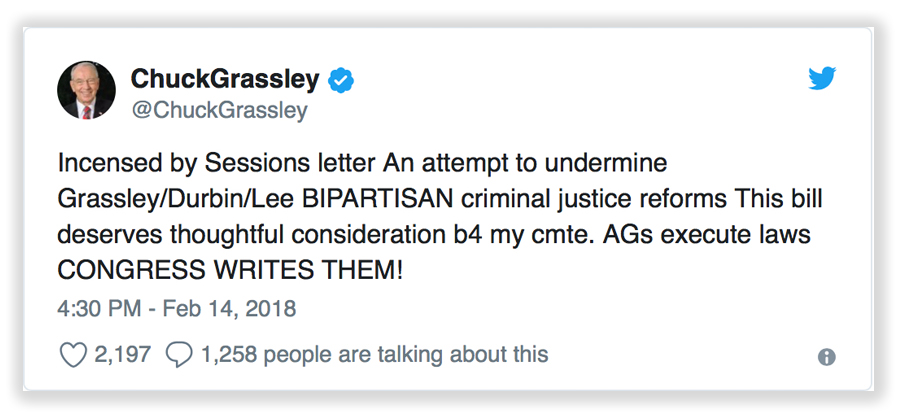
flipflop170920Watered down or not, the SRCA fell to demagoguery from the likes of Sen. Ted Cruz (R-Texas), who supported the measure before he started running for president, but then opposed it on the campaign trail. An even greater foe was then-Sen. Jefferson Beauregard Sessions III, who is now Attorney General.

Nevertheless, building on the Senate’s success in repealing Obamacare and passing comprehensive tax reform, some U.S. senators are now planning to take a second stab at passing a bipartisan criminal justice reform bill after it stalled amid GOP infighting. Sens. Dick Durbin (D-Illinois) and Chuck Grassley (R-Iowa) said Tuesday that they will reintroduce the SRCA, but they did not specify exactly when.

“While the political landscape in Washington has changed, the same problems presented by the current sentencing regime remain,” Grassley said. Despite the fact the bill has been worked on now over three different congresses, Durbin believes it the “best chance in a generation to right the wrongs of a badly broken system.”

The bill cleared the Senate Judiciary Committee in 2015, with Sen. John Cornyn (R-Texas) – one of the co-sponsors – predicting it would come to a floor vote soon afterwards. As Senate law-and-order conservatives started taking whacks at it, House Speaker Paul Ryan (R-Wisconsin) questioned whether the House would even be willing to debate the version of SRCA the Senate was cooking up. The bill died with the end of the last congress.

Starting with the day after its death last January, Grassley and Durbin began expressing interest in reviving the criminal justice bill. Along with Sen. Mike Lee (R-Utah), reportedly met with President Trump’s son-in-law and senior adviser Jared Kushner last March to discuss the issue. Kushner has a special interest in federal criminal justice reform.

sessions170918The push to pass the criminal justice reform bill could set up a potential fight with the Dept. of Justice, and Sessions, who was one of the leading opponents against the legislation when he was a member of the Senate. It is not known how much influence the AG still has with the President, who thinks Sessions is both “weak” and an “idiot.”

Sen. Thom Tillis (R-North Carolina), another supporter of the criminal justice reform effort, speculated last January that Sessions as attorney general would have as a chief objective enforcing what Congress sends him — even if he disagrees with it — rather than slipping into the role of legislator and try to change the laws. “He’s going to be focused on being the nation’s top law enforcement official,” Tillis said. “I don’t necessarily see him weighing in heavily on public policy choices that President Trump makes.”

The Hill, Senators to reintroduce bipartisan criminal justice bill (Sept. 19, 2017)

– Thomas L. Root

LISAStatHeader2small

U.S. District Judge Sues Court of Appeals Over Psych Order – Update for September 20, 2017

We post news and comment on federal criminal justice issues, focused primarily on trial and post-conviction matters, legislative initiatives, and sentencing issues.

LISAStatHeader2small
CALL ME CRAZY, BUT I’M SUING YOU

The cadre of 519 sitting U.S. District Judges includes a list of some first-class jurists. We have a number of favorites for criminal matters, not because they’re soft soaps, but rather because they’re thoughtful and dedicated to the difficult task of making decisions that protect crime victims and the rights of the accused.

adams170920We also have a rogues list, which we are glad to say is mercifully short. But one judge who has amply earned his seat on that panel is Judge John R. Adams of the United States District Court for the Northern District of Ohio. It would be difficult for us to identify a judge who is consistently more mercurial or petty. He’s a guy who once held a public defender in contempt for subpoenaing witnesses, added 24 months to a sentence on a remand after United States v. Booker invalidated the mandatory guidelines, and had an employment discrimination case taken from him by the 6th Circuit because of his bias against one of the parties’ lawyer and discord which “appears to be, at least in part, the result of the protracted nature of this litigation to which the district judge has contributed greatly.”

As a parenthetical, we were personally involved in a post-conviction proceeding from a conviction in Judge Adams’ court that languished for five years before a ruling, and then the ruling came only because the prisoner filed a petition for writ of mandamus with the 6th Court of Appeals seeking an order telling Judge Adams to rule on the 2255 motion.

Apparently the good judge holds others to timeliness standards to which he does not hold himself. After demanding that magistrate judges to which he assigns social security appeals complete their decisions within 30 days of all of the pleadings being filed, Judge Adams threatened him with a contempt finding when he missed the deadline. When the other judges in the Northern District of Ohio unanimously asked Judge Adams to withdraw his “show cause” order against the magistrate as “unwarranted and improper,” the Judge refused, and shot back that the Chief Judge had failed to “discipline” two magistrate judges who had protested Judge Adams’ 30-day demand, both of whom Judge Adams believed had “disrespectful[ly] and “defiant[ly]” suggested that their need to manage other cases was a valid reason not to comply with Judge Adams’s Scheduling Order.

This capped a 9-year battle Judge Adams had waged against the other judges of the court, arising from Judge Adams’ candidate for magistrate judge being passed over in 2008 in favor of someone else selected by majority vote of the judges.

adams1776170920In 2013, four other district judges filed a judicial complaint against Judge Adams’ weird and disruptive conduct, which they called “prejudicial to the effective and expeditious administration of the business of the courts.” After a 2-year investigation, the 6th Circuit Judicial Council held that Judge Adams’s issuance of the Show Cause Order constituted misconduct, his refusal to cooperate with the Special Committee’s request that he undergo a mental health examination with a psychiatrist selected by the Special Committee constituted misconduct, and Judge Adams might suffer from a mental disability, but because he had refused to undergo the requested mental health examination, no one knew for sure. The Judicial Council ordered that Judge Adams be publicly reprimanded for his actions, undergo a mental health examination by a psychiatrist selected by the Committee and submit to any treatment or counseling deemed necessary by the psychiatrist. Finally, it ordered that no new cases be assigned to Judge Adams for two years, and his current cases be transferred to other judges (subject to suspension if he underwent and passed a psychological exam).

The Judicial Conference of the United States upheld the order last August.

Last week, Judge Adams sued the 6th Circuit in U.S. District Court for the District of Columbia, alleging that the order violates his 5th Amendment right to due process. Judge Adams claims the Judicial Conduct and Disability Act of 1980 is unconstitutionally vague, “because it lacks minimal enforcement guidelines identifying when an Article III judge may be subject to a disability investigation, and, accordingly, when an Article III judge may be disciplined for objecting in good faith to undergoing a compelled psychiatric examination as part of an investigation into whether he suffers from a disability rendering him unable to discharge his duties.”

judge160222Judge Adams contends he “has an obvious liberty interest in the outcome of any misconduct or disability proceeding against him. He also has an obvious liberty interest in not being subjected to an involuntary psychiatric examination and a further liberty interest in not being stigmatized as having committed misconduct and having his mental health questioned.”

He asks the court to declare unconstitutional the Judicial Council’s order and memorandum requiring him to undergo a psychiatric exam.

Adams v. Judicial Council of the Sixth Circuit, Case No. 1:17-cv-1894 (D.D.C., filed Sept. 14, 2017)

– Thomas L. Root

LISAStatHeader2small

It’s Official – The AG Declared to be an “Idiot” – Update for September 19, 2017

We post news and comment on federal criminal justice issues, focused primarily on trial and post-conviction matters, legislative initiatives, and sentencing issues.

LISAStatHeader2smallNEWS FROM THE WHITE HOUSE

We always kind of suspected this, but it’s still nice to get confirmation.

sessions170918The New York Times reported last week that in the middle of an Oval Office “horsewhipping” of Attorney General Jefferson Beauregard Sessions III by President Trump last May, over Sessions’ recusal of himself from the Trump Russia probe, the President got a phone call informing him that Robert Mueller had been appointed to be special counsel for the investigation. After the call, Trump “lobbed a volley of insults at Mr. Sessions, telling the attorney general it was his fault they were in the current situation. Mr. Trump told Mr. Sessions that choosing him to be attorney general was one of the worst decisions he had made, called him an “idiot,” and said that he should resign.”

The Attorney General is an “idiot?” At least now if we say it, we can attribute it to the man who hired him.

justicereform161128Also from 1600 Pennsylvania Avenue, President Trump’s son-in-law and senior adviser, Jared Kushner, hosted a White House roundtable last week to gather recommendations for improving mentoring and job training in federal prisons.  

A bipartisan group of about two dozen elected officials, religious leaders and business leaders attended the first major criminal justice-related event held by the Kushner-led Office of American Innovation. “There is a lot of agreement from the left and the center and the right that once a person has committed a crime we should make sure we give them the best opportunities to try to live a productive life after serving their time,” Kushner said.

Members of Congress attending were Sen. John Cornyn, R-Texas, Sen. Sheldon Whitehouse, D-Rhode Island, Rep. Doug Collins, R-Georgia, and Rep. Sheila Jackson Lee, D-Texas. Several cabinet-level officials were there, as well as two governors — both Republicans — representing the state-level effort.

idiot170918Kushner’s interest in criminal justice policy is much different than that of Trump and Attorney General Jefferson Beauregard Sessions III, reportedly branded an “idiot”by his boss, who have called for more aggressive prosecutions of drug offenders and illegal immigrants.

The New York Times, Trump Humiliated Jeff Sessions After Mueller Appointment (Sept. 14, 2017)

Washington Post, Kushner to gather bipartisan group to come up with ideas for federal prisons (Sept. 13, 2017)

– Thomas L. Root

LISAStatHeader2small

8th Circuit Finds Constructive Variance in “Nothingburger” Case – Update for Monday, September 18, 2017

We post news and comment on federal criminal justice issues, focused primarily on trial and post-conviction matters, legislative initiatives, and sentencing issues.

LISAStatHeader2small
8TH CIRCUIT FINDS CONSTRUCTIVE VARIANCE

cheeseburger170918It’s appropriate that on National Cheeseburger Day, we would report on a strange little “nothing burger” of a case handed down last week by the 8th Circuit. The appellate court reversed a misdemeanor conviction of a South Dakota man for “threatening, intimidating, or intentionally interfering with” a U.S. Forest Service officer engaged in the performance of duties.

Tom McDill, who owned property next to a national forest, wanted to set up a business of hauling off piles of wood debris from forest land and selling it. He also wanted a permit to cut down some beetle-infested national forest trees to keep the bugs from spreading to his land. Neither of these was unreasonable, but Tom has kind of an “in-your-face” style of discussion that creeped out a couple of female USFS employees. A USFS cop gave him two misdemeanor summonses, listing the offenses as “intentionally interfering w USFS employee in process of her duties” and “harassment + interference w/ USFS employee in process of her duties,” respectively, in violation of 36 CFR 261.3(c)).

whatsaid170918The citations charged Tom with harassment (not prohibited by 261.3(c)) and interference. This, the verdict was permissible only if it rested on the theory that Tom intentionally interfered with the employees. But, as the 8th Circuit put it last week, “the court effectively altered the charges set forth in the citations.”

The government’s case established that Tom intimidated the employees, and both were frightened by Tom’s size and demeanor. The government argued that Tom “intimidated and arguably interfered with… a forest officer.” And in its verdict, the court told Tom that evidence showed Tom was “intimidating, interfering, or threatening them… because they were Forest Service officers.”

The case is a nothingburger

The 8th Circuit held last week that “there was at least a substantial likelihood that McDill was convicted of an offense for which he was not charged. Accordingly, McDill was subjected to a constructive amendment… that materially and substantially affected McDill’s right to notice of the charges against him… McDill relied on the language of the citations in preparing his defense, and was unfairly surprised when the government pursued a conviction based on the theory that he intimidated or threatened [the USFS employees]…” The error “undermined the ‘fairness, integrity or public reputation of judicial proceedings’.”

United States v. McDill, Case No. 15-2503 (8th Cir., Sept. 15, 2017)

– Thomas L. Root

LISAStatHeader2small

6th Circuit Says “There’s Crazy, and Then There’s Crazy Like A Fox” – Update for September 14, 2017

We post news and comment on federal criminal justice issues, focused primarily on trial and post-conviction matters, legislative initiatives, and sentencing issues.

LISAStatHeader2small
NUTZPAH

repo170915The facts of the case hardly seem like a federal crime. Repo man Garry Valentine showed up at Airiz Coleman’s house in Youngstown, Ohio, to repossess Airiz’s truck for nonpayment of the note. Airiz took exception, and – as the court drily puts it – “pointed a handgun approximately six or seven inches from Valentine’s face and threatened to kill him. Defendant’s wife intervened and Valentine was able to call the police.” The police came and arrested Airiz, seizing some cheap 5-shot revolver.

So far, it seems unremarkable, the kind of thing the local cops would handle. Airiz would be charged with some kind of assault, spend some time in jail, get bailed out, cop a plea and get maybe 6 months. Except, of course, it turns out Airiz had a prior felony, so the feds – who should have better things to do in Youngstown – picked up the case, charging Airiz with being a felon in possession of a firearm.

sovereigncitizen161125This is where the case gets interesting. While awaiting trial, Airiz apparently became acquainted with the Sovereign Citizen movement. We’ve described it before. The sovereign citizen movement is a loose grouping of litigants, commentators, tax protesters, financial-scheme promoters, and assorted whackos, who take the position that they are answerable only to their particular interpretation of the common law and are not subject to the United States Code or federal courts, although some of them have great affection for the Uniform Commercial Code (as they understand it to be, which it is not). Others prefer admiralty law. They do not recognize United States currency, although they freely spend it, and maintain that they are “free of any legal constraints.” They have special enmity for the federal income tax.

Airiz became an eager convert. At his arraignment, he acknowledged his but challenged the court’s jurisdiction over him, arguing that the government was “trying to charge him with” a “commercial crime” and that the United States could not be the victim of a commercial crime, whatever that meant. Airiz demanded of the magistrate judge to know if he was forcing Airiz “to contract,” and he referred to himself as a “flesh and blood living being.” He claimed that his detention on “U.S. soil” was unconstitutional.

When his public defender tried to quit because Airiz was “combative” and “confrontational,” Airiz told the court that he was present “on special appearance, as a third-party intervenor” and claimed that he was a “beneficiary and executor to the legal estate of the decedent.” He said he had surrendered his birth certificate “to the Court for set-off, settlement.” He contended that he was not a corporation, an estate, or a legal fiction, but rather, was “a living man… living private on the land.” He “authorized” the court “to settle and close the account, case, constructive trust” and again argued the court lacked “jurisdiction” and referenced his “copyright.” The district court quickly came to see the public defender’s point, and appointed other counsel.

crazy170915Several days before trial, Defendant repeated his jurisdiction claim, explaining again that he is “a living man… not a ‘corporate fiction’… [who] never signed any ‘Contract’ with the Public Defender’s Office.” He also appointed “Respondent: James S. Gwin” (who was the District Judge hearing the case) “as Trustee to settle and close” the case. Airiz signed the notice as his own “Authorized Representative” and listed an address in “Warren, Ohio Republic,” with a zip code in brackets. Airiz loaded up the record with an Affidavit of Ownership, Declaration of Nationality, Certificate/s of Titles, and Birth Certificates, and declared himself to be a “Moorish American National.” Using a favored sovereign citizen artifice of declaring a copyright in his own name, Airiz demanded payment of “1,000,000,000.00 PER HOUR UPON OCCURANCE [sic]” when anyone used his name.” Finally, for good measure, Airiz attached a proposed “Order of Dismissal With Prejudice” pursuant to “Rule 12(b)(1)(2) of the Federal Rules of Civil Procedure” alleging lack of subject-matter and in personam jurisdiction.

Trial with his new counsel did not go well. Airiz claimed that he did not want to testify at trial, but his new attorney insisted he could not argue effectively unless Airiz testified as to his view of what happened. Airiz said he and his wife “didn’t want to argue for a corporation,” and that was why he “tried to be respectful” and said that he wasn’t the defendant, but a man. He was convicted.

At sentencing, Airiz was starting to get it. He painted himself as having overcome a tough childhood to become a good family man, and said he had written a play that a record company was about to produce. He said that he had a job lined up in Hollywood with Charlie Sheen. He said he had saved another inmate’s life while jailed awaiting trial. He told the court he “never meant to dishonor anyone in this courtroom” and that he “always wanted to provide for my family.”

The district court sentenced him to 36 months, one month beneath the bottom of the sentencing range.

stupidity170915On appeal, Airiz somehow ended up being represented by Washington, D.C., megafirm Sidley Austin. His appellate counsel did just about the only thing it could do. It complained that its client was obviously nuts, and that the district court should have had his head examined. Or, in legalese, it argued that Airiz’s “bizarre statements over the course of multiple hearings and trial, and his interaction with his counsel—as reported by those attorneys—triggered reasonable cause to believe” that he did not understand the nature and consequences of the criminal proceedings and lacked the ability to consult with counsel to prepare his defense.

Airiz offered a few examples: He said the “first tell-tale sign was his ‘stringing together legal jargon that made no sense’,” such as saying he was

“here on special appearance, third-party intervenor, okay, who was injured by this action, and beneficiary and executor to the legal estate of the decedent” He also believed that he could authorize the district court “to settle and close” the case and that he could “decline any more offers of imprisonment, fines, fees, or any other penalties.” Second, Defendant argues that he “utterly fail[ed] to grasp that the jury had convicted him of a federal criminal offense[.]” At the hearing to remove Mack as counsel, Defendant repeatedly insisted that his “debt” had been taken care of, and the court was therefore required to release him from custody. Third, Defendant claims that his “abnormal splintering of the self” should have raised a red flag. At the hearing on his first attorney’s motion to withdraw, Defendant characterized himself as the defendant’s “surety,” and at trial, as his “authorized representative.” In his objections to the presentence report, Defendant claimed that he was not a defendant, but “a natural living man” (and not a U.S. citizen). Fourth, he displayed “a grandiose belief in his own superior knowledge,” via his “belligerence with the prosecutor while being cross-examined at trial.” In particular, Defendant confusingly discussed his 2008 felony convictions, first claiming that he prevailed, then that he had taken a plea, and finally claiming that he had done so “unconsciously.” He also read a “revised” passage from the Bill of Rights—his version of that document. Fifth, although “fairly lucid” at sentencing, Defendant allegedly made “lofty claims that suggested he was not fully connected to reality.” This included his assertion that he was writing a play and had a “guaranteed job on anger management in L.A. with Charlie Sheen.”

In fact, Airiz argued, the district court itself twice commented that Defendant was not making any sense.

chutzpah170915It was a pretty gutsy move: act nuts with a side of chutzpah. Call it “nutzpah.” Spout nonsense at trial, and then appeal on the grounds that the court should have known you were acting crazy. But earlier this week, the 6th Circuit refused to buy it. There was nothing that unusual about Airiz’s “meritless rhetoric,” which was “frequently espoused by tax protesters, sovereign citizens, and self-proclaimed Moorish-Americans.” The jurisdiction claims, the “Moorish-American” business, the name copyright, the “third-party intervenor” status: been there, the Court said. Done that. Have the Sovereign Citizen t-shirt.

The 6th noted that two other circuits had rejected the claim that professing to be a sovereign citizen was “an expression of incompetency,” in the absence of mental illness or uncontrollable behavior. A competency hearing is not necessary where the only evidence of incompetence is “the unusual nature of the defendant’s beliefs.”

tshirt170915The appeals court held that Airiz showed that he understood the criminal nature of the proceedings, as reflected by the fact that he challenged the court’s jurisdiction. Airiz “demonstrated his ability to make legal arguments, albeit atypical ones. He drafted a detailed affidavit, provided state documents, and cited case law, statutes, and constitutions. His trial testimony was designed to counter incriminating facts.” He cooperated with the Probation Officer in preparation of the presentence report. But “perhaps most telling” was Airiz’s “articulate, passionate allocution” begging the court to return him to his family. The Court said that Airiz’s “swan song at sentencing reflects a carefully crafted attempt to present himself as a virtuous man, good father, and community leader, a character very different than the one presented at earlier stages of the proceedings.”

swan170915Yes, but how about Airiz’s claim of a Hollywood job offer? Was that not evidence of “grandiose and possibly delusional thinking.” The 6th Circuit thought not: “Given certain similarities between his behavior and Charlie Sheen’s behavior (both in real life and on television), it could also have been an attempt at rather ironic humor.”

United States v. Coleman, Case No. 16-3972 (6th Cir., Sept. 13, 2017)

– Thomas L. Root

LISAStatHeader2small