
We post news and comment on federal criminal justice issues, focused primarily on trial and post-conviction matters, legislative initiatives, and sentencing issues.

WE FIND THE GOVERNMENT’S B.S. ‘TROUBLING’
Crystall Robles-Lopez was a homegirl. At 30 years old, she had never traveled from her home in Puerto Rico, never been on an airplane, and instead grew up in poverty. When someone offered her $1,500 to carry a couple of suitcases full of… well, something, Crystall wasn’t sure what… on an airline flight to New Jersey, she felt like she had won the lottery.

Free money and an all-expenses paid trip to sunny Newark, New Jersey. Wowsa!
Sadly, the “something” was about 25 lbs. of powder cocaine. Crystall didn’t make it out of the San Juan airport before being caught.
Crystall’s Presentence Report recommended she receive a 3-level Guidelines (USSG § 3B1.2) mitigating-role reduction. The government argued against it, pointing out that the only crime at issue was Crystall transporting coke, and she couldn’t have a minor role in a one-person crime. Besides, the government said, she was the ‘primary player’ in the conspiracy, she understood the crux of the criminal activity more than any other participant, she hailed Uber rides to take herself to the hotel and then to the airport, and she maneuvered the cocaine to minimize the potential to get caught in a highly policed environment.”
 Last week, the 1st Circuit threw out Crystall’s sentence. It criticized the district court for not identifying the “relevant conduct as a whole” to determine Crystall’s role among all of the players. Instead, the Circuit observed, “the district court recognized only the steps Robles herself took to smuggle the two suitcases of cocaine through the airport and onto the plane. By declining to consider any ‘activities… undertaken in preparation for that offense, or in the course of attempting to avoid detection or responsibility for that offense,’’ the court failed to identify the full universe of relevant participants.”
“Instead,” the 1st said, the district court merely recited “the facts that made Robles guilty of the crimes for which she was charged.” But the purpose of the § 3B1.2 factors “is not to establish guilt; it is to help a court decide whether to apply leniency because a defendant, while guilty, played a substantially subordinate role in the criminal activity.” The district court “incorrectly… placed inappropriate determinative weight on the government’s assertion that her role was indispensable to the success of the criminal endeavor.” But the Guidelines note that “a defendant who… is simply being paid to perform certain tasks should be considered for an adjustment” and caution that “an essential or indispensable role in the criminal activity is not determinative” of eligibility.
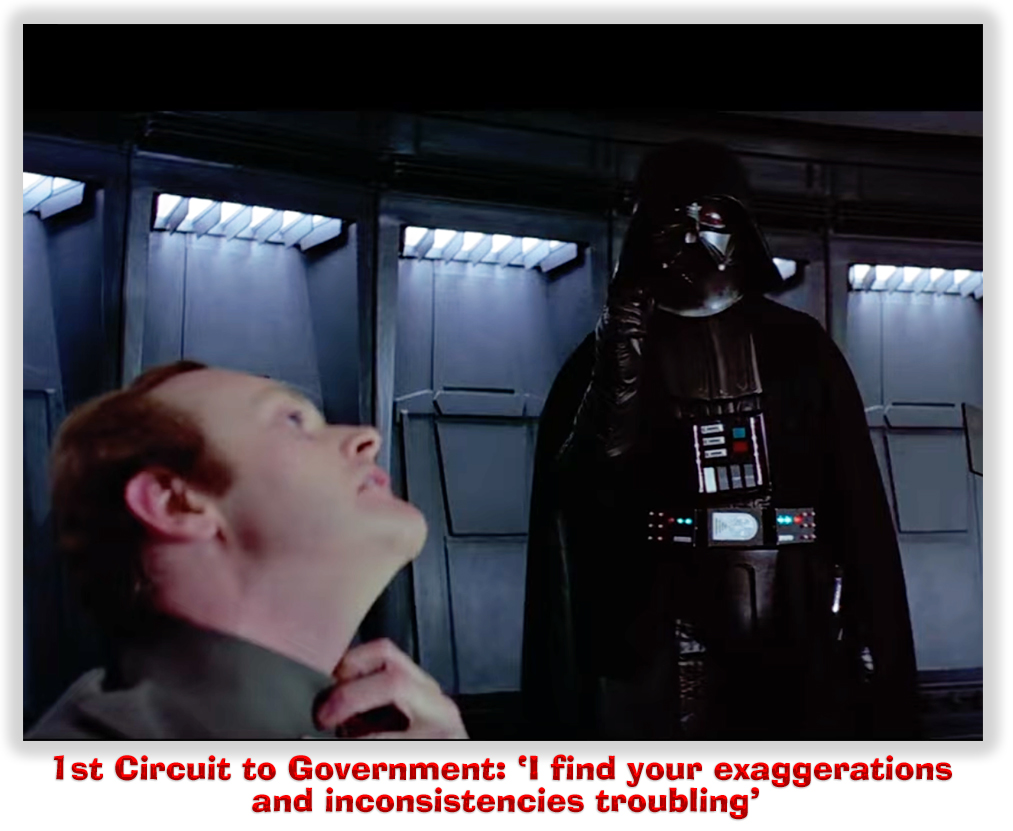 The 1st Circuit included a sharp rebuke aimed at the government: “The government makes an unsupportable attempt in its appellate briefing to cast Robles as ‘the star of the show’ and the ‘primary player’ in the conspiracy, making assertions about her role and activities that are patently inconsistent with uncontroverted record evidence… These exaggerations and inconsistencies by the government are troubling.”
United States v. Robles-López, Case No. 23-1587, 2026 U.S. App. LEXIS 6427 (1st Cir., dated February 4, 2026, but released on March 4, 2026)
~ Thomas L. Root