Tag Archives: Prohibiting Punishment of Acquitted Conduct Act

SIZZLE BUT NO STEAK YET IN WASHINGTON – UPDATE FOR AUGUST 13, 2021

We post news and comment on federal criminal justice issues, focused primarily on trial and post-conviction matters, legislative initiatives, and sentencing issues.

LAST WEEK IN WASHINGTON

oddcouple210219The news website Axios reported last week that Sens. Richard Durbin (D-Illinois) and Charles Grassley (R-Iowa) – the Senate’s criminal-justice reform “odd couple” – “are working to win Senate passage of a big criminal justice reform package this Congress.”

Axios cited approval of three bills by the Senate Judiciary Committee, the COVID-19 Safer Detention Act, the First Step Implementation Act, and the Prohibiting Use of Acquitted Conduct Act as being “three measures, Grassley told Axios, they ‘hope to package along with potentially other proposals to pass the Senate sometime this Congress’.” Durbin separately told Axios in his own statement that he’s “committed to bringing these bills to the Senate floor this Congress.”

Axios predicts the final package also may include a measure for CARES Act confinees who otherwise may be forced to return to prison, a Republican Senate staffer told Axios, as well as the EQUAL Act. One challenge will be the crime spike, Axios said, which has the potential of sapping support from senators afraid of being branded soft on crime.

I like Axios, which is a pretty even-handed service, albeit more of a news aggregator than a news reporter. (Nothing wrong with news aggregators – LISA is largely one itself). But because it’s an aggregator, I am not sure whether Axios’s report represents something new, or is just a survey of what we already know.

caresbear210104In other developments, a coalition of five civil rights groups last week urged the Dept of Justice to reconsider its position on sending back to prison thousands of federal inmates transferred to home confinement during the pandemic, offering a legal analysis they believe would justify keeping them out from behind bars.

They argued that the Trump-era legal memo that concluded BOP is required by law to revoke home confinement for those transferred during the pandemic as soon as the emergency period is over, contending the Office of Legal Counsel memo is based on a flawed interpretation of the CARES Act.

Update: Yesterday, Senators Richard Durbin (D-Illinois) and Cory Booker (D-New Jersey) wrote to President Biden, urging him to act on keeping CARES Act home confinees at home. They suggested, in part, that the Bureau of Prisons could “provide relief for certain individuals through prerelease home confinement, under 18 USC § 3624(c)(2), and the Elderly Home Detention Pilot Program, pursuant to 34 USC § 6054l(g). For those who do not qualify for those provisions, BOP can recommend, and DOJ should support, compassionate release pursuant to 18 USC 3582(c)(l)(A). Compassionate release is authorized whenever extraordinary and compelling reasons warrant a sentence reduction, and the once-in-a-century global pandemic that led to these home confinement placements certainly constitutes such an extraordinary and compelling circumstance.”

So far, the President has resisted by inaction such calls to address the looming home confinement crisis.

Axios, Senate plans barrage on crime (August 1, 2021)

The Hill, Civil rights groups offer DOJ legal strategy on keeping inmates home after pandemic (August 4, 2021)

Letter to Dawn E. Johnsen, Acting Asst Attorney General (August 4, 2021)

The Hill, Top Senate Democrats urge Biden to take immediate action on home confinement program (August 12, 2021)

Letter to President Biden from Sens. Durbin and Booker (August 12, 2021)

– Thomas L. Root

Ted Fumes, Committee Votes, Prisoners Hope – Update for June 11, 2021

We post news and comment on federal criminal justice issues, focused primarily on trial and post-conviction matters, legislative initiatives, and sentencing issues.

RETROACTIVE FIRST STEP CLOSER TO REALITY

The Senate Judiciary Committee yesterday approved sending the First Step Implementation Act (S.1014) to the full Senate by a 13-9 vote.

retro160110The FSIA extends retroactive treatment to changes in 18 U.S.C. § 924(c) gun charges and 21 USC 841(b)(1) drug penalties made by the First Step Act in 2018. As well, the legislation extends a more lenient definition of prior drug offenses to the lower level penalties of 21 USC § 841(b)(1)(C), (D), and (E).

Additionally, FSIA changes application of the drug offense safety valve (18 USC 3553[f]) to let judges apply safety valve sentences where the court finds that a defendant’s criminal history score overstates the seriousness of a criminal past. The bill also includes extensive changes in the review of juvenile sentences and expungement of records.

A charge of using or carrying a gun during a drug trafficking crime (18 USC § 924(c)) carried a mandatory consecutive sentence of at least five years. If the offense was the second or a successive § 924(c) offense, the minimum sentence was 25 years. The government often would charge multiple § 924(c) counts in a single indictment. So if a defendant carried a gun while selling drugs on Monday, the sentence would be perhaps 36 months for selling the drugs, but an extra 60 months for carrying a gun. If the defendant carried a gun while selling drugs on Tuesday as well, the sentence would be a total of 36 months for selling the drugs on both days, but another 300 months would be added for carrying a gun the second day, for a total sentence of 396 months. If the defendant carried a gun while selling drugs on Wednesday, another 300 months would be added, and so on.

Sentencestack170404The First Step Act changed the law so that the 300-month additional time would not be added unless a defendant had previously been convicted of a § 924(c) offense. That change would give Tuesday’s defendant a total sentence of 156 months instead of 396 months. However, the First Step Act did not make the change retroactive, leaving people sentenced on December 20, 2018, with 300-month add-on sentences, while those sentenced on December 22, 2018, would only get 60-month additional sentences.

The same retroactivity would apply to changes in the drug mandatory minimum sentences mandated by the First Step Act. The mandatory life sentence under 21 USC § 841(b)(1)(A) for offenses enhanced by prior drug convictions was reduced to 25 years, and the 20-year mandatory minimum in 21 USC § 841(b)(1)(B) for offenses involving lesser drug quantities was cut to 15 years.

The First Step Act included another change. People convicted of drug trafficking under 21 USC § 841 would receive higher sentences if they had prior “felony drug convictions,” even if they had received probation for the offense. First Step substituted “serious drug felony,” which requires that the defendant have served more than a year in prison for the offense. That change has been extended to all punishment sections of § 841(b)(1) and made the changes retroactive.

The Judiciary Committee approved the FSIA to move on to the Senate on a bipartisan vote. All 11 Democrats and three Republicans voted for FSIA, but only after Sen Ted Cruz (R-Texas) argued for three amendments that would have limited judges’ authority to reduce sentences. All three amendments failed, after which Cruz delivered a polemic against Democrats, predicting that FSIA would never pass the Senate because his amendments were rejected. The diatribe was epic, one in which Cruz used the phrase “murderers, rapists and child molesters” as a substitute for prisoners no fewer than ten times.

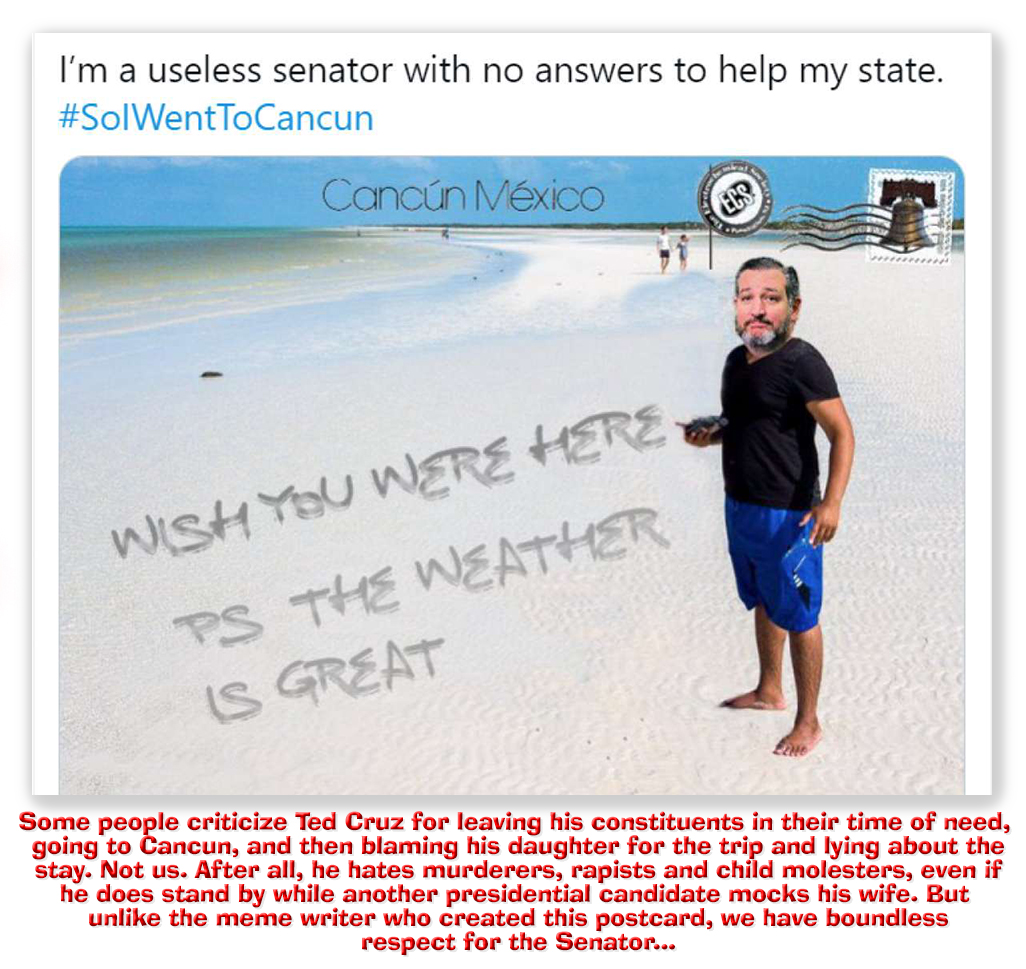
cruz210611A dramatic moment occurred when, part way through Cruz’s denunciation of more lenient sentences, Committee Chairman Richard Durbin (D-Illinois) interrupted to report that the union representing BOP corrections officers had thrown its support behind FSIA. That would have given more reasonable people reason the reflect on their denunciation of the dangers of letting judges make decisions on reducing sentences. I mean, if the people who spend their careers guarding federal inmates think that a little flexibility and leniency in sentencing is appropriate, maybe a guy who leaves his constituents freezing in the dark while he jets off to Cancun should defer to their judgment.

But reflection and reason are for lesser mortals, not Ted (who has been described by a fellow Republican in terms not normally associated with mortals).

Even if Cruz is wrong, the FSIA and other bills – the COVID-19 Safer Detention Act (S.312), passed by the Committee on May 27, and the Prohibiting Punishment of Acquitted Conduct Act of 2021 (S.601), approved yesterday – have a long way to go. The full Senate and House of Representatives both must pass the measures. There is no schedule for full Congressional action.

First Step Implementation Act of 2021

Senate Judiciary Committee, Hearing (June 10, 2021)

Office of Senator Charles Grassley, Senate Judiciary Committee Advances Two Bipartisan Durbin, Grassley Criminal Justice Bills (June 10, 2021)

– Thomas L. Root