Tag Archives: grand jury

Grand Jury Master Class – Update for November 26, 2025

We post news and comment on federal criminal justice issues, focused primarily on trial and post-conviction matters, legislative initiatives, and sentencing issues.

A ‘HOW TO’ MANUAL FOR GETTING GRAND JURY MATERIALS (IT AIN’T EASY)

Watching Eastern District of Virginia US Attorney Lindsey Halligan make a hash of the criminal action against former FBI director James Comey provided a month’s worth of entertainment last week. It’s why a lot of people watch NASCAR – not for the racing but because there may be an awesome wreck at some point.

Last week’s legal festivities culminated in US District Court Judge Cameron McGowen Currie dismissing the Comey and Letitia James indictments this past Monday because crack insurance lawyer Halligan – although eminently qualified to be a United States Attorney – was never properly appointed to her position.

The legal geek in me was somewhat disappointed, because it left some of the meaty, substantive issues – such as did the grand jury ever really see the indictment that was ultimately handed up and is this the queen mother of all vindictive prosecutions – unanswered. But regardless, the litigation has thus far been a master’s course for a defendant seeking access to the records of the grand jury that indicted him.

Previously, a US Magistrate Judge, recognizing that ordering the prosecution to turn over grand jury material was “an extraordinary remedy,” had nonetheless noted that “given the … prospect that government misconduct may have tainted the grand jury proceedings, disclosure of grand jury materials under these unique circumstances is necessary.” The 24-page opinion granted the defense full access to grand jury material, finding evidence that Halligan may have misinformed the grand jurors of the law, violated the defendant’s attorney-client privilege by using materials seized from one of his lawyers at the time of the search, violated the 4th Amendment, and handed up an indictment that was never approved by the grand jury.

The Magistrate Judge found eleven separate, detailed and serious allegations supported release. “The traditional policies underlying grand jury secrecy are only moderately applicable to this case,” the Court said. “Here, the grand jury’s role in this case is over and the statute of limitations has expired so there is no danger that release of grand jury materials could impact future grand jury proceedings. The only person to testify before the grand jury was a single federal agent. There are no other ‘persons who have information with respect to the commission of crimes’ who testified before the grand jury, either voluntarily or pursuant to a subpoena. The government has offered no particularized reason why grand jury materials should be kept from the person the grand jury indicted… On the other hand, as the Court has found, these materials are essential if Mr. Comey is to fully and fairly defend himself in the face of the irregularities that have characterized this investigation from its inception.”

The decision underscores the level of detail required to obtain access to grand jury materials. It should be required reading for defendants who figure that a “pretty please” is all it takes to get access to grand jury materials.

United States v. Comey, Case No 1:25-cr-272, 2025 U.S. Dist. LEXIS 226131 (E.D.Va. November 17, 2025)

~ Thomas L. Root
SCOTUS Being Asked to Review Access to Grand Jury Transcripts – Update for September 10, 2019

We post news and comment on federal criminal justice issues, focused primarily on trial and post-conviction matters, legislative initiatives, and sentencing issues.

ACCESS TO GRAND JURY RECORDS ISSUE BEING URGED AT SUPREME COURT

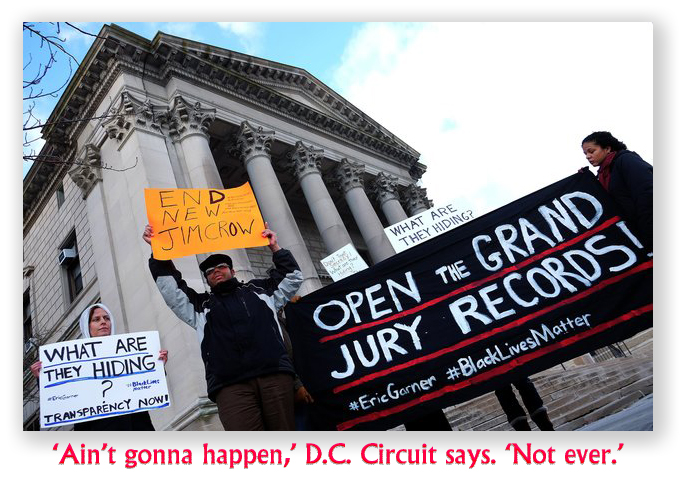
grandjury190911In an April 8, 2019, post, I reported on a U.S. Court of Appeals for the District of Columbia Circuit decision denying some 60-year old grand jury records sought by historian Stuart McKeever for a book he was writing. His request did not fit any of the reasons for disclosure specified in Federal Rule of Criminal Procedure 6(e)(2)(B), but Stuart argued that beyond the limitations of the rule, the district court had “inherent authority” to disclose historically significant grand jury matters. The district court agreed, but the D.C. Circuit reversed.

Last week, Stuart filed a petition for writ of certiorari with the Supreme Court, represented by the D.C. office of big-law firm Latham & Watkins. What makes the petition likelier to be granted is interest already being shown by the House Judiciary Committee, which is fighting to see the grand jury transcripts from the Mueller investigation by advancing the same argument. Like Stuart McKeever, the House demand for records cannot be pigeon-holed into any permissible use subsection of F.R.Crim.P. 6(e)(2)(B). So, like Stuart, the Judiciary Committee is arguing that the court had the inherent authority to release the records.

A Supreme Court decision finding that courts had inherent authority to release grand jury records could benefit inmates seeking grand jury records for post-conviction proceedings. A decision on the petition for certiorari will not come until late this year.

McKeever v. Barr, Case No. 19-307 (Supreme Court, filed Sept. 5, 2019)

National Law Journal, Justices Could Decide If Judges Have Power to Release Grand Jury Records (Sept. 6)

– Thomas L. Root

District Court Have No ‘Inherent Authority’ to Release Grand Jury Material – Update for April 8, 2019

We post news and comment on federal criminal justice issues, focused primarily on trial and post-conviction matters, legislative initiatives, and sentencing issues.

GRAND JURY RECORD ACCESS FURTHER CURTAILED

A lot of prisoners start preparing for post-conviction filings by filing motions with their district courts demanding grand jury transcripts. And they are always turned down. And they fume and fuss, never appreciating how stout the walls protecting grand jury secrecy really are.

Last week, the D.C. Circuit made getting breach the grand jury-secrecy walls even more daunting.

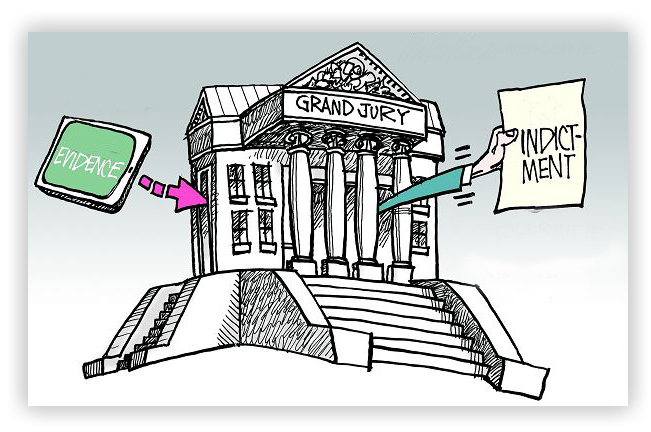
grandjury190408Let’s start with a simple primer. Grand jury proceedings are secret.

And for good reasons. First, because prosecutors can drag any smell old carcass in from the the grand jury panel, a lot of not-so-accurate dirty laundry belonging to people who never end up being charged with a crime could be aired if the records were open. Second, because there is neither a moderating judge nor defense counsel present at a grand jury, all sorts of scurrilous and inadmissible drivel can be dumped into the record, matters that should never be made public so as to shame the subjects, even if they are guilty of some criminal offense or another. Third, witnesses may be cowed if required to testify against someone who has not been publicly charged for fear that their allegations, even if true, may cost them their reputations, employment or even physical safety.

For those reasons, Rule 6(e) of the Federal Rules of Criminal Procedure severely limits the ability of anyone other than the government (naturally) to access grand jury material. Specifically, a defendant may obtain grand jury records of his or her own proceeding only (1) “preliminarily to or in connection with a judicial proceeding;” or (2) if the defendant is able to show “that a ground may exist to dismiss the indictment because of a matter that occurred before the grand jury.” The second ground is especially circular: in order to obtain any information about the matter before the grand jury, a defendant has to already have information about the matter before the grand jury.

The non-lawyer in us can only be wistful, imagining all of the historically-fascinating information contained in closed grand jury records. Think of the grand jury records relating to the Lincoln assassination, Al Capone, Alger Hiss, the Rosenbergs, the Chicago 8, Watergate… Interesting stuff, if you could get to see it.

Historian Stuart A. McKeever is a guy who wants to see some of it, specifically grand jury records from the 1957 indictment of FBI agent John Joseph Franks, whom Stu figured was involved in making a prominent critic of Dominican Republic dictator Rafael Trujillo disappear. Stu said he needed the grand jury records for a book he’s writing on the critic’s disappearance.

historians190408Stu asked the district court that heard the Franks case to release the grand jury records for their historical interest and merit. His request was not based on any of the exceptions in Rule 6(e)(3)(E) of the Federal Rules of Criminal Procedure, but instead on the district court’s inherent authority to disclose historically significant grand jury matters. The court agreed it had such authority.

Last week, the Circuit Court reversed the district court. It noted that Rule 6(e)(2)(B) prohibits disclosures about grand jury matters “unless these rules provide otherwise. The only rule to ‘provide otherwise’ is Rule 6(e)(3). Rules 6(e)(2) and (3) together explicitly require secrecy in all other circumstances.

“Where Congress explicitly enumerates certain exceptions to a general prohibition,” the Court said, “additional exceptions are not to be implied, in the absence of evidence of a contrary legislative intent… The Rule on its face prohibits such a communication because it does not except it from the general prohibition. It would be most peculiar to [stress] that the exceptions in Rule 6(e) must be ‘narrowly construed,’ yet to hold now that they may be supplemented by unwritten additions.”

McKeever v. Barr, 2019 U.S. App. LEXIS 10061 (DC Cir. Apr. 5, 2019)
<><>

– Thomas L. Root