We post news and comment on federal criminal justice issues, focused primarily on trial and post-conviction matters, legislative initiatives, and sentencing issues.

THE FUGITIVE
 The Supreme Court heard oral argument last week on whether people who flee from supervised release can claim that the term of their supervised release nevertheless continued and expired while they were a fugitive. If the term of supervision can expire while a defendant is a fugitive, and a doctrine called fugitive tolling does not apply to prevent that expiration, then a court could not revoke supervised release for violations of the conditions of supervision after the term’s expiration.
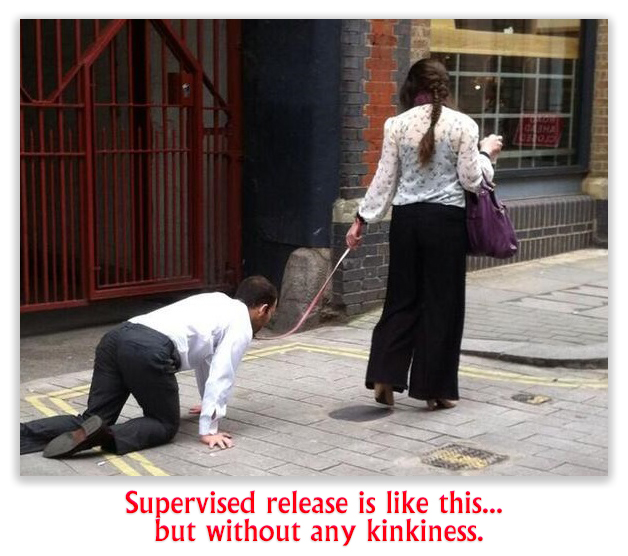
[Explainer: Supervised release is a period after the defendant is released from prison during which he or she is subject to the supervision of a probation officer and must comply with a long list of standard and special conditions. Violation of the terms of supervised release may result in the imposition of more restrictions, the lengthening of the supervised release term, or even being sent back to prison].
The doctrine, called fugitive tolling, suspends the running of supervised release while the defendant is on the lam. Without fugitive tolling, a district court would lack the authority to revoke supervised release for violations that weren’t charged until after the term of supervision ended.
The justices struggled with how the Dept of Justice scenario aligned with the law and congressional intent over federal court jurisdiction and sentencing on such matters.
The underlying issue stems from the case of Isabel Rico. She lost touch with her probation officer during her 4-year supervised-release term stemming from a drug trafficking conviction, who decided that she had absconded. While she was out of touch, she was convicted by state authorities for evading the police, driving without a license and possessing drug paraphernalia.
She wasn’t arrested until well after the expiration of her supervised release term. The government charged her with two minor violations that occurred during her term, as well as for committing the crimes of evading, no license and drug paraphernalia (which occurred after her supervised release term ended). Isabel objected that the district court lacked jurisdiction to consider the 2022 drug-related offense as a supervised-release violation because her term of supervised release had expired in June 2021.
 The government responded that the clock on Isabel’s supervised release term was paused when she absconded in May 2018, with about three years remaining, and did not resume until she was apprehended in January 2023 – meaning that she remained on supervised release when she committed the 2022 state offenses. Isabel argued that the “fugitive tolling” doctrine on which the government relied was inapplicable in the context of supervised release.
It was a big deal because the only violations she committed during the original supervised release term were low-grade ones carrying minor penalties. The 2022 violations were Grade A, however, carrying stiffer punishment under the Sentencing Guidelines.
At the oral argument, Justice Neil Gorsuch observed that the government has already gone to Congress in an effort to amend a section of the Sentencing Reform Act dealing with a violation of supervised release. “Congress has proven pretty solicitous in this area,” he said. But Congress never adopted any fugitive tolling provision, meaning that the government is now asking the Supreme Court to create one. “And the alternative is for us to create a fugitive tolling doctrine pretty [much out of] whole cloth… And so we’re going to have to come up with a whole common law doctrine here to supplement what [the law] already says.”
Justices Ketanji Brown Jackson and Sonia Sotomayor questioned whether the government’s theory of abscondment amounted to extending a period of punishment. “The traditional tolling is that the clock stops with respect to the obligation when you run away, and it picks up again when you’re found again,” Jackson said. “So it seems to me that what you’re actually asking for is an extension rule.”
Fugitive tolling is shaped by one central statutory provision, 18 USC 3583(i), which holds that if a court issues a warrant for a supervised release violation before the term expires, the court will continue to have jurisdiction to revoke supervision and impose punishment for those violations. Thus, if a defendant becomes a fugitive while on supervised release, and the probation officer files a petition to revoke before the term ends, fugitive tolling is unnecessary to revoke the defendant’s term of supervision.
 Section 3583(i) gives the court authority to revoke supervision if the defendant becomes a fugitive. A court would not have to rely on any further conduct by the defendant, such as the commission of a new crime, to revoke supervised release. And when the court turns to the appropriate sentence for the revocation, it could simply take into account all of the defendant’s conduct, including new crimes committed after the expiration of the term of supervised release.
The case will be decided by the end of June 2026.
SCOTUSBlog, Court leans against applying fugitive tolling in federal supervised release (Nov 5, 2025)
Bloomberg Law, US Supreme Court Struggles With Dispute Over Supervised Release (Nov 3, 2025)
Rico v United States, Case No 24-1056 (argument held Nov 3, 2025)
~ Thomas L. Root