Tag Archives: federal tort claims act

Medical Malpractice, Drunk Judges, Armed Dopers – Update for February 5, 2026

We post news and comment on federal criminal justice issues, focused primarily on trial and post-conviction matters, legislative initiatives, and sentencing issues.

ARE THESE SHORTS LEGAL?

Some legal case shorts from the last week:

(1)  BOP Pays Out on Inmate Death from Medical Malpractice –  George Thacker reported to FCI Edgefield camp for a 33-month sentence on December 9, 2022. On Christmas Day, he was so doubled over in pain that he could hardly walk. Instead of performing an exam or medical tests, health services staff gave him ibuprofen and sent him back to his unit.

George died the next day from complications due to a perforated duodenal ulcer and peptic ulcer disease. George’s daughter (who is executor of George’s estate) hired legal counsel and sued the BOP under the Federal Tort Claims Act, alleging medical malpractice.

Last week, George’s daughter and the US Attorney for South Carolina reached an agreement for the government to pay $750,000 to settle the claim. A petition was filed Tuesday seeking the court’s final approval on the settlement.

Motion to Approve Settlement and Legal Fees, Docket Entry 28, Wesolowski v. United States, Case No 6:25-cv-6675 (January 27, 2026)

Chattanooga Times Free Press, $750K settlement pending in former Rhea County executive’s 2022 death (January 29, 2026)

(2)     Will He Recommend RDAP for Himself? – U.S. District Judge Thomas Ludington (Eastern District of Michigan) goes to trial at the end of this month on a charge that he crashed a car while “super drunk” near his northern Michigan vacation home.

Last October, Judge Ludington, allegedly crashed his 2019 Cadillac CT6 into two traffic signs near Petoskey, disabling his Caddy and triggering at least one airbag.

He was charged on counts of operating a motor vehicle while intoxicated and operating with a high blood-alcohol content. The “super drunk charge” is punishable by up to 180 days in jail, a $700 fine, 360 hours of community service, and vehicle immobilization. In Michigan, a person is considered drunk with a blood-alcohol level hits 0.08. A person is considered super drunk when BAC hits 0.17. 

mLive, Federal Bay City judge charged in ‘super drunk’ crash in northern Michigan (January 27, 2026)

(3) 5th Circuit declares § 922(g)(1) unconstitutional as applied to defendant Charles Hembree was convicted of being a felon in possession of a firearm in violation of 18 USC § 922(g)(1) because of a single prior felony conviction for simple possession of methamphetamine. On appeal, Chuck argued that § 922(g)(1) was unconstitutional as applied to his situation.

Last week, the 5th Circuit agreed that convicting Chuck of § 922(g)(1) violated the 2nd Amendment. The Circuit ruled that there was no historical evidence that people possessing contraband that didn’t pose a danger to others were prohibiting from owning guns.

The 5th held that for possessing something prohibited to trigger prohibition on possessing a gun, the item had to be a weapon or something similar that harmed or could harm other people.

United States v. Hembree, Case No 24-60436, 2026 U.S.App. LEXIS 2051 (5th Cir. January 27, 2026)


~ Thomas L. Root

Ho-hum SCOTUS Civil Procedure Decision Strikes Blow for “Majestic Equality” – Update for January 23, 2026

We post news and comment on federal criminal justice issues, focused primarily on trial and post-conviction matters, legislative initiatives, and sentencing issues.

NOW SERVING: ‘BERK CHOY’ IN ERIE SAUCE

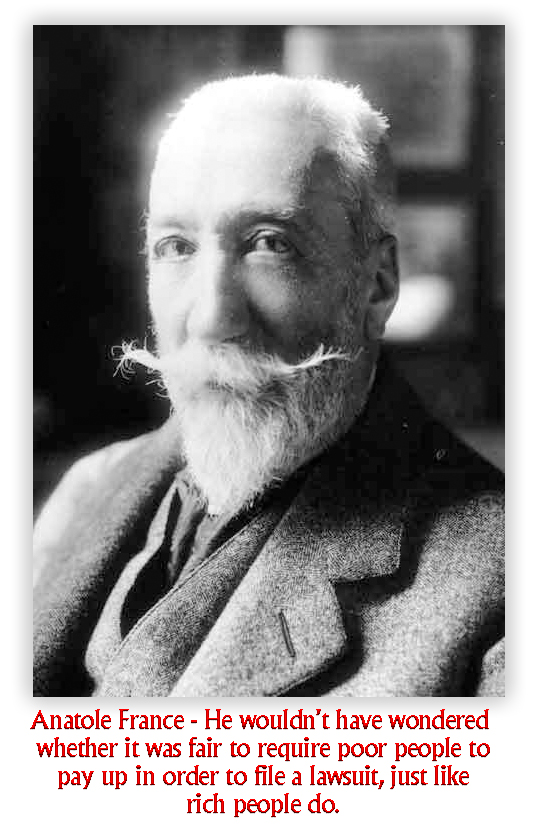
Jacques Anatole Francois Thibault wrote in Le Lys Rouge (what I otherwise thought was a dreadful novel when I was forced to read it as a callow youth) that

The law, in its majestic equality, forbids the rich as well as the poor to sleep under bridges, to beg in the streets, and to steal bread.

Like their noncustodial brethren, Federal prisoners who suffer from ham-handed medical care while in Bureau of Prisons custody have always been able to sue for medical malpractice. They must do so through the Federal Tort Claims Act (FTCA), which provides a legal framework for suing the United States in what otherwise is a plain-vanilla state law med-mal suit.

Most states have adopted in one form or another (by statute or in rules of civil proceeding) a requirement that a med-mal complaint must be supported by an “affidavit of merit,” a statement under oath by a medical expert that attests to the merit of the claim. The reason for such a requirement is to winnow out nonsensical malpractice claims early on to decrease the burden on the courts and the inconvenience to defendants and the insurance companies who defend them.

Sounds like a great idea! What could possibly go wrong?

Just this: Hiring a medical expert (almost always a licensed physician who also works as an expert witness) to review a med-mal complaint requires an upfront outlay of somewhere north of $5,000 to get the medical file read and the affidavit signed. Especially given the unforgiving statute of limitations binding FTCA plaintiffs (six months from denial of the administrative claim to filing the suit), these state “affidavit of merit” requirements shut down med-mal remedies for all but the wealthiest inmate filers.

The rich have to hire experts out of their pocket change if they want to bring an FTCA action. Seems only fair that the impoverished be required to do so as well. Ah, the law’s “majestic equality.”

Normally, a med-mal victim finds a lawyer (usually one who advertises on late-night TV) to take the case and front costs such as the expert’s fee. But prisoners do not, because their medical costs have been paid by the governments and juries don’t care much that prisoners – whose living costs are already being paid by the government – suffered some pain and inconvenience because of medical lunacy. Generally speaking, if a plaintiff’s lawyer cannot see $250,000 or more in likely damages, he won’t take the case no matter what his freeway billboard might say.

Add to that the fact that the government already has a stable of lawyers, so legal costs are not a factor in figuring out whether to settle, and the inmate has a case that attracting a lawyer to take it on for a percentage is a very tall order.

Over the years, I have worked on any number of unsuccessful arguments to district courts and courts of appeal that state laws and rules mandating “affidavits of merit” do not bind federal courts. Back in the day, when I was studying law by candlelight, we 1Ls pored over Erie Railroad Co. v. Tompkins, a civil procedure classic in which the Supreme Court ruled that in a civil case brought in federal court (where no federal statute applied), courts were to apply federal rules of procedure but state common law. Erie is a little more complex than that, but you get the gist: a med-mal plaintiff must use state med-mal law in proving that the doctor screwed up, but the rules governing how to proceed – from everything from what motions may be brought, how discovery is conducted, and how the defendant gets served – depends on the Federal Rules of Civil Procedure.

Harold Berk sued Dr. Wilson Choy in federal court for medical malpractice under Delaware state law. Section 6853 of Title 18, Delaware Code, required Harry to accompany his complaint with an affidavit of merit “signed by an expert witness, as defined in § 6854 of this title, and accompanied by a current curriculum vitae of the witness, stating that there are reasonable grounds to believe that there has been health-care medical negligence committed by each defendant.”  Harry claimed that Erie made § 6853 unenforceable in federal court because it is displaced by the Federal Rules of Civil Procedure. He lost in the district court and 3rd Circuit.

This week, however, the Supreme Court handed Harry a 9-0 win, turning Delaware’s statute into chopped ‘Berk Choy.”

The Court found the analysis to be simple. If a Federal rule governs a question arising in a civil action, it applies unless it exceeds statutory authorization or Congress’s rulemaking power. Here, the Court ruled, FRCivP 8 answers the question:  Rule 8 prescribes the information a plaintiff must present about the merits of his claim at the outset of litigation: “a short and plain statement of the claim showing that [he] is entitled to relief.” By requiring no more than a statement of the claim, the Court held, Rule 8 establishes “implicitly, but with unmistakable clarity that evidence of the claim is not required.”

Rule 12 reinforces the point, Justice Amy Coney Barrett wrote for the Court: “By providing only one ground for dismissal based on the merits — ‘failure to state a claim upon which relief can be granted,’ Rule 12(b)(6) — and prohibiting courts from considering “matters outside the pleadings” when evaluating whether a plaintiff has stated a claim,” the federal procedural rules ask only whether the complaint’s factual allegations, if taken as true, “state a claim to relief that is plausible on its face.”

Justice Barrett observed that the Supreme Court “has consistently rejected efforts by lower federal courts to require more information than Rule 8 requires. Delaware’s law and Rule 8 thus give different answers to the question whether Berk’s complaint can be dismissed as insufficient because it was unaccompanied by an affidavit.”

For federal prisoners and even impecunious pro se filers, this ruling is significant. They may still face a mountain to climb in proving their case, but at least they’ve crossed the foothills by getting on file without paying an enormous upfront cost.

Writing in SCOTUSBlog, Ronald Mann said that Berk v. Choy

is interesting in its own way because it draws on a vision of the federal rules that goes far beyond the text. Barrett easily could have written an opinion saying there is no direct conflict between the rules and Delaware law. In truth, the conflict is between Delaware law and the grand conception of what the federal rules are designed to accomplish: a system where the courthouse doors are wide open upon a simple statement of a claim. For its paean to that system, I suspect this opinion will be widely noted.

Berk v. Choy, Case No. 24-440, 2026 US LEXIS 497 (January 20, 2026)

Erie Railroad. Co. v. Tompkins, 304 US 64 (1938)

SCOTUSBlog.com, Justices reject state limits on malpractice actions for cases in federal court (January 21, 2026)

~ Thomas L. Root

News From Here And There – Update for November 6, 2025

We post news and comment on federal criminal justice issues, focused primarily on trial and post-conviction matters, legislative initiatives, and sentencing issues.

FEDERAL SHORTS

Bang, Bang: Remember the Bureau of Prisons correction officer who pursued a suspicious BMW parked at MDC Brooklyn through city streets back in September 2023, finally opening fire on the fleeing car at the foot of Brooklyn Bridge (and hitting one of the malefactors in the back)?

Last week, the officer, Leon Wilson, was convicted in U.S. District Court for the Eastern District of New York of depriving the man he shot of his civil rights, as well as an 18 USC § 924(c) offense for using a gun in a crime of violence.

Wilson, who had no arrest authority except on MDC property, faces a mandatory 10-year sentence for the § 924(c) violation.

The New York Times reported that, “Outside the courtroom after the verdict, Mr. Wilson was emotional. He said he had not reported the incident because he was “traumatized,” and that he thought someone had escaped from the jail.”

The people in the car were trying to drop off cigarettes and cellphones to be smuggled into the facility.

New York Times, Guard is Convicted of Pursuing Jail Smugglers and Firing at Them (October 28, 2025)

Do As We Say, Not As We Do: Federal judges have excoriated and fined lawyers for filing AI-generated motions and briefs full of false quotations and case citations.

Now, the Senate Judiciary Committee is taking aim at judges who do the same.

Two federal judges in New Jersey and Mississippi admitted last month that their offices used artificial intelligence to draft factually inaccurate court documents that included fake quotes, mangled facts and even fictional litigants — drawing a rebuke from the head of the Senate Judiciary Committee.

“I’ve never seen or heard of anything like this from any federal court,” Sen Charles Grassley (R-Iowa), chairman of the Judiciary Committee, said in a Senate floor speech last week.

The Committee revealed the week before that Judge Henry T. Wingate of the Southern District of Mississippi and Julien X. Neals of the District of New Jersey admitted that their offices used AI in preparing the mistake-laden filings in the summer.  In true form, the judges blamed someone else, attributing the mistakes to a law clerk and a law school intern, respectively.

Grassley demanded that courts establish rules on AI use in litigation. “I call on every judge in America to take this issue seriously and formalize measures to prevent the misuse of artificial intelligence in their chambers,” he said.

Washington Post, Federal Judges Using AI Filed Court Orders with False Quotes, Fake Names (October 29, 2025)

Beaten Inmate Gets Paid:  A federal judge last week found that an incarcerated, self-represented Florence ADX prisoner should be compensated $10,000 by the government for a BOP prison guard’s unwarranted use of force.

After a five-day bench trial in which the inmate represented himself on his Federal Tort Claims Act complaint, Senior District Court Judge R. Brooke Jackson determined the prisoner had successfully proven one of his three battery claims, that he was slammed into a wall by the officer in a 2018 incident, suffering psychological damage from the encounter.

Being slammed into a wall “has had a profound and lasting negative impact on him. In 18 years prior to the incident in (prison) custody, Mr. Mohamed had no suicide risk assessments; since this incident, he has had 12,” Jackson found in his October 24 order.

The Court noted in a wry aside that the prisoner’s administrative remedies filed for loss of his property did “not settle the matter. Instead, they show [the inmate] and the BOP talking past one another,” a sensation that is all too common in the administrative remedy process.

Colorado Politics, Federal Judge Awards $10,000 to Supermax Prisoner For Guard’s Use of Force (October 29, 2025)

Mohamed v United States, Case No. 1:20-cv-2516, 2025 U.S. Dist. LEXIS 210451 (D. Colo. October, 24, 2025)

Homeland Security Behaving Badly: A couple of federal agents for Homeland Security wound up on the wrong side of the courtroom last week.

In Utah, DHS agent, Nicholas Kindle, an expert on the synthetic drug bath salts was sentenced to 60 months last week for selling the drug while on the job in Salt Lake City.

Before he was sentenced October 22, Nick’s defense attorney argued the sentence should be reduced to reflect his willingness to cooperate with the FBI. He asked for a below-Guidelines 33-month sentence.

Meanwhile, in Minneapolis, former DHS Timothy Gregg pled guilty last Wednesday to production of child pornography after producing videos of his sexual abuse of a 17-year-old.

Gregg testified he thought she was 19, but he later admitted that he had looked her up on a DHS law enforcement database and learned she was 17.

Gregg is the third Minnesota-based law enforcement officer charged with creating or possessing child sex abuse material this year.

Salt Lake City Tribune, A Utah federal agent and bath salts expert is headed to prison for selling the drug. Here’s how long he’ll serve. (October 29, 2025)

Minnesota Public Radio News, Ex federal agent admits guilt in child sex abuse case as attorney recounts harrowing surrender (October 30, 2025)

~ Thomas L. Root

Beck v. Choy May Be Supreme Court “Sleeper” Case for Inmate Healthcare Rights – Update for October 10, 2025

We post news and comment on federal criminal justice issues, focused primarily on trial and post-conviction matters, legislative initiatives, and sentencing issues.

BORING… UNTIL IT’S NOT

The Supreme Court heard oral argument in a case that most would think makes melba toast exciting by comparison.  But it’s a sleeper, a question of boring civil procedure that has major importance to federal inmates seeking to hold the Bureau of Prisons accountable for healthcare malpractice.

When prisoners receive negligent healthcare, many start planning to bring an 8th Amendment claim for deliberate indifference to serious medical needs.  However, proving that ham-handed medical care was inflicted deliberately is hard. Add to that the fact that since the Supreme Court’s Egbert v. Boule decision in 2022, bringing any federal constitutional claim seeking money damages – a so-called Bivens action – is just about impossible.

Impossible and unnecessary, because healthcare negligence is medical malpractice, and medical malpractice is negligence.  A prisoner can easily bring a negligence action against federal officers or employees under the Federal Tort Claims Act (explainer here).  Proving negligence is much easier than proving deliberate indifference. And, face it, most of the lousy healthcare in the BOP system is the result of negligence rather than a deliberate design to inflict cruelty on inmates. As Hanlon’s Razor cautions us, “Never attribute to malice that which is adequately explained by stupidity.”

There is a catch, however. When a prisoner brings a malpractice suit, he or she must do so in the state where the negligence occurred. The suit is judged according to state malpractice law, although it is brought in federal court. And most states have rules or statutes that require the plaintiff bringing the lawsuit to accompany his or her complaint with an affidavit from an expert that sets out the standard of care in the state and the expert’s belief that the defendant BOP doc or nurse failed to live up to it.

These are typically called “affidavits of merit,” and they are required in order to discourage frivolous lawsuits. They’re tough for inmates, however, even those with strong cases, because no expert is going to provide such an affidavit unless hired. The last time I hired one for a prisoner, it cost $5,000 (and that was eight years ago). Most inmates just don’t have that kind of money lying around.

The affidavit of merit rule has wiped out thousands of inmate FTCA suits over the years, making it impossible for them to get past the complaint stage to where they can engage in discovery (and maybe obtain a settlement). I have not been alone in arguing to courts that the law requires applying federal rules of procedure but state laws governing the substantive issue of whether malpractice has occurred.  This holding, as first-year law students can recite in their sleep, is Erie Railroad Co. v Tompkins.

Erie Railroad Co. v. Tompkins is a landmark Supreme Court decision in which the Court held that the United States does not have a general federal common law. Instead, while federal courts may follow federal procedural rules – such as the Federal Rules of Civil Procedure – they must apply state substantive law, not federal law, to lawsuits that do not involve federal questions. Most American lawyers and legal scholars regard Erie as one of the most important decisions in U.S. Supreme Court history, a decision that has been described as “go[ing] to the heart” of the American system of federalism.

The issue of whether state laws requiring an affidavit of merit with a medical malpractice complaint are substantive or procedural has now reached the Supreme Court. Last Monday, the Court heard argument in Berk v. Choy, a case that asks whether the Delaware state affidavit of merit requirement is a procedural requirement – in which case it does not apply in a federal court FTCA suit – or a substantive requirement that federal courts have to honor.

At the argument, some of the Justices viewed the requirements as “unacceptably hostile to the central conception of the federal trial system,” according to SCOTUSBlog:

Justice Elena Kagan led that group, drawing on a big-picture conception of the Federal Rules of Civil Procedure doubtless influenced by her decades teaching about the subject as a professor. For Kagan, the Delaware rules fly in the face of “the entire thrust of the Federal Rules,” which were “meant to establish a notice pleading system where all you had to do was say: ‘Here I am, here’s my claim, I’m going to be seeking damages, the end,’ and everything else was supposed to happen later in the normal course of things.”

Justice Ketanji Brown Jackson, for example, saw Delaware’s rule as hostile to the federal system: “[W]e have this Delaware law saying what is necessary to file or initiate a malpractice lawsuit as a matter of procedure. You have to have this separate [affidavit]. Notably, it’s not evidence. It is just what is a necessary step to initiate this lawsuit. And under federal law, no such thing is required. The federal law says that the action commences by filing a complaint with the court.”

Justice Sonia Sotomayor pointed to the requirements for filing an answer to a complaint: “The Federal Rules require that an answer be served in 20 days; the Delaware rule says the answer doesn’t have to be served until the affidavit’s filed.”

The defendant hospital argued that the Court shouldn’t focus on details like those cited by Jackson and Sotomayor, contending that there was no reason “that a federal court must ignore the entirety of a state statute if any part of it might conflict with a federal rule in some case.”

Several justices recognized that such an approach would ask SCOTUS to pick and choose among the various pieces of the Delaware statute.  Justice Neil Gorsuch said, “You are cracking and extracting… some things from the Delaware rule that you would apply in federal court and other things that you wouldn’t… [W]e’re creating this Frankenstein of a statute, right? We’re taking bits and pieces and adapting it, but what authority does a federal court have to rewrite Delaware law in that fashion?” 

SCOTUSBlog writer Ronald Mann said that it was difficult to determine from the argument how the Court would rule. “[I]t is safe to say that several justices will reject Delaware’s procedures, and hard to believe that Kagan won’t write something, but not at all clear what side the court, as a whole, will favor.”

A ruling invalidating the affidavit of merit requirement would be a major victory for inmate FTCA filers.

Berk v. Choy, Case No 24-440 (argued October 6, 2025)

SCOTUSBlog.com, Justices debate state limits on malpractice actions for cases in federal court (October 7, 2025)

~ Thomas L. Root

Suing the BOP for Medical Malpractice: Not for Amateurs – Update for May 1, 2025

We post news and comment on federal criminal justice issues, focused primarily on trial and post-conviction matters, legislative initiatives, and sentencing issues.

REMINDER: FEDERAL TORT CLAIMS CAN BE A MINEFIELD

BivensdeadWith the Supreme Court having pounded a stake through the heart of Bivens v. Six Unnamed Known Agents of the Bureau of Narcotics as a means of collecting damages for Bureau of Prisons medical errors and omissions (and, incidentally, holding the BOP accountable for providing even minimally acceptable healthcare), the only way to vindicate government medical misfeasance is a tort claim action.

You cannot bring a tort action against the government unless the claim meets the restrictions of the Federal Tort Claims Act, a law which provides many ways for a pro se prisoner plaintiff to screw up.

I had a call from one such unfortunate inmate this past week. He had filed his administrative exhaustion (done on an SF-95 form, not a BP-9) and gotten the usual denial. He thought he was good to go with a lawsuit. But in his SF-95, he asked for $50,000 in damages. He was shocked to learn that his SF-95 claim for $50,000 had capped his lawsuit claim at that amount.

Two cases decided last week remind litigants of other pitfalls.

Although an FTCA action is brought under a federal statute, the laws that govern whether a BOP employee was negligent (in medical cases, whether he committed medical malpractice) are the laws of the state where the neglect happened. Most state medical malpractice statutes require that a malpractice claim be supported by an affidavit from a medical expert.

A former FCI Sandstone inmate sued, claiming that BOP health service employees had failed to properly treat him for injuries from a fall. The district court ruled that the plaintiff’s expert-disclosure affidavit required by Minnesota law was deficient and threw out the case.

Recently, the 8th Circuit agreed that the plaintiff’s affidavit “fail[ed] to satisfy the requirements of Minn. Stat. 145.682” by failing to reference the applicable standard of care, the appropriate amount of time, the proper standard of care, the preoperative standard of care, and the standard of care.

Of course, for most inmates filing FTCA actions without an attorney, access to state law materials – let alone the ability to pay for a medical expert witness – is just not going to happen.

In another case, back in 2019, an inmate sued a BOP employee in a Bivens action for sexual assault. The case was dismissed, but the prisoner appealed. Two years later, while the appeal was pending, he brought an FTCA suit with the same claim.

healthcare220224The district court dismissed the FTCA claim in 2022 for lack of subject matter jurisdiction, finding that the BOP employee was not acting within the scope of her employment (an FTCA requirement) at the time of the alleged assault.

Last week, the 4th Circuit dismissed his Bivens appeal as well. The FTCA contains a little-noticed “judgment bar” under 28 USC § 2676 that prohibits claims arising from the same event after an FTCA judgment. The 2022 FTCA dismissal thus permanently blocked the plaintiff’s Bivens appeal.

Mancini v. United States, Case No. 24-1464, 2025 U.S. App. LEXIS 9190, (8th Cir. Apr. 18, 2025)

Longworth v. Mansukhani, Case No. 21-7609, 2025 U.S. App. LEXIS 9032 (4th Cir. Apr. 16, 2025)

– Thomas L. Root

‘Sexual Abuse Victims: We’ve Got Your Back!’ Said No BOP Official Ever – Update for October 5, 2023

We post news and comment on federal criminal justice issues, focused primarily on trial and post-conviction matters, legislative initiatives, and sentencing issues.

LEGAL ABUSE CONTINUES AFTER SEX ABUSE ENDS

The California office of a New York law firm announced last week that it had sued the Federal Bureau of Prisons alleging that 10 inmates were sexually assaulted while in BOP custody while housed at FCI Dublin. The action was brought under the Prison Rape Elimination Act.

Slater Slater Schulman LLP said at least 20 different BOP sex abuse perps have been identified by at least 92 former female inmates at FCI Dublin. And the lawyers are going after them.

rape230207However, a 6th Circuit decision last week suggests that holding the BOP liable for its employees’ sex crimes could be a hard sell.

L.C. (we’ll call her ‘Lonnie,’ not her real name) was in the BOP’s Residential Drug Abuse Program at FMC Lexington when her path crossed with Hosea Lee, a BOP RDAP instructor and serial rapist. When happened then was ugly and left Lonnie with a sexually transmitted disease. Hosea was eventually walked off the compound, arrested and convicted.

Lonnie was traumatized by being repeatedly raped and assaulted by a person she was powerless to resist. Eventually, she got medical treatment for herpes, at which time a BOP Health Services nurse told her that Harry had given herpes to all of his inmate victims. She said another BOP employee, a counselor, told her that Hosea had been reported to BOP officials a long time before she had been raped.

Lonnie sued the BOP under the Federal Tort Claims Act, arguing that the agency had a duty to protect inmates from serial rapist employees and it negligently failed to do so. To make clear how seriously the BOP takes its obligations to protect inmates from criminal sex acts of its own staff, the BOP argued in court that it had discretion whether to protect female inmates from sexual predator staff and anyway, Lonnie had not made a plausible claim that BOP management knew that Hosea liked to rape female inmates.

didnotknow231005Under the FTCA, a federal agency is immune from being sued for negligence if it is accused of not performing a function that is discretionary or grounded in policy. The district court held that investigating and taking action where the BOP has become aware of alleged misconduct is discretionary, so Lonnie’s FTCA suit had to be dismissed. Even if that were not so, the district court said, Lonnie’s negligence claim should be dismissed under Fed.R.Civ.P. 12(b)(6) because her complaint failed to “allege sufficiently” that the BOP knew or should have known of Hosea’s attacks.

Last week, the 6th Circuit left Lonnie with nothing. The Circuit agreed that BOP Program Statements impose a mandatory requirement that the first BOP official with “information concerning incidents or possible incidents of sexual abuse or sexual harassment,” report such information and investigate immediately. “These are mandatory regulations and policies that allow no judgment or choice,” the 6th said.

But Lonnie had not “plausibly alleged that BOP officials failed timely to report or investigate information that Lee may have been attacking women incarcerated at FMC before November 22, 2019,” the Court ruled. While Lonnie pointed to her allegation that a BOP told her that Hosea had been reported “a long time ago,” her complaint “provides no context for when the counselor made the statement, which limits our ability to draw inferences that the counselor herself knew of Lee’s attacks before November 22, 2019, or that the counselor later came to learn that others knew of his attacks before then. [Lonnie’s] allegation that a medical department staffer told her on February 18, 2020, that all of Lee’s victims had contracted herpes does not permit the inference that staff treated multiple other victims before November 22, 2019, and knew then that each person they were treating had contracted herpes because Lee had attacked them.”

bartsimpson231005The Circuit admitted that “there is of course a possibility that some BOP officials knew of Lee’s assaults before November 22, 2019, and failed to act on that information… With so many holes in the timeline in [Lonnie’s] allegations, we cannot plausibly draw the necessary inferences in a manner that satisfies the pleading standard.”

In an opinion piece appearing on CNN two weeks ago, US District Court Judge Reggie Walton (District of Columbia) wrote that a commission he served on heard from former prisoners who “described in detail to me and to my fellow commission members the abuse they endured while incarcerated, sometimes over many years. Some recounted how they were disbelieved, silenced or unofficially punished for speaking out and seeking help. The formerly incarcerated people who testified spoke of the guilt, shame and rage that consumed them after being sexually assaulted and how the abuse cast a shadow over their lives even years after they were released — trauma evident in their voices, on their faces and in the tears many shed.”

As the government made clear before the 6th Circuit, it will take any position necessary – even that the BOP is not liable if it knows its employees are raping prisoners – to avoid paying damages to those harmed by agency negligence.

PR Newswire, Approximately 250 Survivors of Sexual Assault File Lawsuits Against U.S. Federal Bureau of Prisons and State of California For Being Sexually Assaulted by Correctional Staff While Incarcerated (September 27, 2023)

LC v. United States, Case No. 22-6105, 2023 U.S.App. LEXIS 25695 (6th Cir. September 28, 2023)

CNN, Opinion: Sexual assault should never be part of a prison term (September 17, 2023)

– Thomas L. Root

The Law’s Still Majestic… – Update for July 26, 2021

We post news and comment on federal criminal justice issues, focused primarily on trial and post-conviction matters, legislative initiatives, and sentencing issues.

“THE LAW, IN ITS MAJESTIC EQUALITY…

… forbids the rich as well as the poor to sleep under bridges, to beg in the streets, and to steal bread,” so goes a famous 19th quotation. If you recall it, you have either read The Red Lily (which is unlikely) or remember that I’ve used the quotation before.

quackdoc210707It’s just that the observation is so apt, especially where prisoners try to bring Federal Tort Claim Act cases alleging medical malpractice by the quackery that is BOP healthcare.

In an effort to cut down on worthless medical malpractice (“med-mal”) claims, most state procedural rules require that such a claim be accompanied by an expert’s affidavit attesting that the plaintiff’s cause of action has some merit. If you’re the average man or woman on the street, and you watch mid-day game shows, you have already lined up a lawyer who will take your case for a 40% cut of the winnings. So it’s no problem: your lawyer has a compliant expert who will provide an affidavit swearing that some imbecile medical provider cut off your right leg and attached it to your ear.

But if you happen to be in prison, you’ve got a couple of hurdles to jump. First, finding a personal injury lawyer who wants to devote her time and money (yeah, PI lawyers front the expenses of the trial, which may hit six figures in some instances) is tough. As hard as it is to believe, juries do not have a lot of sympathy for federal prisoners who say they were hurt by lousy doctoring. Second, the biggest components of damages are lost earnings and medical costs. Inmates have no medical costs (except for the occasional $2.00 health service co-pay) or any lost earnings.

Because damages are what fire up a jury to award big bucks, the personal injury bar does not see inmate cases as being worth much.

pay210708‘No lawyer’ means that inmates have to pony up $5,000 right from jump to hire an expert, in order to get the affidavit they need to avoid having their FTCA claims thrown out.

Seems fair, right? After all, the requirement applies to all med-mal plaintiffs, rich and poor alike. The guy left in a wheelchair by a negligent truck driver, being represented by some megafirm needs an expert. So does an inmate making 25¢ an hour, Equality realized!

A couple of years ago, the 6th and 7th Circuits ruled that the Federal Rules do not require such affidavits, and thus are inconsistent with state rules. The Supremacy Clause of the Constitution holds that federal rules displace inconsistent state rules, and the FTCA expressly holds that federal rules govern its application.

notapply210726Last week, the 4th Circuit followed the 6th and 7th, holding that a West Virginia law requiring medical certifications before filing med-mal suits does not apply to FTCA actions. “About half of all states similarly demand that medical malpractice plaintiffs secure some sort of early support from a qualifying expert,” the Circuit said. “But there is now a growing consensus that certificate requirements like West Virginia’s do not govern actions in federal court, because they conflict with and are thus supplanted by the Federal Rules of Civil Procedure… We agree, and hold that failure to comply with West Virginia’s MPLA is not grounds for dismissal of Pledger’s federal-court FTCA action.”

Pledger v. Lynch, Case No 18-2213, 2021 U.S. App. LEXIS 21587 (4th Cir, July 21, 2021)

– Thomas L. Root

Inmate FTCA Medical Complaints Don’t Need Expert Affidavits, Two Circuits Say – Update for November 11, 2019

We post news and comment on federal criminal justice issues, focused primarily on trial and post-conviction matters, legislative initiatives, and sentencing issues.

“THE LAW, IN ITS MAJESTIC EQUALITY…

anatole191111… forbids the rich as well as the poor to sleep under bridges, to beg in the streets, and to steal bread,” so goes a famous 19th-century quotation. Seldom was that better illustrated than in Federal Tort Claims Act cases brought by prisoners for medical malpractice.

There was a time I thought that complaints about poor health care in the Federal Bureau of Prisons system could be written off to inmate kvetching. After all, inmates do not want to be where they are, and beyond complaining about the alleged lousy criminal justice system that put them where they are, prisoners naturally complain about every aspect of prison – food, correctional officers, recreational opportunities – that they can conjure. But without a doubt, the principal complaint is that the BOP healthcare system is a disaster.

But I have seen too many cases where this is true. In my estimation, the problem is not that the healthcare itself. When the BOP decides that treatment is needed, that treatment is pretty good (chiefly because the specialists brought in are not government doctors, but local practitioners). As I have written about before, the difficulty is in convincing the people who populate the BOP healthcare establishment that care is needed to begin with.

drquack191111Those healthcare people usually conclude, as a first line of defense, that an inmate is malingering. I have worked on cases of a guy with a hump that erupted on his shoulder the size of a grapefruit, who asked about it for months only to have BOP physician assistants tell him (without a biopsy) that it was merely a benign lipoma. When the healthcare people grudgingly consented to have it looked at by an outside surgeon, the inmate quickly began chemotherapy, surgery and radiation – in that order – for the liposarcoma it was. I have worked on cases where inmates went blind because the BOP refused to send him for an outside vision test, which would have showed ocular hypertension, and where an inmate lost a leg to diabetes because healthcare staff argued he was lying about what was diabetic neuropathy.

When a prisoner suffers from poor healthcare, he or she may sue for medical malpractice under the Federal Tort Claims Act. An FTCA med-mal suit must be brought after making an administrative claim on a prescribed Department of Justice form, and is governed by the substantive malpractice law of the state in which the care was given or withheld.

As every first-year law student learns, in federal civil procedure – at least where the action is in federal court because of a diversity of citizenship of the parties – federal procedural law (the Federal Rules of Civil Procedure) is followed by the substantive law of the state is followed. While an FTCA action is not a diversity case, courts have ruled that the Federal Rules of Civil Procedure apply nonetheless.

And there’s the rub. In an effort to cut down on worthless med-mal claims, most state rules require that when the complaint is filed, it must be accompanied by an affidavit of an expert that the plaintiff’s cause of action has some merit. This requirement means that inmates have to pony up $2,500 to $5,000 right from jump to hire an expert in order to avoid having their FTCA claims dismissed as soon as they are filed.

witness191111That seems fair, right? After all, the requirement applies to all med-mal plaintiffs. The rich and poor alike are required to come up with thousands of dollars in order to even get a foot in the door. Anatole France would be proud – what “majestic equality!”

Last week, two circuits said otherwise. In the 6th Circuit, Dennis Gallivan had surgery while at FCI Elkton. He says the procedure was botched, and left him permanently disabled. Dennis sued under the FTCA.

The district court held that Ohio Civil Rule 10(D)(2) governed. That rule requires a person alleging medical negligence to include a medical professional’s affidavit stating that the claim has merit. Dennis didn’t have such an affidavit (or the spare $2,500-plus needed to get one), so his FTCA suit was thrown out.

Last week, the 6th Circuit reinstated Dennis’ complaint. The Federal Rules do not require such an affidavit, and thus are inconsistent with Ohio’s rule. This inconsistency is important, the Court said, because the Supremacy Clause of the Constitution means that federal rules displace inconsistent state rules, and federal rules govern the FTCA’s application.

Ironically, one of the government’s arguments against Denny’s position was that a 7th Circuit decision, Hahn v. Walsh, had previously held that a state rule requiring an affidavit could coexist with the federal rules that did not require such an affidavit. The 6th rejected that argument, only about 48 hours after a 7th Circuit decision held that Hahn did not apply to the FTCA.

The 7th addressed 735 ILCS § 5/2-622, a state statute that requires the plaintiff in a medical-malpractice suit to file an affidavit stating that “there is a reasonable and meritorious cause” for litigation. . The plaintiff needs a physician’s report to support the affidavit’s assertions. Like the 6th Circuit, the 7th held that because Federal Rules of Civil Procedure 8 did not require such an affidavit, the Illinois statute was inconsistent, and thus did not apply to an FTCA complaint.

accessdenied191111The 7th observed that “a prisoner may have insuperable difficulty obtaining a favorable physician’s report before filing a complaint, so if a complaint not accompanied by an… affidavit is defective, many a prisoner will be unable to litigate a malpractice claim. But if a prisoner or other pro se plaintiff has until the summary judgment stage to comply with the state law, information obtained in discovery may allow a physician to evaluate the medical records and decide whether there is reasonable cause for liability.”

These cases are significant. They do not suggest that a prisoner will not need an expert: every med-mal case sooner or later requires one or more. But it does mean that a prisoner can get to the discovery stage of the proceeding, and have a greater likelihood of getting a tort lawyer to pick up the case and expenses, than he or she did before.

Gallivan v. United States, 2019 U.S.App.LEXIS 33304 (6th Cir. Nov. 7, 2019
Young v. United States, 2019 U.S.App.LEXIS 32944 (7th Cir. Nov. 4, 2019)

– Thomas L. Root