We’re still doing a weekly newsletter … we’re just posting pieces of it every day. The news is fresher this way …
C’MON NOW, TOUCH ME…
Jim Morrison and the Doors weren’t thinking about this kind of touching, but neither, it turns out, do federal statutes. Applying Johnson v. United States and Descamps v. United States to sex offenses, the 3rd Circuit ruled last week that a defendant was improperly sentenced under the Repeat and Dangerous Sex Offender guideline, USSG Sec. 4B1.5, because – applying Descamps‘ categorical approach – the Delaware statutes underlying his prior convictions were broader than federal law.
U.S.S.G. Sec. 4B1.5 refers to a qualifying predicate “sex offense conviction” as “any offense [under 18 U.S.C. Sec. 2426(b)(1)(B)], if the offense was perpetrated against a minor.” The government claimed the defendant’s 1991 Delaware convictions for 1st- and 3rd-degree sexual contact were equivalent to a federal conviction for aggravated sexual abuse under 18 U.S.C. Sec. 2241.
The 3rd Circuit disagreed. It found that Federal aggravated sexual abuse had “sexual act” as an element. The least serious form of a sexual act was touching a person’s private parts, but not through clothing. Delaware law, on the other hand, prohibited “sexual contact,” which specifically included touching another’s privates through clothing.
What’s more, the Court said, Federal law required an “‘intent to abuse, humiliate, harass, degrade, or arouse or gratify’ a sexual desire. By contrast, Delaware’s definition omits this specific intent requirement and criminalizes intentional touching ‘which touching, under the circumstances as viewed by a reasonable person, is sexual in nature’. This reasonable person standard is broader than the federal law’s intent requirement.”
Finally, at the time the defendant was convicted of Delaware 3rd-degree unlawful sexual contact, “the crime prohibited consensual contact the defendant none-theless knew was ‘offensive to the victim’.” Federal aggravated sexual abuse, by contrast, involves only nonconsensual sexual acts.
Even though the defendant did not raise the Descampsissues in the district court, the 3rd Circuit said the law was sufficiently clear that the sentencing mistake constituted F.R.Crim.P. 52(b) plain error. While the Court noted “the severity” of the defendant’s offenses, it nonetheless noted that the 292-month sentence substantially affected his rights and the fairness of the proceeding, and sent the case back for resentencing without the Repeat and Dangerous Sex Offender guideline.
We’re still doing a weekly newsletter … we’re just posting pieces of it every day. The news is fresher this way …
ENOUGH OUT OF YOU, BUB
In a precedent-setting decision handed down last Friday, the D.C. Circuit Court of Appeals held that BOP placement of inmates in Communica-tions Management Units (CMUs) implicates their due process rights.
Three inmates with terrorism-related convictions sued the BOP for constitutional violations arising from their serving years in BOP CMUs. While the Circuit found the BOP officials named in the damages suit had qualified immunity in this case, its decision breaks new ground in application of the 1st and 5th Amendment to prison conditions.
About a decade ago, the BOP opened two CMUs at Terre Haute, Indiana, and Marion, Illinois. CMUs are described by the BOP as housing “inmates who, due to their current offense, conduct, or other verified information require increased monitoring of communications with persons in the community to ensure the safe, secure, and orderly running of BOP facilities and to protect the public.”
An inmate can be designated to a CMU for several reasons, including a terrorism conviction, a propensity for using communication channels to further illegal activity outside the prison or to contact victims, abuse of approved communication methods, or a potential threat to prison facilities or the public as a result of unmonitored communications. An inmate gets sent to a CMU after a BOP review concludes “designation . . . is necessary to ensure the safety, security, and orderly operation of correctional facilities, or protection of the public.”
CMU inmates have limited and less private communications compared to general population inmates. All visits other than from lawyers are “non-contact,” meaning a glass wall separates the inmate and visitor and communication takes place with a microphone. The visits must be conducted in English, live-monitored, and recorded by BOP. CMU inmates are limited in phone calls and email privileges, and receive enhanced mail screening. But for those limitations, housing unit life is about the same as for the general population.
The Court found it significant that CMU placement is exercised selectively and its “duration is indefinite and could be permanent; the deprivations — while not extreme — necessarily increase in severity over time… Inmates housed in CMUs… may spend years denied contact with their loved ones and with diminished ability to communicate with them. The harms of these deprivations are heightened over time, as children grow older and relationships with the outside become more difficult to maintain.”
The Circuit also seemed a bit concerned that CMU treatment is “viewed as an unusual designation reserved primarily for Muslim individuals convicted of terrorism-related offenses—giving rise to a stigma analogous to sex-offender classification.” Nevertheless, the Court concluded that unlike the stigma of sex offender status, for example, “CMU designation is not based on any formal status as a ‘terrorist’ and not every CMU inmate is associated with terrorist activities. Additionally, CMU designation has no bearing on the length of an inmate’s sentence. Thus, we do not find stigma to be relevant in this context.”
The BOP argued that the Prison Litigation Reform Act blocked any suit, because the inmates could allege no physical harm. The Court disagreed, holding that the PLRA only prohibited suing for mental or emotional damages absent the presence of physical damages, too. Here, the Court said, the suit alleged constitutional violations, and physical damages did not have to be pled. The Court said, “we find it hard to believe that Congress intended to afford virtual immunity to prison officials even when they commit blatant constitutional violations, as long as no physical blow is dealt. It is especially difficult to see how violations of inmates’ First Amendment rights could ever be vindicated, given the unlikelihood of physical harm in that context. Against that backdrop, and a legislative record indicating an intention to still allow awards for meritorious claims, we believe our reading of Section 1997e(e) best aligns with the purposes of the PLRA.”
The BOP officials were entitled to qualified immunity, the Court said, because the constitutional rights they violated were not so “clearly established” that they would have known of them. Even if that is the case, they’re certainly on notice after this decision.
Aref v. Lynch, Case No. 15-5154 (D.C.Cir. Aug. 19, 2016)
We’re still doing a weekly newsletter … we’re just posting pieces of it every day. The news is fresher this way …
DOJ TELLS BOP TO END PRIVATE PRISON CONTRACTS
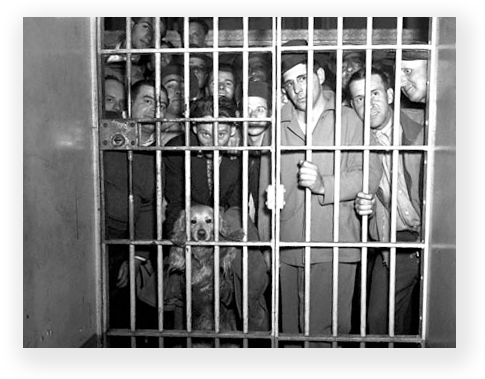
Bad news came out of Washington, D.C., for all of those people who believe that a third inmate sleeping on the floor in a two-man cell, a nonstop diet of rice and beans, and understaffed health services constitute reasonable and effective corrections policy: the Dept. of Justice directed the BOP to phase out all private prison contracts over the next five years.
In a memo to the Director of the BOP, Deputy Attorney General Sally Q. Yates wrote “I am directing that, as each contract reaches the end of its term, the Bureau should either decline to renew that contract or substantially reduce its scope in a manner consistent with law and the overall decline of the Bureau’s inmate population.”
Yates’ action comes on the heels of a DOJ Inspector General’s report issued last week, which looked at 14 contract prisons used by the BOP, and found that in a “majority of the categories… contract prisons incurred more safety and security incidents per capita than comparable BOP institutions… From FYs 2011 through 2014 in eight key categories: (1) contraband, (2) reports of incidents, (3) lockdowns, (4) inmate discipline, (5) telephone monitoring, sexual misconduct, the contract prisons had more incidents per capita than the BOP institutions… For example, the contract prisons confiscated eight times as many contraband cell phones annually on average as the BOP institutions. Contract prisons also had higher rates of assaults, both by inmates on other inmates and by inmates on staff.”
The inspector general’s report concluded that private prisons are dramatically less safe, less secure, and more costly than the BOP’s own prisons. The private facilities, Yates wrote in yesterday’s memo, “simply do not provide the same level of correctional services, programs, and resources” and “do not save substantially on costs.”
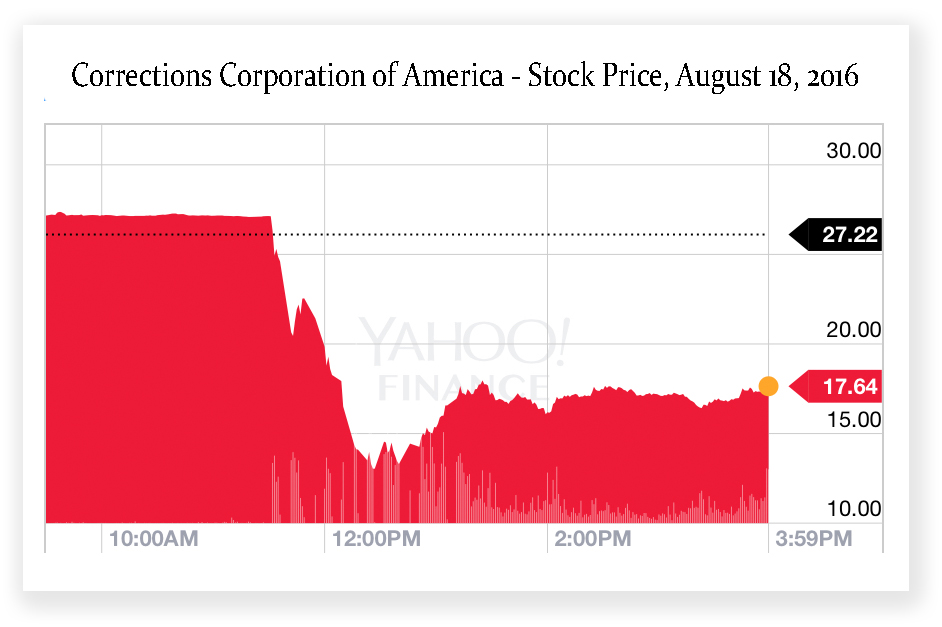
Corrections Corporation of America stock took a tumble yesterday.
Publicly traded prison stocks The GEO Group Inc. (NYSE:GEO) and Corrections Corporation of America (NYSE:CXW) were off around 40% yesterday afternoon after the DOJ announcement. GEO and CXW shares have climbed 65% and 40%, respectively, in the past several years, but they gave up much of that gain in the wake of the DOJ announcement.
Private prisons like GEO Group and CCA have long been criticized for inefficiency, deplorable conditions and, and in some cases, corruption. For example, a University of Wisconsin study examined Mississippi data showing state prison terms were being manipulated to bolster private prisons’ profits. Prisoners suffered longer sentences than their publicly imprisoned peers, and were more likely to return to jail. Other critics have accused private prisons of fostering higher recidivism rates. In fact, in the past, CCA has touted ‘high recidivism’ as a reason private prisons are a ‘unique investment opportunity.’”
The DOJ decision does not necessarily affect Geo Group’s and CCA’s state business, but the states (which account for about half of all private prison business) could follow the DOJ’s lead, especially if they fear that the DOJ report could provide a basis for prisoner lawsuits against them arising from private prisons’ failings. Likewise, the new DOJ policy does not affect private prison contracts with Immigration and Customs Enforcement to run immigrant detention centers or with the U.S. Marshals Service to jail detainees for short periods of time.
The BOP recently declined to renew a contract for approximately 1,200 beds. Yesterday, the BOP amended a current contract solicitation to reduce an upcoming solicitation from a max of 10,800 beds to a max of 3,600. Yesterday’s BOP memo asserted that “taken together, these actions will allow the Bureau to end the housing of inmates at three or more private contract facilities over the next year, and will reduce the total private prison population to less than 14,200 inmates by May 1, 2017 – a greater than 50 percent decrease since 2013.”
We’re still doing a weekly newsletter … we’re just posting pieces of it every day. The news is fresher this way …
MCINTOSH THROWS MARIJUANA PROSECUTIONS FOR A SPIN
Defendants who are facing or have faced marijuana charges in about two-thirds of the United States are paying close attention to this week’s decision in United States v. McIntosh, where the 9th Circuit issued an injunction prohibiting the Dept. of Justice from spending any federal funds to prosecute alleged federal drug law offenses relating to marijuana.
Ten defendants from California and Washington asked the Court to block DOJ prosecutions of 21 U.S.C. Sec. 841 offenses with which they were charged. Back in 2015, Congress – concerned that state efforts to permit the use of medical marijuana were being stymied by DOJ – added a rider to the Consolidated Appropriations Act.
Section 542 of the rider holds that
“None of the funds made available in this Act to the Department of Justice may be used, with respect to the States of Alabama, Alaska, Arizona, California, Colorado, Connecticut, Delaware, District of Columbia, Florida, Hawaii, Illinois, Iowa, Kentucky, Maine, Maryland, Massachusetts, Michigan, Minnesota, Mississippi, Missouri, Montana, Nevada, New Hampshire, New Jersey, New Mexico, Oregon, Rhode Island, South Carolina, Tennessee, Utah, Vermont, Washington, and Wisconsin, to prevent such States from implementing their own State laws that authorize the use, distribution, possession, or cultivation of medical marijuana.”
The defendants claimed that by prosecuting them for growing, possessing and distributing marijuana, the Feds were preventing California and Washington from implementing their medical marijuana programs. The 9th Circuit agreed, holding that “at a minimum, Sec. 542 prohibits DOJ from spending funds from relevant appropriations acts for the prosecution of individuals who engaged in conduct permitted by the State Medical Marijuana Laws and who fully complied with such laws.”
The Court warned that “DOJ does not prevent the implementation of rules authorizing conduct when it prosecutes individuals who engage in conduct unauthorized under state medical marijuana laws. Individuals who do not strictly comply with all state-law conditions regarding the use, distribution, possession, and cultivation of medical marijuana have engaged in conduct that is unauthorized, and prosecuting such individuals does not violate § 542.”
The Court thus sent the cases back to the district courts, where if “DOJ wishes to continue these prosecutions, Appellants are entitled to evidentiary hearings to determine whether their conduct was completely authorized by state law, by which we mean that they strictly complied with all relevant conditions imposed by state law on the use, distribution, possession, and cultivation of medical marijuana.”
What could make this decision nationally significant is the likelihood that it could apply as well to prosecutions in the 31-odd other states and territories listed in the rider, including appeals and collateral attacks.
We’re still doing a weekly newsletter … we’re just posting pieces of it every day. The news is fresher this way …
GOIN’ HOME
Terry Taylor was a felon in possession of a shotgun, ending up with a 300-month sentence. Luckily for Terry, Johnson v. United States invalidated the sentence, and he was resentenced last year to 176 months.
An improvement to be sure. The 54-year (and nearly blind) Terry had already served 160 months by the time he was resentenced, and he’s now in a halfway house with release set for December.
You’d be forgiven for thinking that this one’s over, but on Monday, the 7th Circuit weighed in on Terry’s side in a decision notable for its pro-inmate cant. It seems the new, lower sentence Judge Philip Reinhard imposed on Terry was still more than 100 months above his new Guidelines range. In fact, when Terry was resentenced, the Government and the Court’s own Probation Officer suggested he just be given time served and sent home.
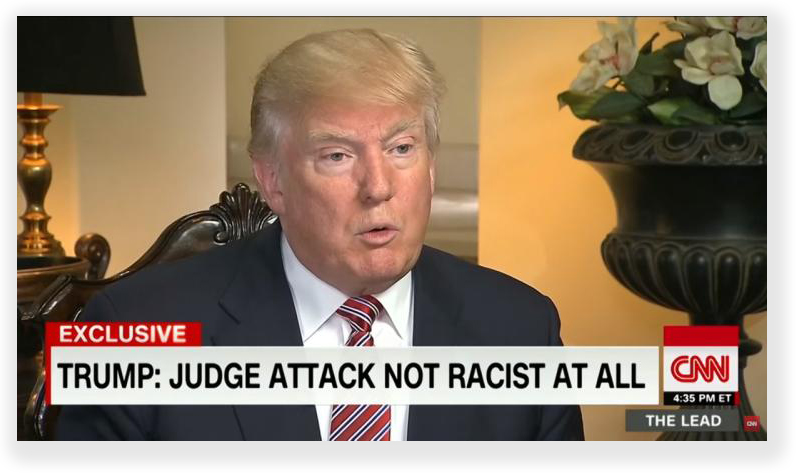
It hardly seems right – Trump slams a federal judge for bias, and he doesn’t get in trouble. Terry does the same, and gets a double sentence.
District Judge was unswayed. He held that the “gravity” of Terry’s criminal history before the gun conviction and the fact that while he was serving his sentence, had filed complaints and a lawsuit critical of judicial behavior (Terry supposed a conspiracy among judges and prosecutors). Judge Reinhard supposed that, if released right away, Terry might follow up his complaints with criminal harassment. Judge Reinhard thought these two grounds were predictive of the likelihood that upon release from prison, Terry would commit further crimes.
One of the judges Terry named as being part ofdrew Judge Posnas part of the panel hearing this sentence appeal. Unlike Judge Reinhard, Judge Posner has thick skin. Judge Posner complained that the District Court’s basis for the above-Guidelines were “flimsy grounds. Most of the defendant’s criminal history prior to the shotgun incident consisted of driving offenses,” Judge Posner wrote, “and he presumably can’t drive any longer because of his vision problem. As for pestering federal judges (including the author of this opinion!) with seemingly groundless complaints about how he’s been treated by the criminal justice system, he has a constitutional right to petition the government for redress of grievances, though if he becomes an utter nuisance his petitioning activity can be reined in. He has not threatened anybody with violence or other criminal harm, and the judge offered no adequate reason for inferring a risk of recidivism from the contents of his complaints.”
The 7th Circuit was clearly troubled that Terry had spent nearly 12 years in prison for a “crime that caused no harm (except perhaps to frighten the person at whom the defendant supposedly brandished his shotgun at the day before he was arrested)…” and “his decade-plus in prison should provide adequate deterrence to anyone thinking of emulating the defendant’s crimes.” The Circuit was apparently convinced that some of Judge Reinhard’s basis for continuing to hammer Terry with an above-Guidelines sentence was that he didn’t much like Terry’s pro se ravings. That was hardly justification, the appellate panel suggested, for Judge Reinhard to base his sentencing decisions on “sheer speculation.”
The Court said that time is of the essence, because Terry will be done in 4 months even with the old, discredited sentence. The Court of Appeals therefore issued the mandate “forthwith” and reminding Taylor’s lawyer he could ask for Judge Reinhard for bail. The reminder served notice on the District Judge, too, that he had better grant it.
We’re still doing a weekly newsletter … we’re just posting pieces of it every day. The news is fresher this way …
THE GUY’S GOT HIS NERVE
After serving six years as Attorney General of the United States, the first two of which was under a Congress where both houses were controlled by his own party, Eric Holder took a job this year with the Washington, D.C. law firm of Covington & Burling. From his $4 million a year perch on K Street (we don’t begrudge him a working wage, because everyone’s got hungry mouths to feed at home), he occasionally graces the op-ed pages of America’s press with opinion pieces about changes that should be made in the American justice system.
Last week, Holder wrote a column for The New York Times entitled “We Can Have Shorter Sentences and Less Crime.” In it, he complained that “financial cost of our current incarceration policy is straining government budgets; the human and community costs are incalculable. Today, a rare bipartisan consensus in favor of changing drug-sentencing laws presents an opportunity to improve the fairness and efficiency of America’s criminal justice system. But to build on this coalition for reform, which includes senior law enforcement officials, we need action in Congress.”
Predictably, Holder blamed “a small group of Republican congressmen using language dredged from the past” for sentencing reform having ground to a halt.
Holder complains that between December 2007 and September 2011, black male defendants received sentences 20 percent longer than their white counterparts. From 1983 to 1997, the number of African-Americans sent to prison for drug offenses went up more than 26-fold, compared with a sevenfold increase for whites. By the early 2000s, more than twice as many African-Americans as whites were in state prisons for drug offenses…”
Horrors. But, Mr. Holder, were you not the Attorney General from early 2009 until last year? Were you not U.S. Attorney for the District of Columbia from 1993 to 1997, and the Deputy Attorney General from 1997 through 2000? In fact, you sent your deputy, Lanny Breuer, to Capital Hill in April 2009 to tell the Senate Judiciary Committee that you wanted “sentencing laws that are tough, smart, fair, and perceived as such by the American public. We have already begun our own internal review of sentencing and the federal cocaine laws. Our goal is to ensure that our sentencing system is tough and predictable, but at the same time promotes public trust and confidence in the fairness of our criminal justice system.”
Congress responded with the Fair Sentencing Act in 2010, but nothing else, and the high level DOJ task force you promised a few months after you took office, which was to review sentencing laws, never went anywhere.
Ohio State law professor Doug Berman said the other day that he considers “former AG Eric Holder (and his boss President Obama) to be among those who really should bear much responsibility if federal policy-makers miss what Holder calls a “once in a generation” opportunity for federal sentencing reform.” Much of what Holder is complaining about was well known while his hands were on the helm.
“In other words,” Prof. Berman said in his blog, “both Prez Obama and AG Holder fiddled while the federal sentencing system was still burning with tough-on-crime, mandatory-minimum “over-reliance” from 2009 to 2013 during the entire first Obama Administration term. And, critically, we should not lose sight of the important reality that Prez Obama’s party controlled both houses of Congress until early 2011 and controlled the Senate until early 2015. Moreover, the enduring and continued (misguided) opposition of Prez Obama and the Justice Department to mens rea reforms supported by the GOP establishment has arguably been the most critical roadblock to getting sweeping reform legislation enacted even now.”
Had Holder really seen all of this to be the priority that he said it was in 2009 and suggests it is now that he is able to pontificate without the burden of actually doing anything about the problem, sentencing reform would have been achieved years ago.
We’re still doing a weekly newsletter … we’re just starting to post pieces of it every day. The news is fresher this way …
O DAY AND NIGHT, BUT THIS IS WONDROUS STRANGE
Like many drug defendants, Bob Miller got hammered with a 200-month plus sentence. Also like many defendants, he belatedly tried to help himself by providing information to the government. That netted him a 20% discount to about 168 months.
When Amendment 782 came along a few years later, Bob applied for a reduction to 134 months, the bottom of his new Guidelines. The Government, no longer his friend, argued against it, pointing out that witnesses said Bob had carried a gun during his drug dealing days, and that he had committed five disciplinary infractions while locked up, two for some hooch, one for possessing something that could have been used as a weapon, and one for destroying BOP property.
Bob pointed out that the Government knew all of that when it moved for his 20% reduction in sentence, but obviously didn’t think it was a problem then. But the judge was convinced to deny Bob’s Sec. 3582(c)(2) motion for sentence reduction, even while saying he was ignoring any evidence that Bob had carried a gun while dealing.
The judge was influenced to deny the reduction by Bob’s BOP disciplinary reports, which the judge called “relatively recent” and serious. The judge said Bob “remains a significant danger to the community.”
So far, this case is not strange at all. Sec. 3582 motions are filed all the time, more than a few are denied, and everyone knows the judge had nearly unfettered discretion. What’s more, everyone knows that when a judge says a defendant is eligible but should not get the sentence cut, that decision is virtually unreviewable by a court of appeals.
But suddenly, as Horatio would have said, something “wondrous strange” happened. Last week, the 7th Circuit reversed the district court’s denial, and sent Bob’s sentence reduction motion it back for more consideration. The appellate court criticized the trial court’s conclusion that Bob was a danger to the community. The issue, the Court of Appeals said, is not whether Bob is presently a danger, but rather “the real question is whether he is likely to remain a significant danger to the community when he is released, which won’t be for another five years or so even if he receives the further reduction that he’s asking for.” What’s more, the 7th said, the district court “did not explain why the two alcohol offenses were now to be counted against the grant of a sentence reduction when they had not been previously.”
Bob also complained that the district court did not consider his achievements in prison, including the courses he completed and his reduction in security and custody. The trial court didn’t consider Bob’s accomplishments, because Bob’s lawyer never told the judge about it. Bob dumped his lawyer on appeal, and filed the certificates as exhibits to his brief. Of course, the Court of Appeals said, litigants generally are not allowed to bypass the district court and present evidence for the first time to the court of appeals.” But curiously enough, the Court said it would make an exception here, because “apart from the fact that the government does not question the certificates’ authenticity and could not have objected to their admission in the district court had they been introduced there, the failure to submit them in that court was the fault not of the defendant but of his lawyer… We can’t begin to understand why… the lawyer didn’t use the documents to help support his client’s motion to reduce sentence. Had the lawyer followed his client’s instructions the district judge would have seen the certificates and the defendant’s case would have been strengthened. And before deciding that reducing the defendant’s sentence would pose a danger to society, the judge could have asked the government for a statement by the prison warden concerning the defendant’s current behavior in prison, an inquiry that would probably have yielded information about the defendant’s efforts to obtain a GED.”
This decision is indeed “wondrous strange.” First, appellate courts usually refuse to review denials of Sec. 3582 motions where the district refuses to exercise its discretion. Second, appellate courts hardly ever permit parties to add to the record on appeal. Third, appellate courts almost always say the actions of a lawyer bind the client.
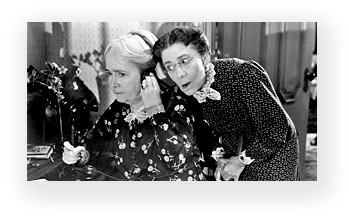
The district court had better read the tea leaves ….
Hamlet replied to Horatio, “And therefore as a stranger give it welcome. There are more things in heaven and earth, Horatio, Than are dreamt of in your philosophy.” The Miller decision is a genuine outlier in 3582 decisions. Some appellate courts will not even entertain an appeal like this one. The 7th Circuit not only heard the case, but essentially built its own record and substituted its own judgment for the district court. To be sure, it just send the case back for the district judge to do as he wishes, but anyone can read the tea leaves. Bob is to get a sentence cut.
It concluded that because it figured the district judge “might decide to grant the sentence reduction once he’s assured that the defendant has taken courses toward the GED, since the judge erred in describing the defendant’s disciplinary infractions as recent, and since he seems not to have considered whether the defendant is likely to remain a danger to the community when he is released from prison, years from now,” it would vacate the denial and send the case back to the trial court.
We’re still doing a weekly newsletter … we’re just starting to post pieces of it every day. The news is fresher this way …
BELLY-ACHING ABOUT CLEMENCY, SENTENCE REFORM
Congress is on vacation for all of August, meaning nothing is getting done in Washington on sentence reform, although the House of Representatives is set to take up the Sentence Reform and Corrections Act of 2015 next month.
That does not mean there isn’t plenty of griping. Last week, Sen. Jeffrey Sessions (R-Alabama) complained that “President Obama continues to abuse executive power in an unprecedented, reckless manner to systematically release high-level drug traffickers and firearms felons. These 214 individuals are not so-called ‘low-level, non-violent’ offenders – which simply do not exist in the federal system. They are serious criminals, including 56 with federal firearms convictions, several career offenders, fugitives, many who violated conditions of their release, and at least one who engaged in witness intimidation.”
According to the Pardon Power law blog, Congressman Bob Goodlatte (R-Virginia) last week whined “that Obama is using commutations ‘to benefit an entire class of offenders who were duly convicted in a court of law.’ Yes, most of the time (but not always) clemency is exercised on behalf of criminals, people who were convicted. If Goodlatte really counts that as “insight” re Obama’s commutations, he is a train wreck indeed. What he doesn’t mention is that those individuals were sentenced under guidelines rejected by both parties in both chambers of Congress as ineffective, if not out right unfair. What he doesn’t mention is the judges in those courts of law complaining about the ridiculous nature of those sentencing guidelines. What he doesn’t mention is the fact that the “entire class of offenders” to date means 562 of 12,000… who just so happened to have applied…”
Summer wine… not what we’re talking about here.
Meanwhile, the liberal website Salon gloomily predicted that “mass incarceration’s profile as a national issue appears to be on the wane. Throughout 2015, the nation’s over-reliance on imprisonment drew a constant spotlight, producing a plethora of bipartisan policy proposals and expressions of moral outrage in Beltway circles… At a moment of great congressional discord, people across the spectrum were finally agreeing on at least one thing: the United States was spending too much money on corrections and locking up too many people, especially black folks. Yet as the presidential campaign heated up, mass incarceration began to fade from the scene. The bully in the presidential campaign playground, Donald Trump, contributed immensely to the change in climate…”
Finally, the libertarian Cato Institute last week wrote about Weldon Angelos, released four decades early from a 55-year drug and gun sentence due not to commutation, but rather “through a negotiated motion by the government that, alas, cannot be replicated in other cases.”
The article said, “Sadly, legislative efforts at sentence reform appear to be mired in an intramural fight among Republicans, as well as hindered by Democratic intransigence toward another worthy reform… Until lawmakers can agree on a means to prevent draconian sentences, clemency will remain the only remedy for such miscarriages of justice. Unfortunately, the federal clemency system is also dysfunctional. Weldon’s petition for clemency was filed in November 2012 — and it then sat, unresolved one way or another, for three-and-a-half years… Even when the Obama administration launched the ‘Clemency Project 2014”’ and Weldon’s case was accepted into that program, he languished in prison as the petition slogged through the seven vertical levels of review any successful clemency case must navigate.”
We’re still doing a weekly newsletter … we’re just starting to post pieces of it every day. The news is fresher this way …
PINOCHIO WITH A BADGE
Marcos Reis-Campos, a member of the Norteño gang, was convicted of killing Luis Fuentes, head of the local MS-13 gang franchise. Marcos said he shot Luis because he felt threatened. At trial, the prosecutor depicted Luis as a house painter and family man, shot down in a senseless gang slaying.
But it turned out that Luis was not quite as pure as the prosecutor said he was. A local gang-specialist copy testified that he was aware of no gangland retaliation going on at the time Luis was shot. If there had been a gangland war going on, that fact would have supported Marcos’ argument that he had feared Luis was going to kill him. It turned out that the cop knew full well that Luis had ordered one of his underlings to kill a rival from another gang just a few weeks before Marcos blew him away, but testified falsely. What’s more, an FBI report established Luis was known for posing as a homeless person to murder opposing gang members. Had the defense possessed the report at trial, it could have used it to cross-examine government witnesses.
Marcos didn’t find out about the cop’s lie and the withheld reports until after he was convicted. He filed a habeas corpus claim, alleging the prosecutor withheld Brady material, evidence that was helpful to the defense that the prosecution should have turned over under Brady v. Maryland. He also raised a Napue claim, that the prosecutor knowingly introduced perjured testimony which went uncorrected, a constitutional violation under Napue v. Illinois.
Sadly for Marco, the state courts concluded that even if the jury had heard the Brady evidence, the evidence concerning Luis’s involvement in the other killing and the FBI report was not material to Marcos’ defense; and (2) his Napue claim failed because, assuming the police officer had committed perjury that the prosecutor knowingly left uncorrected, this too was not material to Marcos’ defense. Marcos appealed the state court denials to federal court under 28 U.S.C. § 2254, and earlier this week, the 9th Circuit reluctantly affirmed the state courts’ denial.
Obtaining federal relief for a state claim is considerably more difficult than winning a 2255 proceeding. It’s not enough for the state court to be wrong. It has to be unreasonable. Thus the 9th Circuit concluded that “the prosecutor’s withholding of information and Molina’s false testimony are very troubling. Yet “troubling”is not the relevant standard. It is materiality… that controls. Ultimately, these failures do not materially change the already negative and violent depiction of Luis Fuentes. It was not unreasonable for the state court to determine that nothing that the government suppressed or falsely proffered addressed the most fundamental question before the jury – whether Marcos Reis-Campos shot Luis Fuentes because he feared for his life on June 26, 2004.As such, though the prosecution’s tactics were suspect, the state court did not err under AEDPA in rejecting Reis-Campos’ claims.”
Thus, it’s not enough that a law enforcement agent lies on the stand. The lie has to alone be a misstatement or omission, had it not occurred, would have turned the case for the defendant. There are those who think the fact that a cop on the stand is lying to convict a defendant is ipso facto a material fact that the jury should know. The courts follow the doctrine of falsus in uno, falsus in omnibus, which is to say that if a witness lies about one thing, the jury is free to conclude that he or she is lying about everything. Given the special status of law enforcement, it seems not too much to ask to hold case agents to a standard of no lying, no way, no how.
Reis-Campos v. Biter, Case No. 5-15683 (9th Cir. August 10, 2016)
We’re still doing a weekly newsletter … we’re just starting to post pieces of it every day. The news is fresher this way …
CIRCUIT TAKES BACK JUDGE GLEESON’S GIFT
In his final days on the Eastern District of New York bench before joining a white-shoe Wall Street law firm, U.S. District Judge John Gleeson invented a blueprint for helping people convicted of federal crimes secure jobs. Yesterday, the 2nd Circuit undid his efforts.
Last March Judge Gleeson issued a “federal certificate of rehabilitation” to a nurse with a 13-year-old fraud conviction. The defendant – identified only as “Jane Doe” — had been shut out of nursing jobs because of her conviction for a car insurance scam. She served 15 months for it 12 years ago.
When we reported on this case a few months ago, we noted that the Justice Department was appealing the decision. In a decision handed down yesterday, the Circuit concluded that Gleeson’s court lacked jurisdiction to hear the expungement motion.
Still, the appellate court was sympathetic even while being rather chary. “The unfortunate consequences of Doe’s conviction compel us to offer a few additional observations,” the Court wrote. “First, our holding that the District Court had no authority to expunge the records of a valid conviction in this case says nothing about Congress’s ability to provide for jurisdiction in similar cases in the future. As described above, Congress has done so in other contexts. It might consider doing so again for certain offenders who, like Doe, want and deserve to have their criminal convictions expunged after a period of successful rehabilitation. Second, only a few months ago (while this appeal was pending), the Attorney General of the United States recognized and aptly described the unfortunate lifelong toll that these convictions often impose on low-level criminal offenders… “[T]oo often,” the Attorney General said, “the way that our society treats Americans who have come into contact with the criminal justice system… turns too many terms of incarceration into what is effectively a life sentence.”

 Jim Morrison and the Doors weren’t thinking about this kind of touching, but neither, it turns out, do federal statutes. Applying Johnson v. United States and Descamps v. United States to sex offenses, the 3rd Circuit ruled last week that a defendant was improperly sentenced under the Repeat and Dangerous Sex Offender guideline, USSG Sec. 4B1.5, because – applying Descamps‘ categorical approach – the Delaware statutes underlying his prior convictions were broader than federal law.
 Finally, at the time the defendant was convicted of Delaware 3rd-degree unlawful sexual contact, “the crime prohibited consensual contact the defendant none-theless knew was ‘offensive to the victim’.” Federal aggravated sexual abuse, by contrast, involves only nonconsensual sexual acts.