We’re still doing a weekly newsletter… we’re just posting pieces of it every day. The news is fresher this way…
BUT HE WAS HIGHLY SKILLED
Chapter 3 enhancements to the United States Sentencing Guidelines provide any number of opportunities for judicial mischief. The defendant’s base offense level can be increased by having a managerial role in the offense, for obstructing justice, using a minor in an offense, reckless endangerment during flight, vulnerable victim… There’s quite a list of enhancements, and about the only commonality among them is that trying to define what conduct should qualify a defendant for the enhancement is akin to nailing Jello onto the wall.
Jello can be nailed to the wall… but it’s not easy.
Guideline 3B1.3, for example, provides that “[i]f the defendant abused a position of public or private trust, or used a special skill, in a manner that significantly facilitated the commission or concealment of the offense, increase by 2 levels.” And what might a “special skill” be? The Application Notes for Sec. 3B1.3 say that “a ‘special skill’ refers to a skill not possessed by members of the general public and usually requiring substantial education, training or licensing. Examples would include pilots, lawyers, doctors, accountants, chemists, and demolition experts.”
Tell that to Jose Villafranca. He got caught in Texas driving a truckload of illegal aliens, an offense for which he got a 57-month sentence. The district court slapped him with a 2-level enhancement – raising his sentencing range by about a year – for his “special skill” of holding a commercial driver’s license.
Last week, the 5th Circuit agreed with the upward adjustment, holding that the “ability to drive a tractor trailer truck as evidenced by the possession of a commercial driver’s license constitutes a special skill for purposes of Sec.3B1.3.” Relying on a prior, unreported case, the court of appeals observed that Jose “had 15 years of commercial truck-driving experience, acted as a licensed truck driver purporting to carry a legitimate load through a checkpoint on one of the nation’s busiest corridors where there are thousands of other tractor-trailers.” The Court argued that “without those special skills, he would have been unable to tow the tractors in which the aliens were hidden… by carrying the aliens in the truck’s trailer, the defendant gave the appearance that he was hauling a legitimate load and made it much more difficult to identify the aliens.”
Of course, the same can be said of a person holding a plain vanilla driver’s license. Knowing how to drive a car with a couple of aliens in the trunk would be similarly skillful. There are about 3.5 million licensed truck drivers in America. Indeed, it is not necessary to hold the license to be knowhow to drive an 18-wheeler. (We confess that years ago, we began driving a tractor-trailer for a produce farm with 10 minutes of on-the-road training).
We’re not denying that there are many very skilled, very experienced truck drivers on the roads. Rather, we’re arguing that the test is whether skill that required much training and education contributed substantially to committing the crime. To make the point, we’d note that had Al Qaeda used air transport pilots on 9/11, those skills would been used to turn the aircraft into the flying bombs they became. But using a few mutts who had never soloed an airplane – let alone held a pilot’s license – was enough to carry out the attack. Likewise in this case, anyone with an hour’s training could have driven a tractor-trailer through a customs station.
This decision makes a mockery of the Application Note, unless “truck driver” is a logical progression of the subset “pilots, lawyers, doctors, accountants, chemists, and demolition experts.” If the trial judge feels the need to vary above the Guidelines range for some reason, he or she should simply do so, rather than reducing Chapter 3 of the Guidelines to an absurdity with bogus enhancements.
Let’s not pull any punches. Jabar Gilliam is a scumbag. Having taken on a troubled 16-year old named Jasmin as his “girlfriend,” he took her from Baltimore to New York so she could turn tricks for him. He beat her up. He raped her. He threatened to turn her younger sister into a prostitute if Jasmin refused to let him pimp her.
‘The fact that Jasmin has a foster mother and a social worker assigned to her suggests that her life hadn’t been roses before Jabar got his hands on her. Yet someone cared enough that, when Jabar spirited her off to the Big Apple, her disappearance was immediately reported to the police. The locals got the Maryland State Police involved right away. Jasmin has told her foster mother about her new boyfriend Jabar, and it didn’t take the police long to figure out it was Mr. Gilliam.
An MSP investigator was on the case within three days of Jasmin’s disappearance. After talking to Jasmin’s biological mother – whom Jabar had apparently told he intended to pimp her daughter – the investigator contacted Sprint. He told the cellphone provider he was “investigating a missing child who is . . . being prostituted,” and requested GPS location information for Jabar’s cell phone. He said that he was making the request because of “an exigent situation involving … immediate danger of death or serious bodily injury to a person.” Sprint promptly complied, and began feeding Jabar’s real-time GPS location information to the MSP investigator, who passed the information on to the FBI and NYPD.
The same day, Jasmin called her biological mother from the Bronx apartment of Gilliam’s mother. Sprint’s location information placed Jabar’s cellphone nearby. Canvassing the neighborhood, two New York cops saw Jabar and Jasmin on the street and followed them to an apartment building. When one of them confronted Jabar, he tried to run. The decision dryly reports “a scuffle ensued, after which Gilliam was arrested.” We can only hope they displayed the same restraint for which the NYPD is well known.
Jabar was convicted of sex trafficking of a minor by force, fraud, or coercion in violation of 18 U.S.C. 1591(a), (b)(1), and (b)(2), and of transporting a minor in interstate commerce for prostitution in violation of 18 U.S.C. 2423(a). He got 20 years. At trial, he challenging the use of GPS location information to find and arrest him. The district court ruled that the Stored Communications Act, 18 U.S.C. §2702(c)(4), authorized, and under the 4th Amendment, exigent circumstances permitted the MSP to obtain location information from Sprint without a warrant.
Yesterday, the 2nd Circuit upheld the conviction. Considering the alternative – letting Jabar walk out of prison a free pimp – the outcome was probably preordained. Yet in doing so, the Court has sanctioned the incremental creep of government intrusion into individual privacy.
The Stored Communications Act says that a provider like Sprint “may divulge a record or other information pertaining to a subscriber . . . to a governmental entity, if the provider, in good faith, believes that an emergency involving danger of death or serious physical injury to any person requires disclosure without delay of information relating to the emergency.” The disclosure may not include the contents of the communications, but the Court had no trouble concluding that “other information” included GPS data.
The Court’s understandable concern for Jasmin’s well-being led it to easily conclude that the situation involved “an emergency involving danger of . . . serious physical injury.” The Court said “we think it obvious that “involving” includes a realistic threat of such injury, not just a completed injury.” To the MSP officer, the Circuit ruled, “the evidence available… at the time of the search for Gilliam’s location was compelling. Based on discussions with Jasmin’s foster mother, social worker, and biological mother, law enforcement officers had a substantial basis to believe that Gilliam was bringing Jasmin to New York City to require her to work there as a prostitute. That type of sexual exploitation of a minor has often been found to pose a significant risk of serious bodily injury. As the 9th Circuit has observed, prostitution of a child involves the risk of assault or physical abuse by the pimp’s customers or by the pimp himself.”
The 2nd admitted that while “several courts have found that exigent circumstances justified warrantless entry into premises to avoid risk of injury to a minor held there… Locating on the streets a victim of sexual exploitation might seem to present a less immediate need for police action than entering premises where such a victim is being held, but it is nonetheless sufficient to constitute exigent circumstances.” The Circuit ruled that the existence of “exigent circumstances” satisfied both the Stored Communications Act and the 4th Amendment.
There’s nothing quite as odious to polite society as prostitution. Recent blending of the scourge of human trafficking with long-standing societal abhorrence of the sex trade has made it all the worse. Here, the evidence is that Jasmin told Jabar when she met him that she was 17 years old and currently whoring for another pimp. No question she was a victim – indeed an underage victim – but she was certainly not innocent in the nonlegal sense. And of course, it turned out Jabar had hit her and that she was not a willing participant in his pimp practice.
But the expansive application of the exigent circumstances doctrine in this case – easy to do because of the appalling nature of the offense – is troubling. Based on a reasonable belief that someone was engaging in an offense that could lead to other offenses – physical abuse, for example – the police were able to access real-time location information and track a suspect until they caught him.
… except when it’s not.
The appellate panel said that Congress has deemed it reasonable to subordinate any individual privacy interest in cell phone location information to society’s more compelling interest in preventing an imminent threat of death or serious bodily injury, and has therefore given service providers the authority to decide whether there existed an emergency involving danger of death or serious physical injury to any person.” But this was danger by statistic or anecdote. There are thousands of people in America plying the sex trade, and what made this case a federal crime was that the victim was a little more than a year from the age of majority. The danger to her at age 16+ was not statistically greater than the danger to her at age 18, at which time Jabar’s disgusting conduct would no longer be a crime. As the opioid crisis illustrates, illegal drugs pose a risk of physical injury and death. Would this be enough to justify warrantless real-time location monitoring of suspect drug traffickers?
We’re still doing a weekly newsletter… we’re just posting pieces of it every day. The news is fresher this way…
JUST FOLLOW THE (NEW) RULES
Some changes in the Federal Rules, going into effect today, have gotten a fair amount of press. Others, as is usually the case with modifications to procedural rules, have been all but ignored.
The modification to Rule 41 – which governs warrants for search and seizure procedures – gives judges the power to issue warrants allowing for remote access, search, seizure, or copying of electronic data when the location of the data has “been concealed through technological means” or when the information is located on protected devices and have been “damaged without authorization and are located in five or more districts.”
Privacy organizations such as the Electronic Frontier Foundation (EFF) and Access Now have argued the modified rule presents a threat to just about any computer user, even one using privacy tools like Virtual Private Networks (VPNs) or the Tor browser, which conceal a user’s location and online activities.
In a blog post, EFF’s activism director Rainey Reitman argued
there are countless reasons people may want to use technology to shield their privacy. From journalists communicating with sources to victims of domestic violence seeking information on legal services, people worldwide depend on privacy tools for both safety and security. Millions of people who have nothing in particular to hide may also choose to use privacy tools just because they’re concerned about government surveillance of the Internet, or because they don’t like leaving a data trail around haphazardly. If this rule change is not stopped, anyone who is using any technological means to safeguard their location privacy could find themselves suddenly in the jurisdiction of a prosecutor-friendly or technically-naïve judge, anywhere in the country.”
The rule also has implications for users who are compromised by malicious software and are victimized by someone else’s activity.
But there are less controversial rules changes, too. The Federal Rules of Appellate Procedures seek to put the “brief” back in “brief,” cutting the number of words allowed in an appellant’s brief from 14,000 to 13,000. The length of opposition and reply briefs change as well, and – for the first time – a word limit is placed on petitions for rehearing.
Back in the days of horse and buggy, whenever a lawyer had to respond to a pleading filed by another lawyer, he or she could add three days to the time allowed to respond if the pleading had been delivered by mail. The federal courts have shifted completely to service of pleadings by email – the courts’ electronic case filing (ECF) system. However, the Federal Rules of Civil Procedure still provided for the additional three days when the pleading was delivered by ECF.
The Rules Committee Comments has now concluded that the three-day additional time is no longer necessary. The Committee comments that “Rule 5(b)(2) was amended in 2001 to provide for service by electronic means. Although electronic transmission seemed virtually instantaneous even then, electronic service was included in the modes of service that allow 3 added days to act after being served. There were concerns that the transmission might be delayed for some time, and particular concerns that incompatible systems might make it difficult or impossible to open attachments. Those concerns have been substantially alleviated by advances in technology and in widespread skill in using electronic transmission.”
Thus, the 3-day time dodge, enjoyed by procrastinating lawyers everywhere, has now been written out of the Rules of Civil Procedure.
This elimination of the three-day extension for ECF service makes sense. Deadlines should be simple to calculate.
Of interest to pro se prison litigants, the Federal Rules of Appellate Procedure have now made use of the prison legal mail system mandatory. Under the prison “mailbox rule,” the Supreme Court held in Houston v. Lack, a prisoner is deemed to have filed a pleading the moment he or she places it in the prison’s mailbox. Most prisons operate a “legal mail” system, where inmates deliver mail to the courts to an officer, who stamps the envelope with the date of delivery and logs it in a permanent record.
Changes in the Federal Rules of Appellate Procedure now mandate that a prisoner seeking to take advantage of the prison “mailbox rule” must use the institution’s legal mail system (if there is one), and must accompany the filing with “a declaration in compliance with 28 U.S.C. Sec. 1746—or a notarized statement—setting out the date of deposit and stating that first-class postage is being prepaid; or evidence (such as a postmark or date stamp) showing that the [filing] was so deposited and that postage was prepaid.” A prisoner may file the declaration later, with the Court’s permission, but who wants to gamble on getting that OK’d?
The new mandatory use of legal mail and the declaration applies to all filings a prisoner makes in the Court of Appeals starting on December 1.
We’re still doing a weekly newsletter… we’re just posting pieces of it every day. The news is fresher this way…
SUPREME COURT COOL TO ORAL ARGUMENT IN BECKLES
A largely skeptical Supreme Court heard oral argument in Beckles v. United States on Monday. Beckles considers whether Johnson v. United States applies to the “career offender” sentencing guidelines in Chapter 4B, leaving observers with the impression that the Court might find a little vagueness in the United States Sentencing Guidelines to be expected, and not unconstitutionally bad.
Justice Kagan recused herself, so the case was heard by only seven judges, Justice Scalia’s seat still being vacant.
Johnson v. United States, decided in June 2015, held that the residual clause in the definition of “crime of violence” in the Armed Career Criminal Act, 18 U.S.C. 924(e), was unconstitutionally vague. Similar language is found a number of other places in the statutes and the Sentencing Guidelines. In one case, the question of whether Johnson applies to the definition of “crime of violence” in 18 U.S.C. 16(b), will be argued in the Supreme Court in Lynch v. Dimaya, which was accepted for Supreme Court review at the end of last September.
In Beckles, the Government changed its position after the 11th Circuit appeal that resulted in this case, leaving the Supreme Court to appoint a lawyer to defend the Circuit’s ruling. The Department of Justice’s position before the Supreme Court was a strange amalgam: while conceding that the career offender Guidelines are unconstitutionally vague under Johnson, the Government argued against making such a ruling retroactive. It said that if the court were to rule that Johnson applies retroactively to Guidelines career offender sentences, there would be “unwarranted costs on the public to the extent that it releases dangerous recidivists into communities.”
Inconsistency is rarely a good thing.
Part of the complexity of the argument resulted from the Government taking what Justice Kennedy criticized as an inconsistent position. The Government argued that the advisory Guidelines are subject to vagueness challenges because of the important role that they continue to play in the post-Booker world. But on the other hand, the Government’s contention that the advisory status of the Guidelines should prevent the Court from making any vagueness ruling retroactive. It unconvincingly relied on a distinction between “likelihood of a sentence” and “eligibility for a sentence” as the reason for the different positions on the vagueness question and the retroactivity question.
The court-appointed attorney defending the 11th Circuit decision argued that Travis Beckles’ position would call other Guidelines sentencing enhancements — such as the abuse of trust under U.S.S.G. Sec. 3B1.3 — into question. He suggested that the core principles of sentencing, such as adequate deterrence, are “even more vague” than the career offender residual clause.
Justice Alito picked up on that point, observing that the sentencing guidelines are replete with what could be called vague phrases. “I mean, I just opened them at random,” Justice Alito said. “I can see provisions that would generate a — you know, an arguable vagueness challenge if they were in a criminal statute.”
Could sentencing guidelines also be deliciously ambiguous? Some Justices may think so…
Beckles shows just how complicated the Court’s middle path on sentencing has become. The Court is struggling to regulate an advisory system in light of the fact that the purely discretionary system that came before the Guidelines was essentially unregulated. Travis Beckles’ attorney spent much of her argument fending off questions by four Justices – Alito, Breyer, Kennedy, and Chief Justice Roberts – about how a Guideline could be unconstitutionally vague when the purely discretionary system used by federal courts before the Guidelines were adopted was constitutionally permissible.
Later questions by Justice Breyer and the Chief Justice appeared to accept that a purely discretionary system might be subject to different rules than an advisory system. “It would seem to me that even the vaguest guideline would be an improvement and so difficult to argue that it’s too vague to be applied,” Roberts observed at one point.
Under sympathetic questioning from Justice Sotomayor, Beckles’ attorney rejected predictions that retroactivity would cause chaos in the courts. She noted that the 9th Circuit already allows defendants to challenge sentencing guidelines on vagueness, and that those challenges have not caused any land rush on the courts.
Other unusual aspects of the Court’s post-Booker law were also on display. Chief Justice Roberts and Justice Alito both asked whether the Court’s recent decisions about the quasi-legal status of the advisory Guidelines in Peugh v. United States (2013) and Molina-Martinez v. United States (2016) should endure in the face of changing sentencing patterns in the district courts. Justice Breyer, who has a history with the Sentencing Commission, raised the possibility that the courts should be more indulgent of vague sentencing guidelines than vague statutes because the Commission is in a better position than Congress to refine the law.
Justice Ginsburg suggested that the case could be decided without reaching the questions vagueness or retroactivity, but the Government urged the Court not to do that, noting that many cases pending in the lower courts raise the vagueness and the retroactivity.
One law professor said “it is hard to read the transcript of the Beckles argument and think that the defendant is likely to prevail. Only Justice Sotomayor seemed to be asking friendly questions of petitioner’s counsel, and only she seemed to resist the Government’s likelihood/eligibility argument.”
If the Supreme Court acts as it has in the past, a decision will issue in Beckles anytime from February to April.
We’re still doing a weekly newsletter… we’re just posting pieces of it every day. The news is fresher this way…
THE SNITCH IN YOUR POCKET
Everyone knows that one of the government’s canniest bloodhounds can be found in your back pocket. By using cell tower data – even if your cellphone is not spewing GPS information – Uncle Sam can track you down within a hundred yards, and not even break a sweat. Sure, the Galaxy Note 7 can catch your pants on fire. But it can bring the heat in more ways than just that.
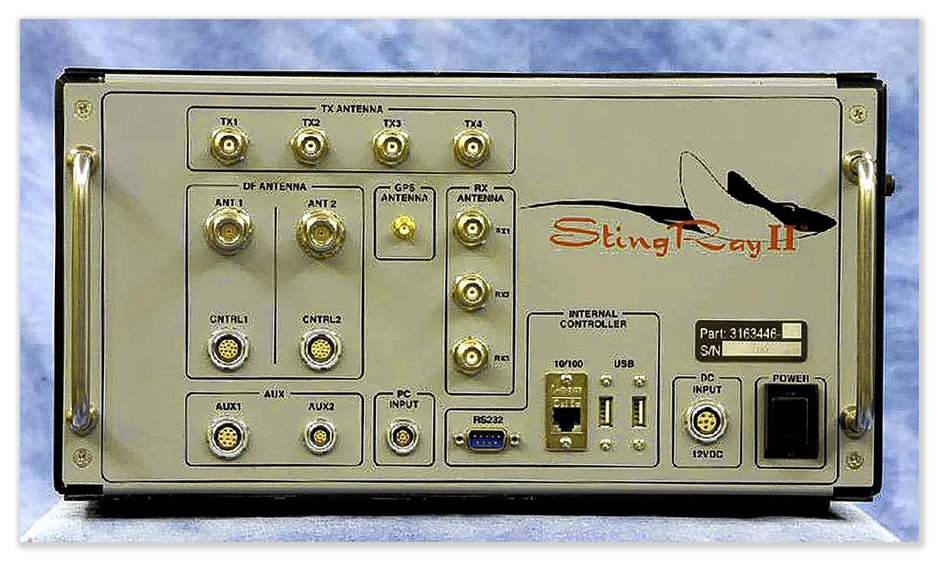
But sometimes, even more precision is needed than mere triangulation. That’s where the Stingray comes in. A Stingray, also known as a cell site simulator, determines a phone’s location by spoofing a cell tower, and thus tricking a cellphone into sending it a stream of data. Stingrays are electronic vacuum cleaners, sucking up not just transmissions that were spoofed from a target’s phone, but information from all other cellphones in the vicinity.
Naturally, a gizmo like the Stingray is all but irresistible to a whole alphabet soupbowl of federal and state agencies. Because irritating defense attorneys would only file a lot of foolish motions about privacy and the 4th Amendment and such, the agencies have run a concerted maskirovka over the last six years or so to hide the fact that they were spoofing cell service in order to catch people.
In recent years, the use of Stingrays and similar devices has come under increased scrutiny. Last year, the Department of Homeland Security and the Department of Justice both said they were adopting new policies that required a warrant for use of the spoofers.
The Harris Corp. Stingray II – craft little device, indeed.
Last week, a divided 7th Circuit panel held that use of Stingray to catch a parole violator – an arrest that resulted in agents finding a gun and convicting the defendant of felon-in-possession – did not require a warrant. The decision marks the first time that questions regarding the proper use of Stingrays, also known as cell-site simulators, have reached the federal appellate level.
Damian Patrick had an outstanding warrant for a probation violation and was found via the use of a stingray in Milwaukee in 2013. The Milwaukee police got a search warrant authorizing them to locate Damian using cellphone data. His phone ratted him out, which enabled the police to find him. When they arrested him, he was packing heat.
Damian challenged the search and seizure of the gun, without which there would not have been a felon-in-possession conviction. He argued thathis person was not contraband or the proceeds of a crime, and that it therefore was off limits to investigation.
As we reported last July, a Southern District of New York trial judge ruled in United States v. Lambis, Case No. 15cr734 (S.D.N.Y. July 12, 2016), that use of a Stingray requires a warrant. But the 7th US Circuit Court of Appeals decided last Wednesday that the fact that law enforcement used the Stingray against Patrick is immaterial. The Court said that
a person wanted on probable cause (and an arrest warrant) who is taken into custody in a public place, where he had no legitimate expectation of privacy, cannot complain about how the police learned his location… From his perspective, it is all the same whether a paid informant, a jilted lover, police with binoculars, a bartender, a member of a rival gang, a spy trailing his car after it left his driveway, the phone company’s cell towers, or a device pretending to be a cell tower, provided location information. A fugitive cannot be picky about how he is run to ground. So it would be inappropriate to use the exclusionary rule, even if the police should have told the judge that they planned to use a cell-site simulator to execute the location warrant.
In a lengthy dissent, 7th Circuit Chief Judge Diane Wood blasted the secrecy with which law enforcement cloaks the Stingray. She complained that “we know very little about the device, thanks mostly to the government’s refusal to divulge any information about it. Until recently, the government has gone so far as to dismiss cases and withdraw evidence rather than reveal that the technology was used.”
Judge Wood wrote that “it is time for the Stingray to come out of the shadows, so that its use can be subject to the same kind of scrutiny as other mechanisms, such as thermal imaging devices, GPS trackers, pen registers, beepers, and the like. Its capabilities go far beyond any of those, and cases such as Riley indicate that the Supreme Court might take a dim view of indiscriminate use of something that can read texts and emails, listen to conversations, and perhaps intercept other application data housed not just on the target’s phone, but also on those of countless innocent third parties.”
The importance of the issue and the 2-1 decision with a stinging dissent suggests that the odds might be better than average that the Circuit would take up the issue en banc.
We’re still doing a weekly newsletter… we’re just posting pieces of it every day. The news is fresher this way…
READING TEA LEAVES ON TRUMP AND SENTENCE REFORM
President-elect Trump will take office in 52 days, and justice-reform groups across the political spectrum are scrambling to find a path forward.
Both chambers of the Republican-controlled Congress pushed alternate versions of the Sentencing Reform and Corrections Actof 2015, seeking reforms that would have reduced recidivism and save money. President Obama fully supported the effort.
However, the clock’s run out on the 114th Congress, and the SRCA is dead on arrival. Now, sentence reform advocates are searching for hints on Mr. Trump’s positions.
Many see the selection of Sen. Jeffrey Sessions (R-Alabama) for attorney general as a bad sign. Sessions has been one of SRCA’s staunchest opponents, arguing it “would release thousands of violent felons and endanger millions of Americans whose safety is increasingly threatened by rising crime rates.”
In 2010, Sessions co-sponsored the Fair Sentencing Act, which increased the quantity of crack cocaine needed to trigger a mandatory minimum punishment and aimed to reduce the disparate penalties for crack and powder cocaine. And Trump’s running mate, Indiana Gov. Mike Pence, said at the vice presidential debate that “we need criminal justice reform.”
At other moments, though, Sessions has struck a different tone. During hearings this year, he said “good people don’t smoke marijuana” and criticized DOJ policies that he sets the standard to prosecute drug cases too high.
Trump rarely talked about criminal-justice policies on the campaign trail. Some and some activists are hoping he will see the issue as a way to connect with the rising number of Americans whose friends and family members have served time behind bars. Justice Department data shows that the number of people incarcerated in the U.S. more than quadrupled from 1980 to 2.2 million as of 2014.
Sen. John Cornyn (R-Texas) said last week that Trump’s transition team has not specifically commented on the bill – signaling possible friction between those in Congress who support the effort and those on Trump’s team.
“Obviously the president is going to be an important partner in this effort and I think that there are elements of the legislation that they regard more favorably than others,” Cornyn told reporters. “My sense is that they don’t like the sentencing-reform stuff but the prison reform, which is successful in states like Texas, that seems to have bipartisan support. But we’re just going to have to have that conversation and find out what it would look like.”
Other sentence reformers aren’t giving up. “People say a President Trump would be disastrous for criminal justice reform, but I think that’s completely ridiculous,” said Holly Harris, executive director of the U.S. Justice Action Network.
Harris acknowledged that Trump’s selection of Sessions to head DOJ could set the movement back, but she said having him out of the Senate would at least mean he no longer could directly impede an overhaul bill. She said that others close to Trump, such as Vice President-elect Mike Pence and former House Speaker Newt Gingrich, support changes to criminal-justice laws.
Likewise, Timothy Head, executive director of the Faith & Freedom Coalition, remains optimistic about the sentence reform prospect. Head said Trump may want to use criminal-justice issues to reach out to minority communities, following the example of some Republican governors.
Head expects Trump to be less interested in relatively contentious changes like reducing prison sentences and more attracted to causes that conservatives back, such as helping former prisoners re-enter society and combatting “overcriminalization.” While many overhaul proponents on both sides of the aisle agree there are too many federal crimes on the books, Republican lawmakers want to require criminal intent for more prosecutions. Democrats resist that because they say it could let corporate criminals off the hook.
We’re still doing a weekly newsletter… we’re just posting pieces of it every day. The news is fresher this way…
YOUR MOTION IS PREMATURE, AND THUS DENIED
Everyone knows that 18 U.S.C. 922(g) makes it illegal for a felon to possess a firearm. What is less known is that the statute has a whole laundry list of people besides felons who cannot possess a gun or ammo. For example, subsection (3) prohibits someone “who is an unlawful user of or addicted to any controlled substance” from packing heat.
Why would think he was a meth user?
When an Iowa probation officer stopped by Kyle Turner’s place, Kyle – who was on state probation for something (we don’t know what) – admitted he had a shotgun in his bedroom. Kyle also dropped some urine that tested positive for methamphetamine.
The Feds indicted Kyle for possession of a firearm by an “unlawful user of metham-phetamine.” Kyle filed a motion to dismiss on the grounds that 922(g)(3) was unconstitutionally vague as applied to his conduct, because his indictment failed to allege that he “engaged in regular use of methamphetamine.”
The government responded that the motion to dismiss was premature, because its evidence that would answer Kyle’s claim would be presented at trial. The district court denied Kyle’s motion. After that, Kyle pled guilty while reserving his right to appeal the denial.
Last Tuesday, the 8th Circuit reversed, and sent the case back to the trial court. Federal Rule of Criminal Procedure 12(b)(1) lets parties “raise by pretrial motion any defense, objection, or request that the court can determine without a trial on the merits.” A pretrial motion can be decided if trial of the facts surrounding the commission of the alleged offense would be of no assistance in determining the validity of the motion. The Rule says a district court must rule on such a motion before trial unless there is “good cause to defer a ruling” and deferral will not “adversely affect a party’s right to appeal.”
Here, the Circuit said, a trial on the merits was needed to decide Kyle’s pretrial motion to dismiss. Trial courts may consider evidence beyond the pleadings to make factual findings in pretrial orders, but they may not make factual findings when an issue is “inevitably bound up with evidence about the alleged offense itself.” The relevant question is not what evidence the court relied upon in its ruling, but rather what type of factual finding it made.
The 8th said that the statute’s language, “unlawful user of… any controlled substance… runs the risk of being unconstitutionally vague without a judicially-created temporal nexus between the gun possession and regular drug use.” Therefore, to rule on Kyle’s constitutional challenge, the district court had to determine whether he had engaged in regular drug use at the time he possessed the firearm. The appeals court said the “facts surrounding the commission of the alleged offense would assist with that determination, and the contested defense therefore could not be ruled upon without a trial on the merits.”
So the fact the government didn’t find it convenient to put its evidence on to oppose Kyle’s motion does not mean the motion should be denied.
We’re still doing a weekly newsletter… we’re just posting pieces of it every day. The news is fresher this way…
HE’S HIS OWN MAN
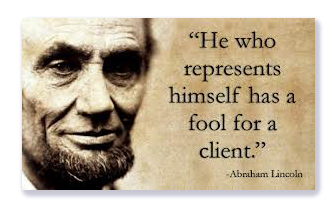
There are plenty of whacko legal theories advanced by inmates representing themselves in criminal or post-conviction proceedings, but it’s good every now and then to be reminded that the Clown Prince of these crazy get-out-of-jail-free cards continues to be the Sovereign Citizen.
Think about a law you don’t like. Any law, at any level of government. It can be a big law, like the Controlled Substances Act or income tax laws. It could be minor, like licensing your dog with the county or separating your recyclables from the general trash.
If you’re a member of the sovereign citizen movement, Forbes magazine described how you approach the problem:
You start by looking for a combination of quotes, definitions, court cases, the Bible, Internet websites, and so on that justify how you can ignore the disliked law without any legal consequences. Be imaginative. Pull a line from the 1215 version of the Magna Carta, a definition from a 1913 legal dictionary, a quote from a founding father or two, and put it in the blender with some official-sounding Supreme Court case excerpts you found on like-minded websites. Better yet, find someone else online who disliked that same law and pay them $150 for a three-ring binder filled with their word salad research.
Et voilà, not only have you proven that you don’t have to obey the law you dislike, heck, it’s your patriotic duty to disobey it, and anyone who tells you otherwise is just plain un-American and is probably part of a world-wide Jewish conspiracy to ensure that Chihuahuas are slaves to the US government.
The Sovereign citizen movement has its adherents within the federal prison system, and the most puzzling aspect of this is that – while claiming sovereignty only makes things harder for the defendant and inevitable inmate – none of them ever seems to figure that out that being a Sovereign citizen is a dead-bang loser of a proposition.
This is the real Daffy Duck. He has no connection to Jermaine’s offense.
We were reminded of how the sovereign movement is at once bafflingly foolish and uniquely futile in a 6th Circuit decision earlier this week on a defendant’s right to self-representation. Jermaine Pryor (also known as “Daffy Duck,” and we’re not making that up) ran a heroin operation. He figured it was pretty slick: people would call a cellphone and ask for “Daffy Duck.” After placing their order, Daffy would tell them when and where to show up for the dope. When he was pulled over for the usual pretext traffic stop and arrested, one of the agents called the “Daffy Duck” phone number, and Jermaine’s cellphone rang. Oops.
When he appeared before a magistrate judge, Jermaine appeared to object to the jurisdiction of the court, announcing that he had “no contracts with the United States corporation or anybody in this courtroom,” and repeatedly ignored the magistrate judge’s requests to be quiet. The court brought him back the next day to complete his initial appearance, and appointed an attorney as his stand-by counsel. Jermaine complained he was “never going to consult with” the attorney, and argued that he was “not a part of your society. . . . I am a moor, and your laws don’t apply to me.” The magistrate judge asked Jermaine if he consented to the appointment, and Jermaine answered “No. I don’t have—no, I don’t consent to anything.” When asked if he intended to hire his own attorney, Pryor indicated that he would not: “Why would I — I am not a minor and no one . . . will be talking for me.”
This guy is a Moor. Like Daffy, he has no connection to Jermaine’s offense.
Next thing Jermaine knew, he was committed for a psych evaluation to see whether he was competent to stand trial. He was competent, just stupid. When he appeared again, the judge directly asked him, “do you wish to represent yourself or do you wish to have counsel represent you?” Jermaine answered “I will be myself” and again challenged the court’s jurisdiction. The court repeated the question, and Pryor asked if the judge was offering him a contract (one of the tenets of the sovereign movement is that if you enters into a contract with the feds, the federal courts gain jurisdiction over you). Jermaine even objected to the court calling him “Mr. Pryor.” The court continued the lawyer as Jermaine’s backup counsel, to which Jermaine immediately and repeatedly objected.
Jermaine figured that if he had a lawyer, then he was consenting to the court’s jurisdiction over him. The notion is loony, but the defendant clung to it like it was his momma.
Jermaine continued to pepper the court with gibberish. On March 19, he submitted an “Affidavit of truth” to the court, disclaiming the court’s jurisdiction, announcing that he had no contracts with any corporation or the United States of America, and stating his standby lawyer “will not represent me.” He later filed affidavits continuing to assert his desire to appear in propria persona and contesting the court’s jurisdiction. The court finally entered an order automatically rejecting any Jermaine letters, which did not squelch the letter-writing campaign in the least.
To no one’s surprise, he was convicted of the drug offense.
This coin is a sovereign. Like Daffy and the Moor, it has no connection to Jermaine’s case, either.
In this week’s 6th Circuit decision, the court disposed of Jermaine’s jurisdiction arguments in a couple of sentences. Yes, the federal drug trafficking laws are a proper exercise of federal authority under the Commerce Clause. Yes, federal courts have subject-matter jurisdiction of cases alleging violation of those laws. Yes, the courts have personal jurisdiction over defendants who are forced into court in handcuffs. Yes, the trial judge was a legitimate Article III judge.
Jermaine’s real appellate issue was whether he had waived his right to a lawyer. Admittedly, this seems like the kid who killed his parents, and then asked the court for mercy because he was an orphan. All through the trial, he rejected the court’s efforts to appoint counsel, even while refusing to answer the court’s questions. Guys like Jermaine make the 6th Amendment’s guarantee of the right of the accused “to have the assistance of counsel for his defense” tough to parse.
The Circuit noted that the 6th Amendment guarantee “implies a right of self-representation,” which can cause friction a times. The Court said that the right to self-representation and the right to counsel are “two faces of the same coin,” because “the assertion of one necessarily requires the waiver of the other.” Because the dangers of self-representation during trial are so substantial, the Circuit said, “a court must make a “searching or formal inquiry” before permitting a waiver of the right to counsel (although no such inquiry is required for the correlative waiver of right to self-representation).” No degree of legal knowledge is required – as Jermaine well illustrated – to assert the right, “so long as the defendant appreciates what he is forgoing.”
Where a request to self-represent is clear, unequivocal, and timely, a trial court must ask the defendant a series of questions drawn based on a template approved for federal judges. But Jermaine frustrated this effort. “To almost every question,” the 6th said, he “responded with a question of his own, mostly addressed at the court’s jurisdiction. When the magistrate judge asked directly whether Pryor wished to represent himself or have counsel represent him, the closest Pryor came to acknowledging that he wished to represent himself was his statement ‘I will be myself.’ This statement can hardly be called a clear assertion of the right to self-representation, especially given Pryor’s failure to confirm that meaning of his statement upon repeated inquiries by the judge.”
Jermaine’s “refusal to provide a straight answer to the thrice-repeated question of whether he wished to be represented by counsel or by himself was a rejection of further inquiry into his waiver of counsel and justified the magistrate judge’s conclusion of the colloquy,” the Court of Appeals concluded. “A court facing such resistance can hardly be expected to proceed through the questions in anticipation that the defendant may change his mind and begin responding.”
We’re still doing a weekly newsletter… we’re just posting pieces of it every day. The news is fresher this way…
CLEMENCY RUNNING OUT OF STEAM?
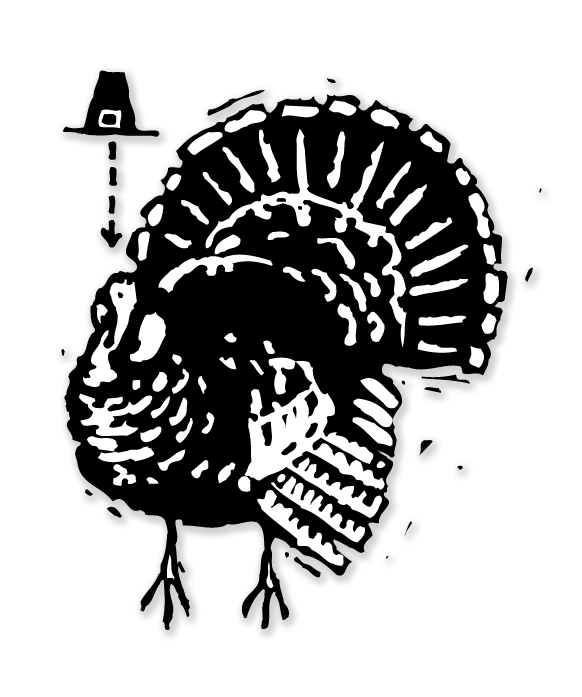
If this old turkey shoots some hoops with PBO, it might increase his chances…
If you want a sentence commutation, be a drug offender. If you want a pardon, be a turkey.
President Barack Obama yesterday commuted the prison sentences of 79 more federal prisoners. The White House wasted no time trumpeting that this latest act brought Obama’s total commutations granted during his eight years of presidency to 1,023.
Most of those receiving clemency had firearms charges along with drug charges. The list included some life sentences being cut to 20 and 30 years, with most inmates being released in the next two years.
The White House said Tuesday that Obama has been commuting sentences for months, believing many U.S. inmates are serving inappropriately long terms for nonviolent crimes, typically drug offenses. The commutations are part of what the White House calls Obama’s “Second Chance” initiative (not to be confused with the Second Chance Act).
The White House says the President is primed to grant more in the remaining weeks of his administration.
“These commutations are great but there are thousands of more people being warehoused in federal prison for drug offenses. They probably won’t get any relief under Donald Trump, which is why President Obama should commute all their sentences before he leaves office,” said Bill Piper, Senior Director of National Affairs at the Drug Policy Alliance.
We as a society have to make sure that people who do take responsibility for their mistakes are able to earn a second chance to contribute to our communities and our country. It’s the right thing to do. It’s the smart thing to do.
Now it’s up to good minds on both sides of the aisle to come together to restore fairness in our criminal justice system, use our tax dollars more effectively, and give second chances to those who have earned them.
Two years ago White House predicted Obama would grant about 2,000 commutations, meaning that – with only 58 days left in his term – the President is only halfway to his goal. A few weeks ago, we predicted that Obama might be rolling out weekly commutation lists, but in November, he granted clemency only twice, to 181 people. Of course, there was an election and the President’s swan-song European tour that got in the way, but if this rate remains, we’re only looking at 200-400 more commutations before January 20th.
The President’s pardon list has been as short as the clemency list has been long. Obama has granted fewer pardons than any president in modern history, 17 in his last eight years. By comparison, he has pardoned ten turkeys during that time, the last two of his term to be saved from the block this afternoon. In other words, a barnyard bird has nearly as good a chance at an Obama pardon as a federal felon.
We’re still doing a weekly newsletter… we’re just posting pieces of it every day. The news is fresher this way…
THERE’S REAL LIFE… AND THEN, THERE’S THE LAW
Richard McFee fired a gun into somebody’s house while the somebody was there. McFee, who unsurprisingly had a felony record, was subsequently convicted of being a felon in possession of a firearm under 18 U.S.C. Sec. 922(g)(1). Because the district court found he had three prior convictions for crimes that qualified as Armed Career Criminal Act (ACCA) predicates (either drug offenses or crimes of violence), it gave him 15 years in prison.
Rich appealed, arguing that one of his priors, a conviction under Minn. Stat. Sec. 609.713, subd. 1 for making terroristic threats, does not qualify as an ACCA predicate offense. Now, to the average Joe or Jane on the street, a felony for making terroristic threats sounds plenty violent, and they might reasonably think that a guy who was convicted of terroristic threats and then later shot up someone’s house shouldn’t be too surprised at a 15-year sentence. But the problem is that Joe and Jane are thinking about real life, and not the law.
Samuel Johnson … but not THE Samuel Johnson.
Such is the state of the law – at least with respect to the federal definition of a crime of violence. It may have started with a guy named Curtis Darnell Johnson: in his 2009 case, the Supreme Court held that the “physical force” needed for a violent crime had to “violent force – i.e., force capable of causing physical pain or injury to another person.” That was followed by Descamps v. United States in 2013, where the Court held that the previous-used “modified categorical approach does not apply to statutes… that contain a single, indivisible set of elements.” Another Johnson came along two years later, one Samuel Johnson, in whose case the Supreme Court ruled the residual clause of the ACCA unconstitutional. And, finally, last summer, the Court ruled in Mathis v. United States that district courts must parse alternatively-phrased state statutes “to determine whether the listed items are elements or means.” If they find elements, the statute is not divisible, and the court may not inquire into the facts of the case. That threshold inquiry is limited to state court interpretations and a plain-text reading of the statute.
The decisions have been coming at a fairly rapid clip, not just from the Supreme Court but from courts of appeal as well. If a state statute sweeps more broadly than does the common law – (for example, state make the act or breaking into a car to rip off a radio “burglary,” but at common law, a burglary had to be of a structure) – then conviction under it will not necessarily count for ACCA purposes, regardless of the facts underlying a defendant’s conviction. Courts are applying Mathis to find that state burglaries are not burglaries for ACCA purposes and that state drug trafficking statutes are not drug trafficking for ACCA purposes. They’re applying Curtis Johnson along with Descamps and Mathis to conclude that strong-arm robberies are not violent. And Samuel Johnson is leading courts, for example, to find that manslaughter is not a violent crime.
It’s only going to get more widespread, too, if the Supreme Court rules in Beckles v. United States that the Samuel Johnson decision applies to Sentencing Guidelines “career offenders” and in Lynch v. Dimaya that the case applies to the term “crime of violence” used elsewhere in the criminal and immigration law codes. Those decisions will be handed down before this Supreme Court term expires in June 2017.
For now, it seems that nothing means what it used to mean. Just ask the 8th Circuit. Last week, it agreed with Richard McFee that making terroristic threats was not a violent crime under the ACCA.
Minnesota’s terroristic threats statute makes it a crime to “threaten, directly or indirectly, to commit any crime of violence with purpose to terrorize another… or in a reckless disregard of the risk of causing such terror.” Minn. Stat. Sec. 609.713, subd. 1. A “crime of violence” is defined by a separate statute, Sec. 609.1095, which sets out a list of crimes that qualify as “violent crime[s]” in Minnesota. Some of the crimes, the Court said, qualify as ACCA predicate offenses and some do not. Thus, “a Minnesota terroristic threats conviction thus is not an ACCA predicate offense under the categorical approach.”
However, if the statute is divisible, the Court said, it could look at Rich’s state court proceeding to see what it is that he really did. “A list of alternative elements in the offense is divisible,” the Court explained, “but a list of alternative means is not. The elements of a crime are what the jury must find beyond a reasonable doubt to convict the defendant; and at a plea hearing, they are what the defendant necessarily admits when he pleads guilty. The specific facts underlying a prior conviction, however, are mere real-world things – extraneous to the crime’s legal requirements.”
The 8th concluded that the Minnesota terroristic threats statute’s definition of ‘crime of violence’ is not divisible. “The fact that the definition of ‘crime of violence’ is contained in a separate section of the Minnesota criminal statutes thus provides textual support for the conclusion that the term ‘crime of violence’ is intended to be an element of the crime and that the list of violent crimes in Minn. Stat. Sec. 609.1095, subd. 1 contains alternative means by which that element may be committed.” Also, Rich’s indictment for the state case, the Court noted, charged him with ‘wrongfully and unlawfully directly or indirectly threaten[ing] to commit a crime of violence, with purpose to cause, or in reckless disregard of the risk causing terror in another.’ “Since the charging document used the single umbrella term of ‘crime of violence’ without specifying the particular crime threatened, the record suggests that the prosecution was only required to prove that McFee threatened a “crime of violence” but not the particular crime he threatened.”
The Circuit concluded that the phrase “to commit any crime of violence” is an element of the Minnesota terroristic threats statute, Minn. Stat. Sec. 609.713, subd. 1, and that the separate definition of ‘crime of violence’ in Sec. 609.1095, subd. l(d), lists means by which that element is met. The element ‘to commit any crime of violence’ is not divisible. Because Minnesota’s definition of ‘crime of violence’” is broader than the ACCA requirement that a prior conviction have ‘as an element the use, attempted use, or threatened use of physical force against the person of another,” the prior conviction cannot count for an ACCA enhancement.



 Last week, the 5th Circuit agreed with the upward adjustment, holding that the “ability to drive a tractor trailer truck as evidenced by the possession of a commercial driver’s license constitutes a special skill for purposes of Sec.3B1.3.” Relying on a prior, unreported case, the court of appeals observed that Jose “had 15 years of commercial truck-driving experience, acted as a licensed truck driver purporting to carry a legitimate load through a checkpoint on one of the nation’s busiest corridors where there are thousands of other tractor-trailers.” The Court argued that “without those special skills, he would have been unable to tow the tractors in which the aliens were hidden… by carrying the aliens in the truck’s trailer, the defendant gave the appearance that he was hauling a legitimate load and made it much more difficult to identify the aliens.”
 We’re not denying that there are many very skilled, very experienced truck drivers on the roads. Rather, we’re arguing that the test is whether skill that required much training and education contributed substantially to committing the crime. To make the point, we’d note that had Al Qaeda used air transport pilots on 9/11, those skills would been used to turn the aircraft into the flying bombs they became. But using a few mutts who had never soloed an airplane – let alone held a pilot’s license – was enough to carry out the attack. Likewise in this case, anyone with an hour’s training could have driven a tractor-trailer through a customs station.